2024 Publication 517-2026

Get Form
form 4029 Preview on Page 1

Here's how it works

01. Edit your form 4029 online
Type text, add images, blackout confidential details, add comments, highlights and more.

02. Sign it in a few clicks
Draw your signature, type it, upload its image, or use your mobile device as a signature pad.

03. Share your form with others
Send publication 517 via email, link, or fax. You can also download it, export it or print it out.

Definition and Meaning of 2024 Publication 517

Publication 517 serves as a critical reference for clergy and religious workers regarding their Social Security and tax obligations. Primarily, it outlines the necessary information concerning the Federal Insurance Contributions Act (FICA) and Self-Employment Contributions Act (SECA) coverage, alongside providing guidance on exemptions from self-employment tax. This publication is essential for understanding U.S. income tax rules specific to religious occupations, including retirement savings arrangements tailored for clergy. The 2024 edition introduces updates such as changes in income thresholds for various tax credits and deductions, ensuring the content reflects current legal standards.

How to Use the 2024 Publication 517

Using Publication 517 effectively requires understanding its application to individual tax scenarios. Religious workers and clergy can refer to this guide to determine tax liabilities and filing requirements specific to their profession. Essential steps include:

  1. Reviewing Eligibility Criteria: Determine whether FICA or SECA taxes apply to your income as a clergy member.
  2. Calculating Tax Obligations: Use the guidance to estimate your taxable income and applicable tax credits or deductions.
  3. Documentation Guidance: Identify necessary forms, such as Schedule SE for self-employment tax calculations, to accurately report income.
  4. Applying Updates: Implement the changes in income thresholds as outlined in the 2024 updates to ensure compliance.

For example, a minister earning a salary from a congregation must consider both their clerical stipends and any self-employment income when using this publication.

Steps to Complete the 2024 Publication 517

Completing Publication 517 involves several systematic steps to ensure accuracy and compliance:

  1. Gather Necessary Documents: Collect all income statements, including W-2s and any records of self-employment income.
  2. Determine Tax Status: Ascertain whether you qualify for FICA or SECA taxes and review potential exemptions.
  3. Calculate Income and Deductions: Input income figures and calculate deductible expenses pertinent to clergy duties.
  4. Complete Tax Forms: Utilize forms such as Schedule SE for self-employment tax and Form 1040 for federal income tax reporting.
  5. Consult IRS Guidelines: Refer to specific sections within Publication 517 for guidance on unique income scenarios or exemptions.

A practical example is a pastor who must account for both a church salary and additional income from speaking engagements.

Key Elements of the 2024 Publication 517

Key elements of the 2024 Publication 517 include:

  • FICA vs. SECA Coverage: Definitions and implications for clergy income.
  • Exemption Guidelines: Criteria and process for seeking exemptions from self-employment tax.
  • Income Tax Rules: Guidance on taxable income, tax credits, and deductions.
  • Retirement Savings: Information on retirement plan contributions applicable to clergy.

These components provide clergy with a comprehensive understanding of their tax obligations and potential benefits.

IRS Guidelines on 2024 Publication 517

The IRS provides explicit guidelines within Publication 517 to facilitate compliance with tax laws for clergy and religious workers. It elucidates:

  • Conditions under which clergy can opt out of Social Security and Medicare.
  • Requirements for record-keeping and tax reporting.
  • Updated income threshold figures for tax credits and deductions as of 2024.

For example, clergy considering opting out of Social Security must submit Form 4361, adhering to specific IRS guidelines outlined in the publication.

Filing Deadlines and Important Dates for 2024 Publication 517

It is crucial to adhere to tax filing deadlines to avoid penalties. Important dates include:

  • April 15, 2024: Deadline for filing federal income taxes unless an extension is filed.
  • January 15, 2024: Due date for the fourth quarterly estimated tax payment for 2023.
  • Specific Extension Deadlines: If applicable, extended deadlines should be clearly noted, typically October 15 for most federal extensions.

These dates ensure that clergy and religious workers remain compliant with tax obligations.

Required Documents for 2024 Publication 517

Several documents are necessary when working with Publication 517:

  • W-2 Forms: For clergy employed by religious organizations.
  • 1099 Forms: For additional income and self-employment earnings.
  • Receipts and Records: Documenting expenses related to clergy duties for deduction purposes.
  • Schedule SE: Essential for calculating self-employment tax obligations.

Precise documentation supports accurate reporting and compliance.

Software Compatibility with 2024 Publication 517

Tax software such as TurboTax and QuickBooks can assist in accurately filing taxes in line with Publication 517. Key features include:

  • Automatic Form Filling: Populating necessary fields specific to clergy income and expenses.
  • Guided Tax Assistance: Ensuring all exemptions and deductions are considered according to current IRS regulations.
  • Error Checking: Reducing errors through integrated checks for common issues faced by clergy.

Using compatible software increases efficiency in tax preparation for clergy members.

be ready to get more

Complete this form in 5 minutes or less

Get form

Got questions?

We have answers to the most popular questions from our customers. If you can't find an answer to your question, please contact us.
Contact us
Yes. Ministers for tax purposes must pay SECA (Self Employed Contributions Act) taxes on their ministerial earnings unless they have properly followed IRS rules to opt out of Social Security, something few ministers qualify to do.
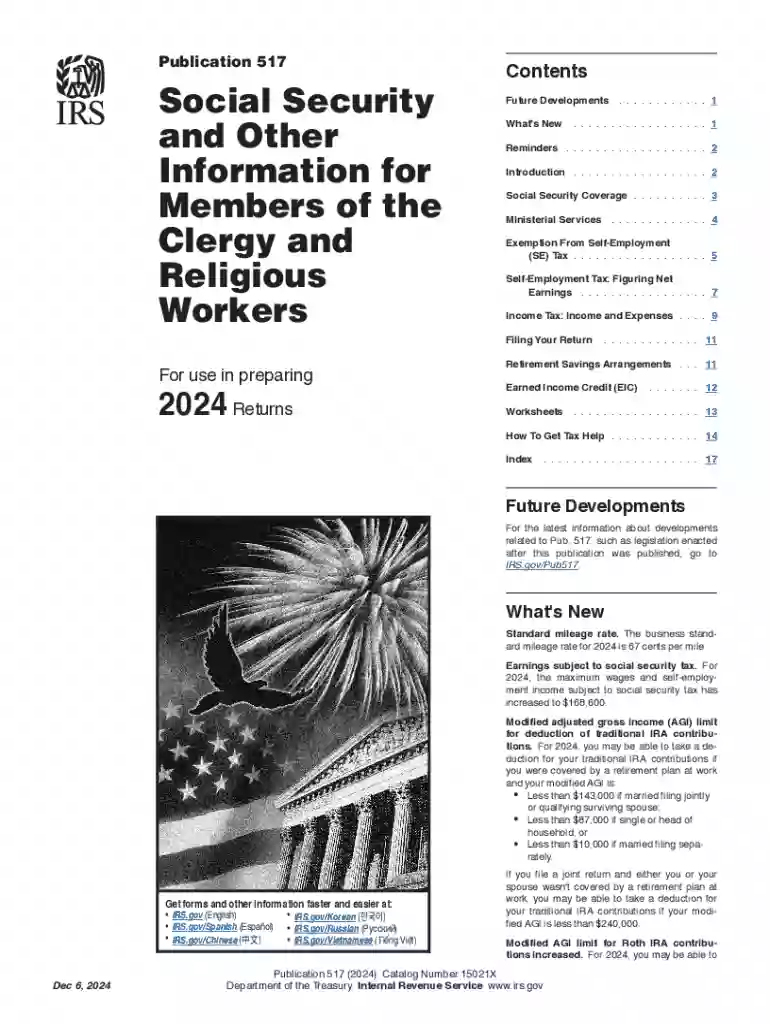
Publication 517 (2024), Social Security and Other Information for Members of the Clergy and Religious Workers. For use in preparing 2024 Returns.
This includes any salary that is paid to you as an employee of the church (even though reported on Form W-2, the church does not withhold Social Security or Medicare taxes), as well as offerings and fees such as those for performing marriages, funerals and baptisms.
The Committee on Ministerial Care has designated that the Housing Allowance for the Orthodox Presbyterian Church 403(b) Retirement Plan be set at $2,700 per month (or $32,400 annually) for the calendar year 2024 and beyond. The 2023 Housing Allowance was $2,500 per month (or $30,600 annually).
Students, scholars, educators, trainees, researchers, and others in the U.S. temporarily are exempt from Social Security taxes on earnings if the work is allowed by the U.S. Citizenship and Immigration Services (USCIS) and its work that they entered the U.S. to carry out.

Security and compliance

At DocHub, your data security is our priority. We follow HIPAA, SOC2, GDPR, and other standards, so you can work on your documents with confidence.
Learn more
ccpa2
pci-dss
gdpr-compliance
hipaa
soc-compliance
be ready to get more

Complete this form in 5 minutes or less

Get form

People also ask

There is no limit on the amount of a ministers salary that a church can designate as a housing allowance. In appropriate situations, a church could designate 100% of a ministers salary as housing allowance.
An exemption from self-employment coverage under Social Security can be obtained by: Any duly ordained, commissioned, or licensed minister of a church, member of a religious order who has not taken a vow of poverty; or.
If you work for a nonprofit or religious organization, the law requires you to pay Social Security taxes on your earnings of $100 or more. Some religious groups oppose paying Social Security taxes. The law allows these groups to not participate in the Social Security program.

irs clergy form