01. Edit your form online
Type text, add images, blackout confidential details, add comments, highlights and more.

Type text, add images, blackout confidential details, add comments, highlights and more.

Draw your signature, type it, upload its image, or use your mobile device as a signature pad.

Send it via email, link, or fax. You can also download it, export it or print it out.
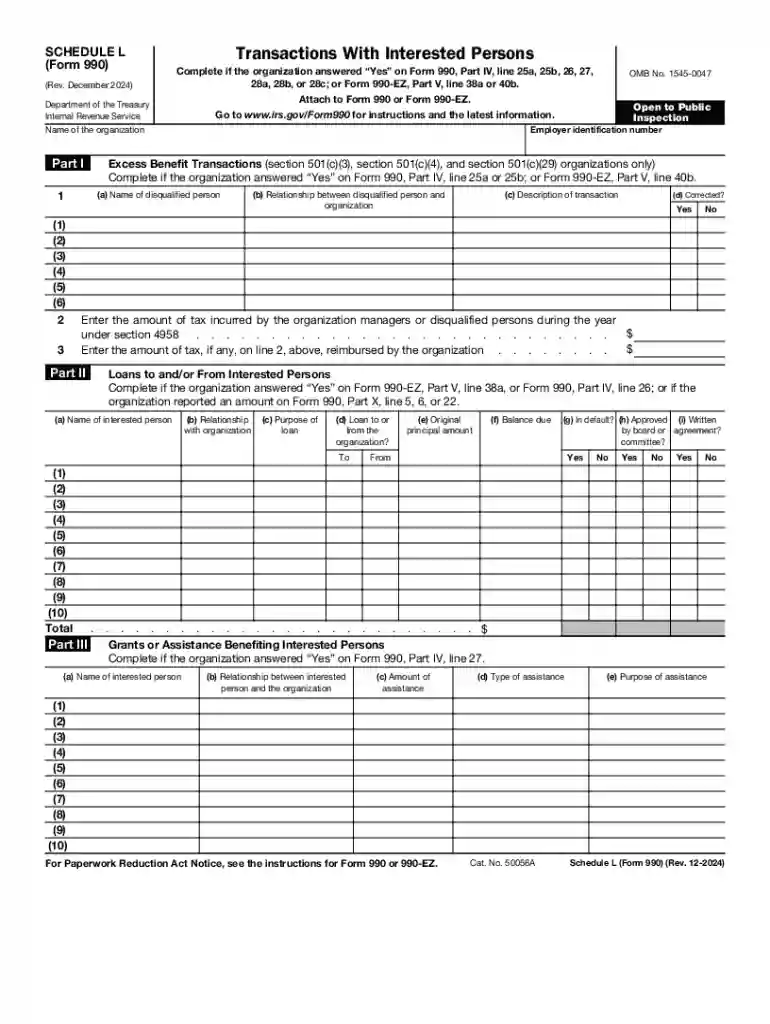
The "Complete if the organization answered Yes on Form 990, Part IV, line 25a, 25b, 26, 27," refers to a specific section of the IRS Form 990 that organizations must complete if they have answered affirmatively to particular questions regarding transactions with interested persons. Form 990 is an annual reporting return that certain federally tax-exempt organizations must file with the IRS. This section involves detailed reporting on financial transactions and relationships that may affect the organization's tax status or compliance with federal tax laws.
Organizations required to use this section of Form 990 must report specific transactions that involve officers, directors, trustees, or key employees. The organization will need to disclose the nature, amount, and parties involved in these transactions. This information helps the IRS ensure compliance with regulations governing tax-exempt entities. It includes tracking potential conflict of interest scenarios that could have implications for benefit or influence.
Filing this section of Form 990 is crucial for maintaining transparency and compliance with IRS regulations. By disclosing transactions with interested persons, organizations can avoid potential penalties related to undisclosed conflicts of interest. It also assists stakeholders and the public in understanding the organization's governance and financial relationships.
The IRS sets forth guidelines in Publication 557 for defining and reporting excess benefit transactions and dealings involving disqualified individuals. These guidelines ensure that tax-exempt organizations operate in a manner consistent with their exempt purposes without inurement to private interests.
Form 990 must be filed by the 15th day of the 5th month after the end of the organization's accounting period, typically May 15 for calendar-year filers. It is essential to consider deadlines to avoid late-filing penalties. Extensions can be requested, but organizations should confirm any IRS updates on deadlines annually.
Failure to accurately complete this form section can result in significant penalties, including fines for both the organization and the individuals responsible for authorizing the filing. The IRS may impose taxes on excess benefit transactions and revoke the organization’s tax-exempt status in severe cases of non-compliance.
Many organizations find it helpful to use tax preparation software like TurboTax or QuickBooks to ensure accurate and timely filing. These programs often include updated tax codes and automated data entry methods that simplify completing complex forms like Form 990. It is advisable to verify that any software used is compatible with IRS e-file service standards for Form 990.
We've got more versions of the Complete if the organization answered Yes on Form 990, Part IV, line 25a, 25b, 26, 27, form. Select the right Complete if the organization answered Yes on Form 990, Part IV, line 25a, 25b, 26, 27, version from the list and start editing it straight away!
| Versions | Form popularity | Fillable & printable |
|---|---|---|
| 2024 | 4.9 Satisfied (33 Votes) | |
| 2023 | 4.5 Satisfied (44 Votes) | |
| 2022 | 4.1 Satisfied (24 Votes) | |
| 2021 | 4.8 Satisfied (166 Votes) | |
| 2020 | 4.2 Satisfied (87 Votes) | |
| 2019 | 4.3 Satisfied (124 Votes) | |
| 2018 | 4.4 Satisfied (363 Votes) | |
| 2017 | 4.3 Satisfied (254 Votes) | |
| 2016 | 4.4 Satisfied (123 Votes) | |
| 2015 | 4.2 Satisfied (72 Votes) | |
| 2013 | 4.6 Satisfied (58 Votes) |
At DocHub, your data security is our priority. We follow HIPAA, SOC2, GDPR, and other standards, so you can work on your documents with confidence.