Definition & Meaning
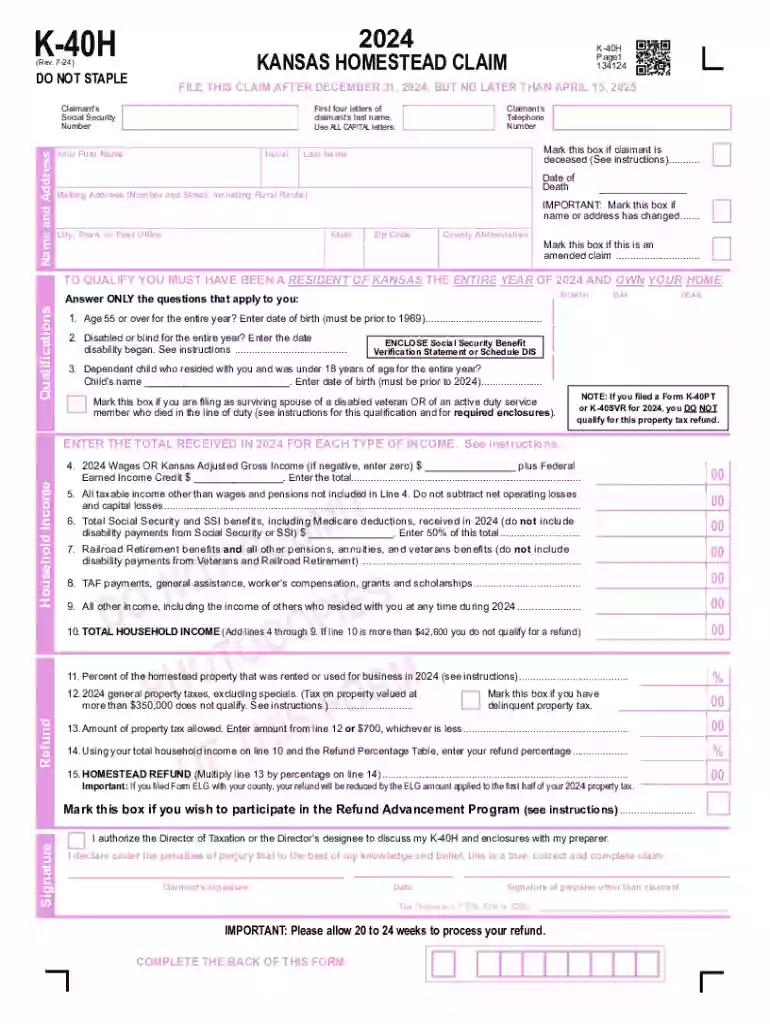
The K-40H form is an essential tool for Kansas homeowners seeking to apply for Homestead or Property Tax Refunds. This form is part of a suite of documents used to claim various property tax-related benefits offered by the state of Kansas. The K-40H focuses specifically on homeowner refunds and is used primarily during the annual tax filing season.
- Purpose: The primary use of the K-40H form is to facilitate the process of applying for eligible property tax refunds.
- Target Group: It is designed for Kansas homeowners who meet specific eligibility criteria.
Steps to Complete the K-40H
Successfully completing the K-40H form requires careful attention to detail.
- Gather Necessary Information: Ensure you have all the required details such as personal identification numbers and property tax details.
- Fill Out Personal Information: Enter your full name, address, and other personal details.
- Income Declaration: Accurately declare your total household income, ensuring compliance with the eligibility thresholds.
- Property Details: Include all required details about the property for which you are claiming the tax refund.
- Review for Accuracy: Double-check all entries to minimize errors that could delay processing.
Required Documents
When submitting the K-40H form, ensure you include all necessary documentation to support your application.
- Proof of Residency: Provide documents that confirm your status as a Kansas resident.
- Income Documentation: Attach forms such as W-2s or 1099s to validate household income claims.
- Property Tax Information: Submit copies of property tax bills to substantiate the refund request.
Form Submission Methods (Online / Mail / In-Person)
There are various ways to submit the K-40H form. Each method has distinct advantages and considerations:
- Online Submission: Fast and convenient, online submission ensures quick processing and instant confirmation of receipt.
- Mail: Submit a hard copy of the form along with required documents via postal service.
- In-Person: Deliver your completed form to a designated tax office, which can offer immediate assistance if required.
Filing Deadlines / Important Dates
Meeting the deadlines for the K-40H form is essential to avoid penalties or missed refunds.
- Annual Deadline: Typically, the filing deadline aligns with the standard tax return filing period. Exact dates can vary, so it's crucial to check the current year's timeline.
- Extensions: While extensions might be available, they require a formal request and are subject to approval.
State-Specific Rules for the K-40H
Kansas has unique rules governing the use and filing of the K-40H form.
- Age-specific Benefits: Different refund types might be available depending on the age of the applicant.
- Property Ownership: Rules defining who qualifies as a homeowner—a critical factor for eligibility.
- Income Considerations: Variations in income cap thresholds can decisively impact eligibility.
IRS Guidelines
Adhering to IRS guidelines is a requisite part of completing the K-40H form.
- Consistency with Federal Returns: Ensure that the information on your K-40H form aligns with that on federal tax documents to avoid discrepancies.
- Auditing and Compliance: Be prepared for potential audits by maintaining accurate and thorough records of all relevant documentation.
Key Elements of the K-40H
The K-40H form encapsulates several fundamental components that applicants must thoroughly understand.
- Personal Information Section: Essential for identifying and processing the applicant's request.
- Income Reporting Section: Critical for determining eligibility based on household income.
- Tax Calculation Area: Provides a breakdown of potential refund amounts, contingent upon income and property tax payments.
Penalties for Non-Compliance
Failing to comply with the K-40H form’s requirements can result in serious consequences.
- Penalties: Inaccurate or delayed submissions could lead to penalties or disqualification from receiving refunds.
- Interest Accrual: Unpaid taxes might accrue interest, increasing the financial burden.
- Legal Action: Severe non-compliance could result in legal repercussions.
Important Terms Related to K-40H
Familiarize yourself with key terminology associated with the K-40H form to enhance your understanding and accuracy while completing it.
- Homestead Refund: Refers to the primary tax relief provided to qualifying homeowners.
- Household Income: Defined as the total gross income of all members living in the household.
- Property Ownership: The legal status required to be eligible for the refund.
This structured approach to the K-40H form ensures that users can comprehensively understand its purpose, complete it accurately, and meet all necessary requirements efficiently.