01. Edit your form online
Type text, add images, blackout confidential details, add comments, highlights and more.

Type text, add images, blackout confidential details, add comments, highlights and more.

Draw your signature, type it, upload its image, or use your mobile device as a signature pad.

Send it via email, link, or fax. You can also download it, export it or print it out.
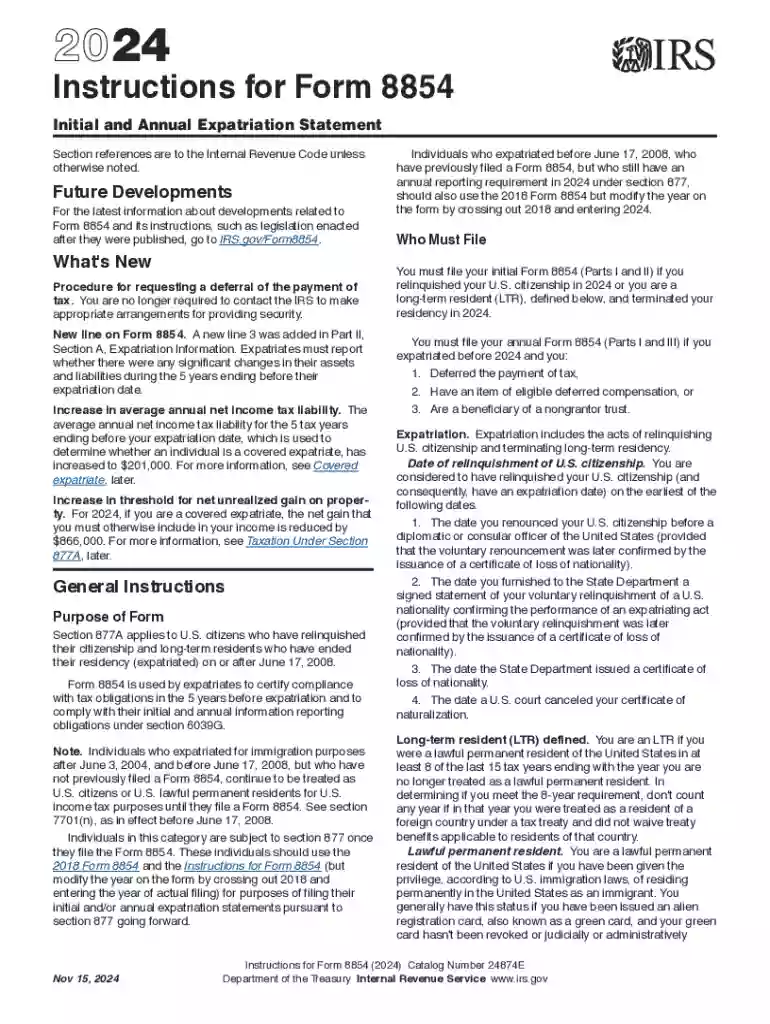
Form 8854, known as the Initial and Annual Expatriation Statement, is a critical document for U.S. citizens and long-term residents who decide to expatriate. Expatriation, in this context, refers to formally relinquishing U.S. citizenship or ending long-term residency. The form captures essential information about the individual's financial status, including assets and liabilities, to determine tax obligations under Section 877A of the Internal Revenue Code.
Complying with Form 8854 is crucial as it directly affects the individual's tax liability. Failure to correctly file can result in significant penalties, so understanding this form is key for expatriates managing their fiscal responsibilities.
Gather Accurate Financial Information: Collect comprehensive data on worldwide income, assets, and liabilities.
Determine Exit Tax Obligations: Calculate potential exit tax liabilities. This tax is applicable if the expatriate meets specific income or net worth thresholds.
Complete Required Sections:
Review and Submit: Double-check the completed form for accuracy and submit by the deadline specified by the IRS, which is typically aligned with the annual tax return due date.
The primary users of Form 8854 are U.S. citizens and long-term residents considering or undergoing expatriation. The Internal Revenue Service (IRS) mandates that these individuals file this form to outline their tax responsibilities and any applicable exit taxes.
Understanding these terms is essential for accurately completing Form 8854 and meeting expatriation tax obligations.
Non-compliance can result in severe penalties. Failure to file or inaccuracies may lead to fines exceeding $10,000. Moreover, expatriates may face continued worldwide tax liability if they do not meet filing requirements.
The IRS provides detailed instructions for Form 8854, emphasizing the need for accurate evaluation of an expatriate's financial status. These guidelines help ensure compliance and inform taxpayers of potential tax consequences associated with expatriation.
Form 8854 should be filed with the annual tax return for the year the expatriation takes place. This deadline is generally April 15; extensions are available but must be requested through the IRS.
Meeting the deadline is crucial to avoid penalties and ensure that the taxpayer’s status is correctly documented with the IRS. Missing the deadline can complicate expatriation taxes and potential reentry into the U.S.
Submitting Form 8854 requires various documents, including:
These documents are necessary to support the figures provided and ensure transparency and accuracy.
The IRS accepts Form 8854 submissions via mail as part of the annual tax return package. Although not typically submitted online, expatriates can clarify submission details with tax professionals to ensure compliance with current IRS regulations.
Selecting the appropriate method of submission is critical. Expatriates should adhere to guidelines to prevent lapses that could incur penalties or delay processing.
We've got more versions of the 2024 Instructions for Form 8854 Instructions for Form 8854, Initial and Annual Expatriation Statemen form. Select the right 2024 Instructions for Form 8854 Instructions for Form 8854, Initial and Annual Expatriation Statemen version from the list and start editing it straight away!
At DocHub, your data security is our priority. We follow HIPAA, SOC2, GDPR, and other standards, so you can work on your documents with confidence.