01. Edit your form online
Type text, add images, blackout confidential details, add comments, highlights and more.

Type text, add images, blackout confidential details, add comments, highlights and more.

Draw your signature, type it, upload its image, or use your mobile device as a signature pad.

Send it via email, link, or fax. You can also download it, export it or print it out.
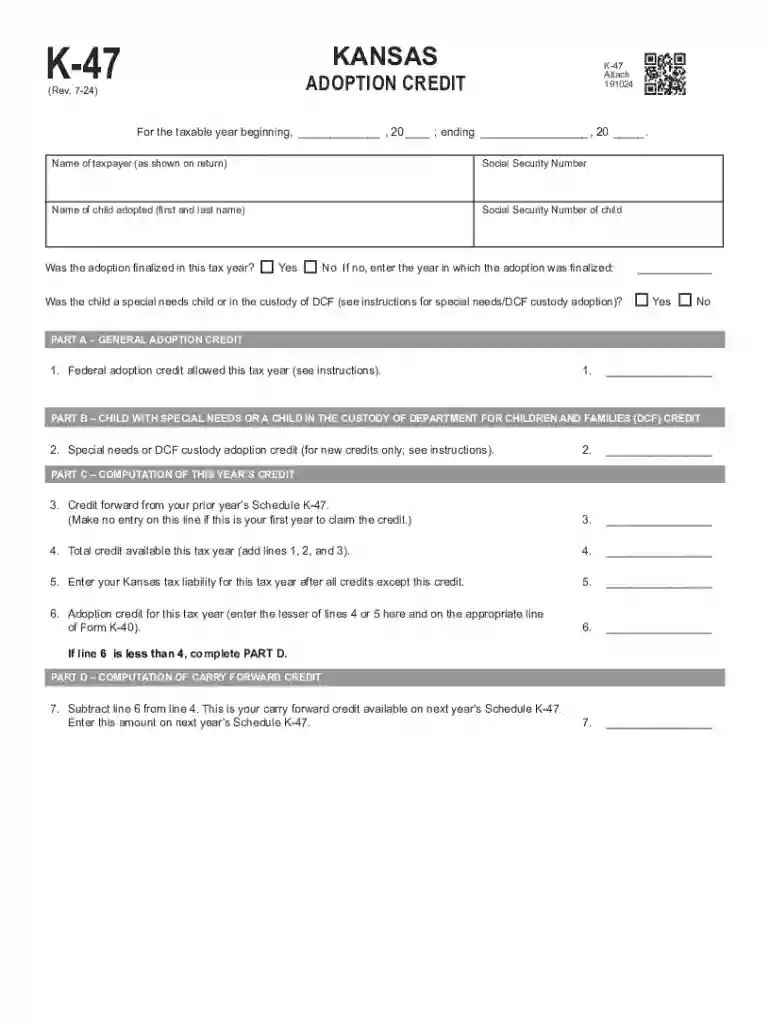
The K-47 form, known as the Kansas Adoption Credit, is designed to provide financial relief to Kansas residents who have adopted children. This credit aims to make adoption more accessible by reducing tax liabilities for taxpayers who have incurred expenses related to the adoption process. The document includes sections detailing eligibility criteria and credit calculation methods. It also outlines how these credits can be applied, specifically highlighting additional credits available for adopting special needs children or those in the custody of the Department for Children and Families (DCF).
To qualify for the K-47 Kansas Adoption Credit, taxpayers must meet specific conditions. These include residing in Kansas and completing the adoption of a child. Moreover, taxpayers can benefit from additional credits if they adopt a special needs child or a child under the care of the DCF. This section offers a comprehensive understanding of what constitutes eligibility for these credits and supports adoptive parents in identifying whether they qualify for additional benefits.


Utilizing the K-47 form involves understanding its various sections and accurately filling out the required information. Begin by entering taxpayer details, followed by specifics about the adopted child, such as their name and adoption date. Then proceed to calculate available credits using the designated lines on the form, which guide you through the arithmetic needed for both general and special adoption credits.
Filling out the K-47 form is a systematic process that ensures all necessary areas are covered to apply for the adoption credit successfully. Here's a step-by-step guide to completing the form:
Understanding the essential components of the K-47 form will help streamline the completion process:
To avoid delays and ensure accuracy, gather necessary documents before filling out the K-47 form. These include:
Familiarizing oneself with key terminologies associated with the K-47 form can aid in a smoother application experience:
Understanding both federal and Kansas-specific tax guidelines is essential when dealing with the K-47 form:
Timeliness is crucial when submitting the K-47 form:
We've got more versions of the K-47 Kansas Adoption Credit - Revised 7-24 form. Select the right K-47 Kansas Adoption Credit - Revised 7-24 version from the list and start editing it straight away!
At DocHub, your data security is our priority. We follow HIPAA, SOC2, GDPR, and other standards, so you can work on your documents with confidence.