Definition and Purpose of the Vanderbilt Teacher Initial Assessment - ADHD
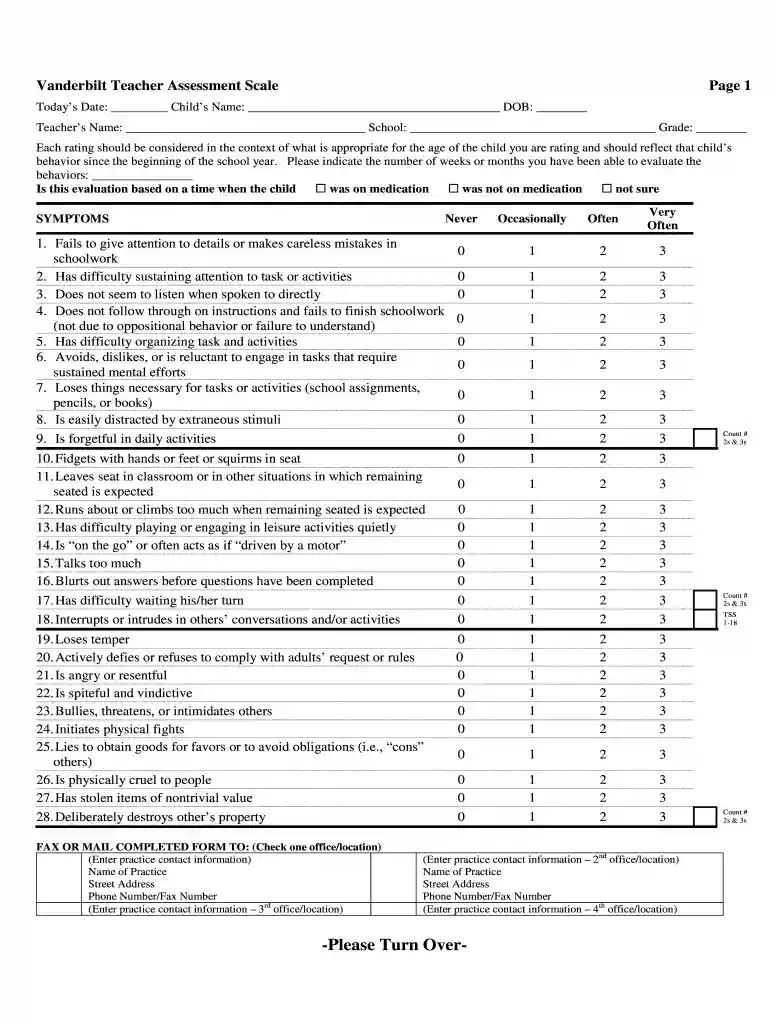
The Vanderbilt Teacher Initial Assessment for ADHD is a comprehensive tool designed to evaluate students' behavioral patterns, symptoms of attention-deficit/hyperactivity disorder (ADHD), and related emotional issues in educational settings. This form aids teachers in systematically observing and documenting behaviors that are symptomatic of ADHD, covering aspects such as hyperactivity, impulsivity, and attention levels. By capturing such data over a period of time, the assessment seeks to provide a broader perspective on the student's academic and social performance, thus suggesting the need for possible interventions or further evaluations.
Components and Elements
This assessment incorporates a variety of components including:
- Behavior Ratings: Scoring mechanisms to assess frequency and intensity of behaviors.
- Performance Impairments: Evaluations of academic and social impediments due to behavioral issues.
- Historical Data: Consideration of past and ongoing concerns, including medication.
- Comparative Analysis: How a child’s behavior correlates with age-appropriate norms.
The form utilizes a structured approach to assist in identifying children who may need additional support or resources, or who may benefit from a diagnostic assessment by a qualified health professional.
How to Use the Vanderbilt Teacher Initial Assessment - ADHD
Step-by-Step Usage Guide
- Familiarization with the Form: Begin by thoroughly reading the instructions provided on the form to understand the criteria you need to evaluate.
- Gradual Observation: Observe and record the child’s behavior consistently over several weeks to capture a representative sample of their conduct.
- Document Behavior: Use the designated sections of the form to rate each behavior according to frequency observed.
- Detail Score Calculations: Calculate scores according to the guidelines to determine the severity of symptoms.
- Consultation and Analysis: Discuss findings with a school psychologist or mental health professional to interpret results effectively.
Practical Examples
- Symptom Frequency: If frequency descriptors range from ‘never’ to ‘very often,’ they must be consistent with daily observations.
- Progress Monitoring: Track changes over time to note improvements or escalations.
Completing the Vanderbilt Teacher Initial Assessment - ADHD
Essential Steps to Fill Out
- Initial Data Entry: Write the student’s demographic information on the form.
- Behavior Assessment: Annotate observations concerning behavioral indicators.
- Impairment Evaluations: Rate the level of academic and social impairment using provided scales.
- Submission: Return the completed form to the designated school representative or relevant mental health professional for further action.
Important Considerations
- Accuracy: Ensure honesty and objectivity when entering observations.
- Context: Include notes on environmental factors that may influence behavior.
Who Uses the Vanderbilt Teacher Initial Assessment - ADHD
Typical User Profiles
- Teachers: Primarily responsible for completion, they observe student interactions and behaviors.
- School Psychologists: Utilize the completed forms to make informed recommendations or diagnoses.
- Pediatricians and Psychiatrists: May use the data collected as part of a broader clinical assessment for ADHD.
Collaborative Environment
- Multidisciplinary Approach: The form is part of a collaborative process involving educators, parents, and healthcare providers. It fosters communication regarding behavioral concerns.
Key Elements of the Vanderbilt Teacher Initial Assessment - ADHD
Central Components That Define the Form
- Rating Scales: Quantitative measurements for behavior frequency and impact assessments.
- Impairment Section: Evaluates how behaviors affect academic performance and social relationships.
- Longitudinal Observation Requirements: Ensures behaviors are measured over time for accuracy.
Critical Features
- Behavioral Indicators: Includes distinct symptoms associated with ADHD for detailed tracking.
- Contextual Observations: Draws attention to symptomatic environments and triggers.
Compliance Guidelines
- Privacy Laws: Adheres to regulations such as FERPA to protect students’ educational records.
- Authorization: Only authorized personnel should have access to fill or interpret the forms.
Protection of Information
- Data Security: Ensure that all completed forms are stored safely in accordance with school and district policies.
Important Terms Related to the Vanderbilt Teacher Initial Assessment - ADHD
Glossary of Key Terms
- Hyperactivity: Excessive energy levels beyond age-normal behavior.
- Impulsivity: Actions performed with little forethought.
- Inattention: Difficulty maintaining focus on tasks.
Application in Context
- Behavioral Distinctions: Involves recognizing the difference between typical childhood behaviors and those requiring additional support.
Examples of Using the Vanderbilt Teacher Initial Assessment - ADHD
Application Scenarios
- Case Study: A student displaying increasing difficulties in completing classroom tasks is evaluated over a 6-week period.
- Intervention Planning: Insights from the assessment inform an individualized education plan (IEP) to support the child effectively.
Typical Outcomes
- Clarity in Diagnosis: Helps facilitate a referral to a mental health professional for formal diagnosis.
- Tailored Interventions: Direct assessments provide foundational data for developing custom interventions.
State-Specific Rules for the Vanderbilt Teacher Initial Assessment - ADHD
Variations Across Jurisdictions
- Regulation Compliance: Differing confidentiality and reporting rules may apply in various states.
- Implementation Guidelines: Procedures for utilizing the forms can adapt to state educational directives.
Considerations
- Education Department Specifics: State departments may have unique recommendations on using such tools in schools.
By leveraging this detailed breakdown, educators and involved professionals can effectively use the Vanderbilt Teacher Initial Assessment for ADHD to support students' educational and emotional well-being, fostering more comprehensive approaches to managing ADHD symptoms in school settings.