CHILD MEDICAL FORM DAYCARE 2026

Get Form
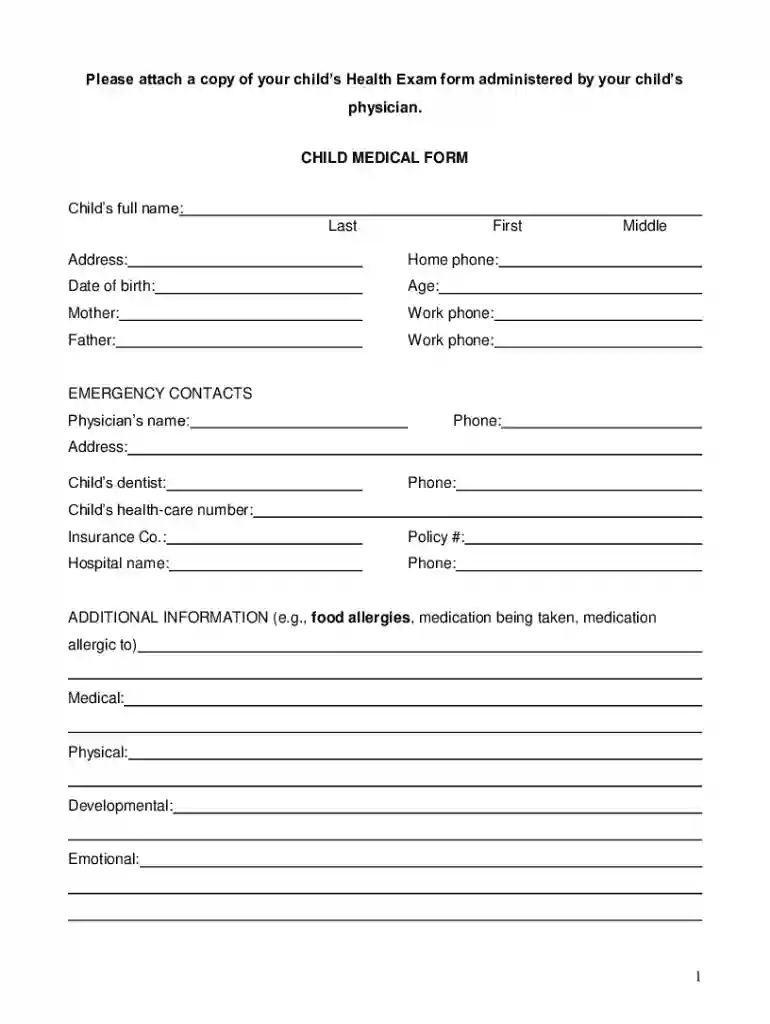
CHILD MEDICAL FORM DAYCARE Preview on Page 1

Here's how it works

01. Edit your form online
Type text, add images, blackout confidential details, add comments, highlights and more.

02. Sign it in a few clicks
Draw your signature, type it, upload its image, or use your mobile device as a signature pad.

03. Share your form with others
Send it via email, link, or fax. You can also download it, export it or print it out.

Definition and Meaning of the Child Medical Form for Daycare

The Child Medical Form for Daycare is a critical document used by daycare centers in the United States to ensure the health and safety of children in their care. This form collects essential medical information about each child, enabling daycare providers to respond effectively in case of a medical emergency. The form typically includes sections that cover personal details, emergency contacts, immunization records, and any known medical conditions or allergies. Additionally, it often grants permission for emergency medical treatment, which is crucial for timely intervention if a child falls ill or is injured while at daycare.

How to Use the Child Medical Form for Daycare

Utilizing the Child Medical Form for Daycare involves several steps to ensure that all necessary information is accurately provided and maintained. Parents or guardians are required to fill out the form, typically during the enrollment process. Detailed instructions are usually provided by the daycare center to guide parents in completing each section. The form must be updated regularly, especially after any significant medical changes, such as new allergies or medical conditions. Daycare staff must also know how to interpret and act upon the information contained within the form, ensuring they can quickly access vital details during an emergency.

Steps to Complete the Child Medical Form for Daycare

  1. Obtain the Form: Parents should receive the medical form from the daycare provider, typically during registration or enrollment.
  2. Fill in Personal Details: Provide the child's full name, date of birth, and address.
  3. List Emergency Contacts: Include primary and secondary contacts, with phone numbers and relationship to the child.
  4. Provide Medical Information: Add any known medical conditions, allergies, and current medications.
  5. Complete Immunization Records: Update with the latest vaccination dates and include a copy of the immunization certificate.
  6. Grant Medical Authorization: Sign the section granting permission for emergency medical treatment, ensuring it's properly dated.
  7. Review and Submit: Double-check all entries for accuracy before submitting the form to the daycare provider.

Why You Should Use the Child Medical Form for Daycare

The Child Medical Form for Daycare is not just a bureaucratic requirement; it's a vital tool for ensuring the well-being of children. By providing comprehensive health information, daycare staff can reduce risks and respond swiftly in emergencies. The form also ensures that caregivers are informed about any specific needs, such as dietary restrictions or medication schedules. Furthermore, having medical authorization in place empowers daycare providers to seek immediate care without delay, potentially saving lives in critical situations.

Key Elements of the Child Medical Form for Daycare

  • Personal Information: Includes the child’s full name, address, and date of birth for proper identification.
  • Emergency Contacts: Designated individuals to contact in an emergency, with their phone numbers and relationship to the child.
  • Medical Conditions: Details on any chronic illnesses or health concerns, such as asthma or diabetes.
  • Allergies and Medications: Information on allergies, including food and medication allergies, as well as any medications the child is currently taking.
  • Immunization Records: Up-to-date vaccination details to ensure the child's immunization schedule is current.
  • Authorization for Emergency Medical Treatment: A signed consent allowing the daycare to initiate medical treatment if needed.

Who Typically Uses the Child Medical Form for Daycare

The primary users of the Child Medical Form for Daycare are parents, guardians, and daycare providers. Parents fill out and submit the form to the daycare center, ensuring that all information is accurate and comprehensive. Daycare providers use the information on the form to care for the child effectively and to make informed decisions in case of a medical emergency. Additionally, healthcare professionals who may be called upon during an emergency will rely on the form to understand the child’s medical history and current health status.


decoration image ratings of Dochub

Legal Use of the Child Medical Form for Daycare

The legal implications of the Child Medical Form for Daycare are significant, as they provide authorization for emergency medical treatment. This section of the form must be signed by the parent or guardian to give the daycare legal permission to seek medical assistance for the child if needed. This legal protection ensures that daycare providers can act swiftly without facing potential liability issues. It also outlines the responsibilities and permissions regarding who can make medical decisions for the child in the absence of the parent or guardian.

Examples of Using the Child Medical Form for Daycare

Consider a scenario where a child has a severe allergic reaction while at daycare. Thanks to the detailed information on the medical form, caregivers are immediately aware of the specific allergies and can administer appropriate treatment promptly. In another instance, if a child has asthma, the form would include details about the condition, necessary medications, and actions to take during an asthma attack. These examples highlight the form’s utility in ensuring that daycare staff has ready access to crucial health information, enabling them to manage and resolve medical issues swiftly and effectively.

be ready to get more

Complete this form in 5 minutes or less

Get form

Got questions?

We have answers to the most popular questions from our customers. If you can't find an answer to your question, please contact us.
Contact us
In most schools, these annual visits are mandatory in other words, you cannot avoid them. If you dont take your child for the annual school physical, they may not be allowed to play school sports that year. On top of that, many can block your childs school year if you ignore annual health checkups and vaccines.
The School-Entry Health Exam provides basic health and screening information that will assist the school and school health personnel in meeting the needs of the child. Florida law requires a school-entry health exam for all students who attend public and non-public schools in Florida.
Grade Level Requirements: Elementary: Section 1003.455, F.S., requires 150 minutes of physical education each week for students in grades K-5. A minimum of 30 consecutive minutes is required on any day that physical education instruction is provided.
This statement shows the total amount parents spent on child care costs during the past year. These annual receipts should cover January 1st through December 31st of the previous year. The last day of February is often the final day that daycare centers should have this information available.
The OCFS-LDSS-4433 form is required for documenting a childs medical health status before enrolling them in childcare. This form includes sections for immunizations, allergies, medications, and needs for special diets.

Security and compliance

At DocHub, your data security is our priority. We follow HIPAA, SOC2, GDPR, and other standards, so you can work on your documents with confidence.

Learn more
ccpa2
pci-dss
gdpr-compliance
hipaa
soc-compliance

People also ask

Immunization Requirements for Entry into Florida Schools Students from Pre-kindergarten through 12th grade who are coming into a Florida school for the first time must present an immunization record (DH 680) and a current Florida School Entry Physical Examination, Form (DH 3040).
This form includes sections for immunizations, allergies, medications, and needs for special diets. Proper completion ensures that healthcare providers can make informed decisions regarding a childs wellbeing. Get Child Medical Statement Form.
Medical statement means a written document, on appropriate letterhead, which reflects a full diagnosis of the illness or injury and a prognosis, including anticipated date of recovery executed by a licensed health care practitioner qualified to make such a diagnosis and prognosis.
A health care directive is a signed legal document that allows the parent, or other designated individual, to make medical decisions on behalf of the child when that child is unconscious or otherwise unable to make decisions for himself/herself.

Related links