01. Edit your form online
Type text, add images, blackout confidential details, add comments, highlights and more.

Type text, add images, blackout confidential details, add comments, highlights and more.

Draw your signature, type it, upload its image, or use your mobile device as a signature pad.

Send it via email, link, or fax. You can also download it, export it or print it out.
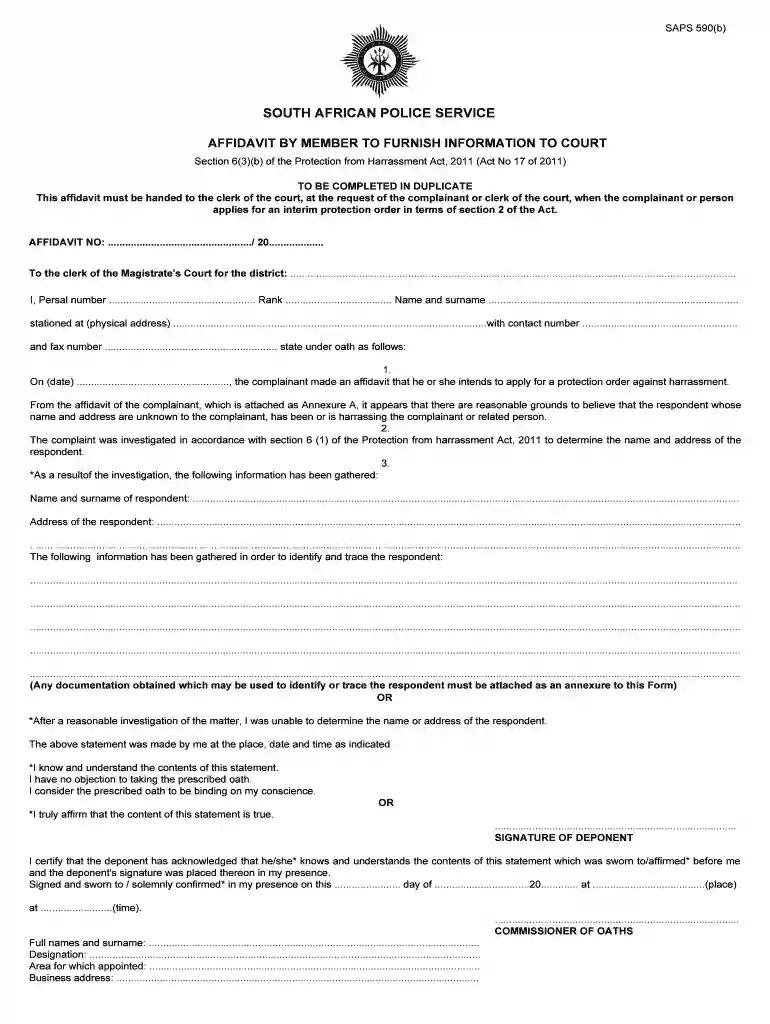
The SAPS 590(b) is a specialized affidavit form utilized by the South African Police Service. It is a vital tool in the judicial process, particularly in the context of harassment complaints under the Protection from Harassment Act, 2011. This form serves as a formal statement where a police officer provides critical information to the court about a harassment case, detailing the findings from their investigation. The authenticity of the information is certified by the officer, ensuring that the document holds legal weight in court proceedings.
Using the SAPS 590(b) requires a systematic approach to ensure that all necessary information is captured accurately. The form is filled out by a police officer who has been involved in the investigation of a harassment claim. The officer needs to:
This methodical process ensures that the affidavit submitted to the court reflects a comprehensive view of the case, thereby aiding in effective judicial decision-making.
Completing the SAPS 590(b) entails several key steps:
Information Collection: The officer collects all relevant details about the incident and the individuals involved.
Documentation: Each piece of collected evidence and observation is documented accurately in the form. This includes police observations and any statements from witnesses.
Verification and Certification: The officer verifies the information for accuracy and certifies the affidavit, confirming its truthfulness before submission to the court.
The goal is to produce a complete and truthful account that assists the court in understanding the nuances of the harassment claim.
The primary users of the SAPS 590(b) are members of the South African Police Service. These officers are tasked with completing the form as part of their investigative duties regarding harassment cases. Once completed, the form becomes a crucial document for legal professionals and judges, who rely on its contents to guide their rulings. Additionally, it is beneficial to complainants as it strengthens their case by providing a formal record from an authoritative source.


The SAPS 590(b) embodies several critical elements that define its importance:
These elements ensure the form is both comprehensive and reliable, facilitating its role in the judicial process.
Legally, the SAPS 590(b) serves as an indispensable affidavit in court proceedings related to harassment cases. It is used to provide the court with verified insights into the police investigation conducted. The detailed account within the form offers judges a sworn statement that can significantly impact their decisions, serving as a reliable piece of evidence. Its use underscores a foundational aspect of transparency and accountability within legal frameworks aimed at protecting individuals from harassment.
Understanding the SAPS 590(b) involves familiarity with several key legal and procedural terms:
These terms are crucial for comprehending the scope and significance of the SAPS 590(b) in legal processes.
Failure to file the SAPS 590(b) correctly or to abide by its guidelines can have severe implications. Officers who neglect these duties may face disciplinary action within their department. In a broader context, improper handling or incomplete filing of the form could jeopardize the integrity of the courtroom proceedings, potentially leading to unfavorable outcomes for the involved parties. Such consequences highlight the necessity for meticulous compliance to uphold justice and legal accuracy.
At DocHub, your data security is our priority. We follow HIPAA, SOC2, GDPR, and other standards, so you can work on your documents with confidence.