




01. Edit your form online
Type text, add images, blackout confidential details, add comments, highlights and more.

Type text, add images, blackout confidential details, add comments, highlights and more.

Draw your signature, type it, upload its image, or use your mobile device as a signature pad.

Send it via email, link, or fax. You can also download it, export it or print it out.
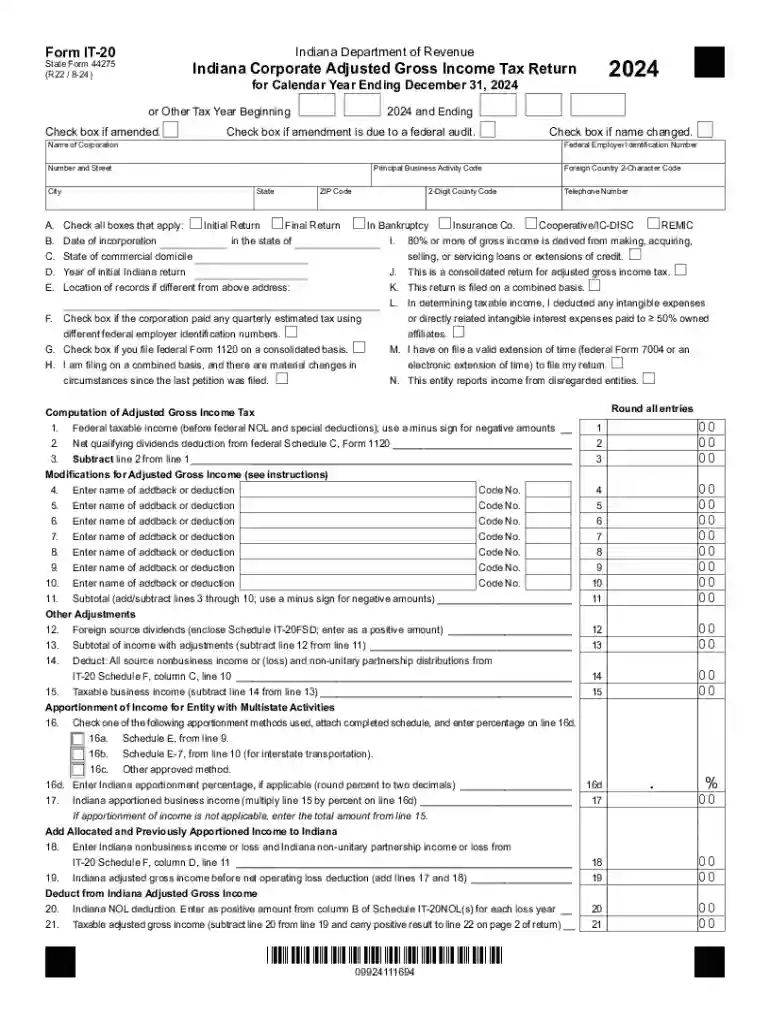
Form IT-20 is the Indiana Corporate Adjusted Gross Income Tax Return. It is used by corporations to report their income, calculate taxes owed, and claim any applicable adjustments and credits for the tax year ending December 31, 2024. This form is essential for determining the corporate tax liability within the state of Indiana.
Corporations engaged in business activities within Indiana must file this form to comply with state tax regulations, ensuring accurate reporting of income and expenses. The form serves as a critical document for both tax compliance and financial planning, encompassing federal taxable income, specific adjustments, and apportionment methods.
Consider a corporation with operations in multiple states. The entity must apportion its income using methods outlined on the IT-20 form to identify the portion taxable in Indiana.
Corporate Identification:
Income Computation:
Adjustment and Apportionment:
Corporations with international operations might need to further modify their approaches to apportionment, adhering to both federal and state regulations.
Federal Conformity Adjustments: Corporations might need to adjust income reported on federal returns to conform with Indiana-specific rules, impacting taxable income and obligations.
A company claiming a significant R&D credit must provide detailed records demonstrating eligibility, including invoices, project summaries, and employee testimonies.
Corporations failing to properly file the IT-20 form may face:
Businesses that miss the deadline due to unforeseen circumstances might seek penalty abatement through demonstrated proof, like natural disasters disrupting operations.
Technology companies and manufacturing firms often utilize IT-20 to navigate complex apportionment scenarios ensuring compliance and optimal tax outcomes.
We've got more versions of the IT-20 form. Select the right IT-20 version from the list and start editing it straight away!
At DocHub, your data security is our priority. We follow HIPAA, SOC2, GDPR, and other standards, so you can work on your documents with confidence.






The period for a new election of a Citizen, to Administer the Executive government of the United States, being not far distant, and the time actuallyRead more
IT-20 Use this form to amend Indiana Corporate Form IT-20 for tax periods beginning before 01/01/2019.


