Schedule IN-OCC 2026

Get Form
Schedule IN-OCC Preview on Page 1

Here's how it works

01. Edit your form online
Type text, add images, blackout confidential details, add comments, highlights and more.

02. Sign it in a few clicks
Draw your signature, type it, upload its image, or use your mobile device as a signature pad.

03. Share your form with others
Send it via email, link, or fax. You can also download it, export it or print it out.

Definition and Meaning of Schedule IN-OCC

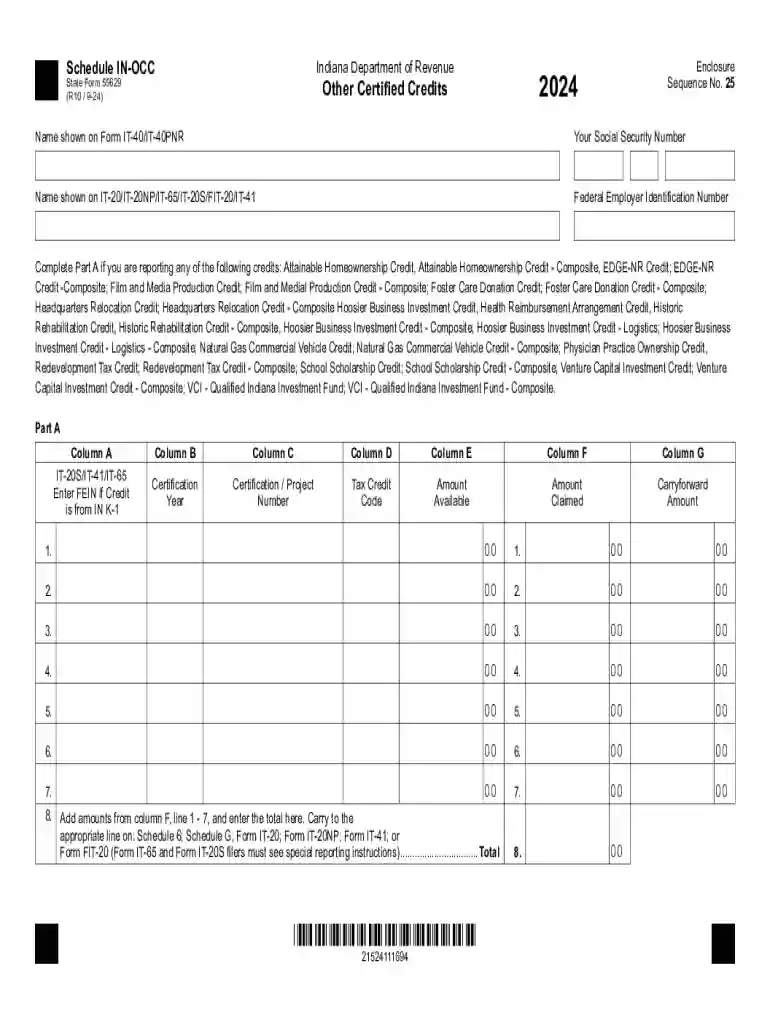
Schedule IN-OCC is a tax schedule from the Indiana Department of Revenue used to report various certified tax credits. It is an essential document for taxpayers seeking to claim state-specific tax deductions through certain credits, such as the Attainable Homeownership Credit or the Film and Media Production Credit. Understanding this schedule is crucial for accurately completing your Indiana state tax return and optimizing your potential credits.

How to Use Schedule IN-OCC

To effectively utilize Schedule IN-OCC, it's vital to comprehend its structure and the information it requires. The schedule is divided into two main parts that ask for unique data related to tax credits:

  1. Part A: Details on the type of credits you are eligible for, including the total credit amount available.
  2. Part B: Requires you to report the amount of the credit you are claiming, along with any amount you plan to carry forward to future tax years.

Completing these sections accurately ensures you claim all eligible credits and comply with state requirements.

How to Obtain Schedule IN-OCC

Acquiring Schedule IN-OCC is straightforward:

  • Online Access: The Indiana Department of Revenue website provides downloadable forms and schedules, including the IN-OCC.
  • Tax Software: Many tax preparation software programs include Schedule IN-OCC as part of their state tax filing package, making it easy to complete your return accurately.
  • Physical Copies: You can request a physical copy from the Indiana Department of Revenue's office if needed.

Having access to the most current version ensures that your filing is up-to-date with the latest state regulations.

Steps to Complete Schedule IN-OCC

The completion of Schedule IN-OCC involves several steps. Here’s a detailed guide:

  1. Gather Required Documents: Collect necessary identification and financial documents, including any certifications for credits you are claiming.
  2. Identify Applicable Credits: Review the credits listed in Part A to determine eligibility.
  3. Calculate Credits: For each eligible credit, calculate the amount available and enter it into Part A.
  4. Claim Credits in Part B: Input the credit amount that you are claiming for the current tax year, and note any carryforward amount.
  5. Review and Verify: Double-check all entries for accuracy and ensure that they comply with the instructions provided in the form.

Completing these steps thoroughly and accurately helps avoid processing delays or filing errors.

Who Typically Uses Schedule IN-OCC

Schedule IN-OCC is primarily used by Indiana taxpayers who qualify for specific state-certified tax credits. Typical users include:

  • Individuals seeking homeownership tax credits: Those who make use of the Attainable Homeownership Credit.
  • Businesses in media production: Corporations or partnerships involved in film or media production who qualify for related credits.
  • Non-profits and small businesses: These entities often utilize credits for investments in specific regional developments or cultural productions.

Understanding who uses this schedule can help effectively target potential credits relevant to your activities.

Key Elements of Schedule IN-OCC

Key elements of the Schedule IN-OCC comprise various sections critical for ensuring all necessary information is compiled and reported:

  • Taxpayer Identification: Basic details are required to match the form with your tax records.
  • Types of Credits: This includes all credits for which you might qualify, along with specific details on claiming them.
  • Instructions and Guidelines: Found alongside the form, these guidelines help prevent common mistakes and clarify detailed reporting requirements.

These components are fundamental to complete the form accurately and ensure all eligible credits are claimed.

Legal Use of Schedule IN-OCC

The legal use of Schedule IN-OCC ensures compliance with state tax laws and maximizes eligible credits. Legal implications include:

  • Compliance with Indiana tax laws: It is necessary to follow instructions to legally claim credits.
  • Accuracy and honesty: These elements are crucial in reporting. Accidental or intentional misreporting can result in penalties.
  • Verification and proof: Documentation for claimed credits, such as eligibility certifications, must be retained for potential audits.

Being aware of these legal considerations is key for responsibly managing tax obligations.

Examples of Using Schedule IN-OCC

Examples clarify how Schedule IN-OCC benefits different entities:

  • Homebuyer Case: John, a first-time homeowner, uses the Attainable Homeownership Credit, reporting $2,000 towards his state tax liability.
  • Media Producer Scenario: A media production company claims a $5,000 Film and Media Production Credit, partially offsetting its corporate state tax obligation.

These scenarios illustrate how various taxpayers can leverage the IN-OCC to reduce tax liabilities through available credits.

be ready to get more

Complete this form in 5 minutes or less

Get form

Got questions?

We have answers to the most popular questions from our customers. If you can't find an answer to your question, please contact us.
Contact us
Schedule 1 for additional income and above the line deductions. Schedule 2 for additional taxes. Schedule 3 for additional credits and payments.
Form 1040 Schedule 1 is the place to report types of income not included on Form 1040, including taxable refunds of state and local income taxes, alimony received, income or loss from a business; rent and royalty income, and more.
Schedule 2 is for Additional Taxes. Like Schedule 1, this form may be blank but included in your 1040. It is a two-page form in two parts. Part I is titled Tax and is for the alternative minimum tax (AMT) and excess advance premium tax credit repayment, which is related to ACA health insurance credits.
Schedule 1 also includes some common adjustments to income, like the student loan interest deduction and deductions for educator expenses. Schedule 2: Supporting documentation for tax form 1040 if box 11b is checked.
Schedule IN-OCC is an Indiana State form used to claim Other Certified Credits. You can see the list of available credits here: Indiana Individual Tax Credits. Check the list to see if any apply to your state tax situation.

Security and compliance

At DocHub, your data security is our priority. We follow HIPAA, SOC2, GDPR, and other standards, so you can work on your documents with confidence.

Learn more
ccpa2
pci-dss
gdpr-compliance
hipaa
soc-compliance
be ready to get more

Complete this form in 5 minutes or less

Get form

People also ask

The Child Tax Credit 20242025 is worth up to $2,000 per child, with up to $1,700 as a refundable credit. Refunds, including payments by direct deposit, wont be issued before March 3, 2025, for those claiming the Additional Child Tax Credit.
What is IRS Form 1040 Schedule 2? High-income taxpayers, self-employed individuals, and those who have taxes to report that havent been included on other forms may need to file Schedule 2. This form might be filed with Form 1040, Form 1040-SR, or Form 1040 NR if you owe taxes on tips, investment income, and more.

Related links