Definition & Purpose of the Business Personal Property Rendition Form
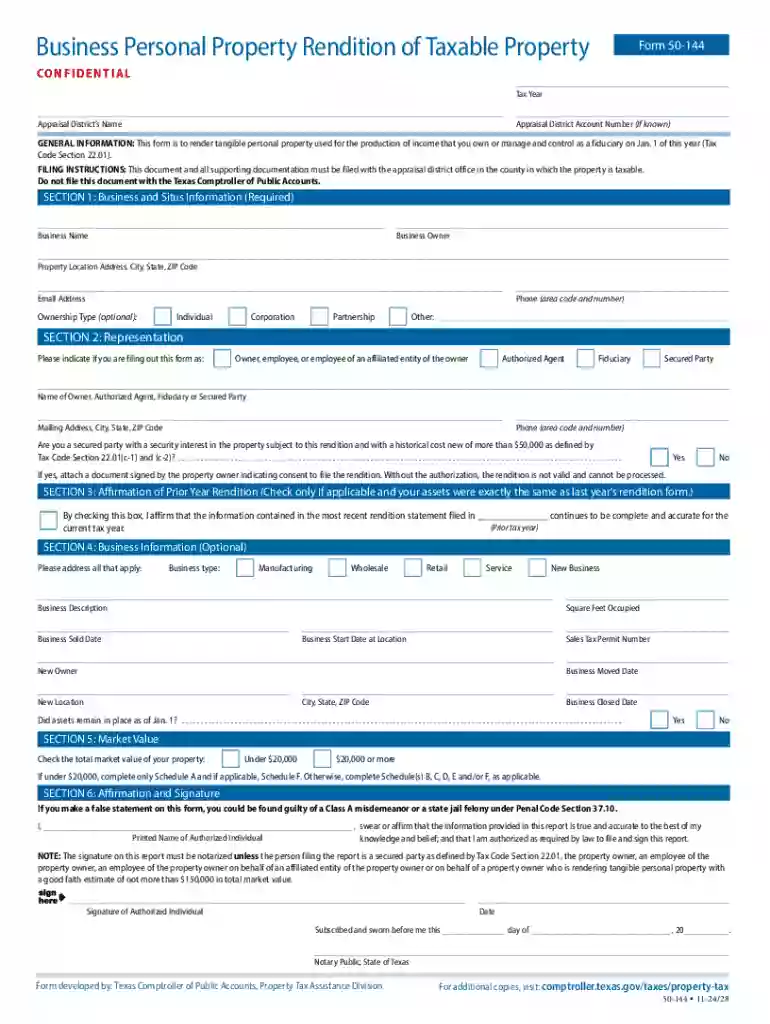
The Business Personal Property Rendition form, specifically Form 50-144 in Texas, is used to report tangible personal property owned or managed by businesses as of January 1 for taxation purposes. This document plays a crucial role in assessing market value and determining tax liabilities for business assets, which include machinery, equipment, inventory, and furniture.
Purpose and Use
- Tax Assessment: The form is crucial for local appraisal districts to assess the market value of a business's tangible assets for tax purposes.
- Legal Compliance: Filing the rendition form is a legal obligation for businesses to accurately report their personal property, preventing potential legal repercussions.
- Enhanced Accuracy: It ensures that businesses are taxed correctly based on their accurate asset representation.
How to Obtain the Business Personal Property Rendition Form
Procurement Methods
- Online Access: Most local appraisal district websites offer downloadable versions of Form 50-144, enabling easy access.
- Direct Request: Forms can be obtained from the local appraisal district's physical office, with the option to request hard copies.
- Professional Advisors: Tax consultants and accountants often provide clients with rendition forms as part of their services.
State Variations
- Uniformity: While Texas specifically uses Form 50-144, other states might have similar forms with different codes and layouts, but the underlying purpose remains consistent.
Steps to Complete the Business Personal Property Rendition Form
General Information: Provide business contact details, including name, address, and business type (LLC, Corporation, etc.).
Asset Description: List all tangible personal property, categorizing items such as machinery, inventory, and office furniture.
Market Value Assessment: Indicate the estimated market value for each item, often requiring supporting documents or appraisals.
Declaration: Sign and date the form, affirming the accuracy of the provided information under penalty of perjury.
Submission: File the completed form with the local appraisal district by the specified deadline, choosing between online, mail, or in-person submission methods.
Common Pitfalls
- Missing Documentation: Ensure all required information and supporting documents are included to prevent delays.
- Inaccurate Valuation: Provide precise market values to avoid disputes with appraisal districts.
Key Elements of the Business Personal Property Rendition Form
Sections Breakdown
- Business Details: Includes sections for business identification, such as legal name and federal identification number.
- Property Listings: Specific areas for describing each type of property, its function, and use within the business.
- Valuation Methodology: Provides options and guidelines for how property values should be estimated and reported.
Legal Obligations
- Mandatory Filing: Businesses are required by law to file the rendition form, ensuring proper tax computation.
- Penalties for Late Filing: Failure to file by the deadline may result in penalties, interest charges, or legal sanctions.
Exemptions
- Industry Specific Exemptions: Some businesses or entities may qualify for specific exemptions based on industry, asset value, or usage, which must be declared.
Penalties for Non-Compliance
Consequences of Non-Filing
- Financial Penalties: Late submission often incurs fines, usually a percentage of the taxes owed.
- Legal Action: Non-compliance may lead to further legal action, including audits and potential lawsuits for continued negligence.
Mitigation Options
- Extensions: Businesses can sometimes apply for filing extensions if preemptive notice is given.
- Negotiation: If penalties are assessed, businesses may negotiate with the appraisal district for reduced fines based on circumstances.
Business Entity Types and Their Relevance
Entities Affected
- Corporations: Often deal with significant tangible assets, making accurate rendition crucial for tax planning.
- Partnerships and LLCs: Must report jointly owned assets, clarifying ownership percentages and tax burdens.
- Sole Proprietorships: While smaller, these need to ensure precise reporting to avoid tax overpayment.
Variations and Special Cases
- Varying Asset Types: Each business type may possess unique asset categories requiring specific attention during reporting.
State-Specific Rules for Business Personal Property Rendition
Texas Rule Highlights
- Filing Times: Generally, the deadline is set on or before April 15, though local municipalities might have specific variations.
- Standard Form Usage: Use of Form 50-144 is standard across Texas, though supplementary forms might be required for complex filings.
Comparative Analysis
- Cross-State Differences: While the general principles of property rendition remain constant, documentation methods and valuations might differ, impacting multistate businesses.
Examples of Using the Business Personal Property Rendition Form
Practical Scenarios
- Tech Companies: Must accurately list computer equipment and software as part of their tangible assets.
- Manufacturers: Detailed reporting of machinery and raw material inventory is essential to reflect operational shifts and capacities.
- Retailers: Accurate stock and inventory reporting ensure taxes are in line with actual business volume.
Illustrative Cases
- Case Study A: A retail business leveraged accurate rendition filing to negotiate lower estimated tax valuations due to an economic downturn, showing the importance of detailed reporting.
- Case Study B: An LLC failed to declare certain fixtures and faced penalties, highlighting the importance of comprehensive documentation.