







Definition and Meaning
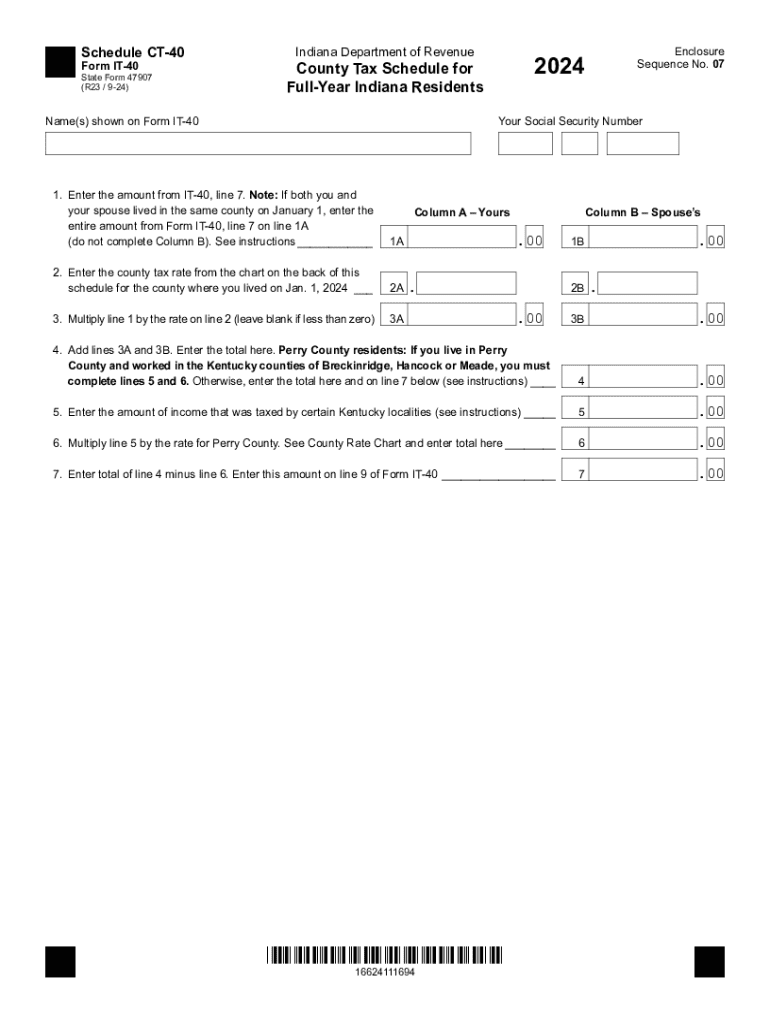
The Schedule CT-40 is a tax form used by full-year residents of Indiana to report county income taxes. This document is specifically designed for individuals who are subject to local income taxes in Indiana. The ET purpose of the Schedule CT-40 is to help residents calculate the applicable county taxes they owe based on their income, providing a standardized method for reporting and ensuring compliance with state tax laws. It plays a crucial role in capturing details about the taxpayer’s residency and employment, especially in cases where a resident works in a neighboring state, such as Kentucky.
How to Use the Schedule CT-40
Using the Schedule CT-40 involves several key steps.
-
Enter Personal Information:
- Provide your full name, address, and social security number at the top of the form.
-
Determine Residency:
- Confirm your status as a full-year resident of Indiana to be eligible for using this form.
-
Calculate Local Income:
- Report the income to calculate the local taxes applicable in your county.
-
Use County Code Chart:
- Reference the county tax rate chart provided within the form to identify your specific county code and applicable tax rate.
-
Complete Calculations:
- Follow the instructions detailed on the form to compute your final county tax liability.
Practical Example:
Residents of Perry County working in Kentucky will need to complete additional sections to account for cross-state employment, which might affect the taxable amount due to varying county tax rates.
Steps to Complete the Schedule CT-40
-
Gather Necessary Documents:
- Before starting, collect all essential documents, such as your W-2 and any other income records.
-
Read Instructions Carefully:
- Each section of the form comes with specific instructions. Carefully read these to avoid missing crucial details.
-
Fill in Personal and Income Details:
- Accurately input your personal information and complete sections that pertain to your income and tax calculations.
-
Verify County Codes:
- Utilize the county tax rate chart within the form to ensure you have the right codes for your county.
-
Complete and Review:
- Double-check all entries for accuracy before finalizing your form.
Edge Cases:
If you've resided in more than one county over the year, you must detail this on the form, as tax rates may vary.
Important Terms Related to Schedule CT-40
-
Full-Year Resident:
- A person who lived in Indiana for the entire tax year.
-
County Tax Rate:
- The percentage of income that is levied by the county, specific to each county in Indiana.
-
Cross-State Employment:
- Situations where a resident of Indiana works in another state, affecting tax liabilities.
-
County Code:
- A unique identifier for each county that aligns with its tax obligations.
State-Specific Rules for the Schedule CT-40
Being an Indiana-specific document, the Schedule CT-40 comes with distinct procedural requirements.
-
Full-Year Resident Criterion:
- Only individuals who have resided in Indiana for the entire tax year can file using this form.
-
Perry County Workers:
- Those living in Perry County but working in Kentucky need precise calculations due to the differing county tax obligations.
-
Local Adjustments:
- Indiana allows for specific deductions that might not apply in other states’ local income tax filings.
Penalties for Non-Compliance
Failure to correctly complete and submit the Schedule CT-40 can result in several consequences:
-
Late Filing Penalty:
- Failing to file by the deadline can incur fines and interest on unpaid taxes.
-
Underpayment of Taxes:
- Inaccuracies leading to underpayment may result in penalties and additional interest charges.
-
Audits:
- Non-compliance increases the likelihood of an audit by the Indiana Department of Revenue, which can result in further penalties.
Form Submission Methods
There are multiple ways to submit Schedule CT-40, each suitable for different taxpayers.
-
Online Submission:
- File digitally through the Indiana Department of Revenue’s online portal for quicker processing.
-
Mail:
- Traditional paper-based filing can be done by mailing the completed form to the designated tax office.
-
In-Person:
- Submission can also be carried out by visiting local offices of the Indiana Department of Revenue.
Digital vs. Paper:
Digital submission generally allows for faster processing and confirmation, whereas paper submissions may offer more privacy to select individuals.
Required Documents
To ensure complete and accurate filing:
-
W-2 Forms:
- Necessary for detailing employment income.
-
1099 Forms:
- Required if applicable for reporting other personal income.
-
Previous Year’s Tax Return:
- Helpful for comparison and ensuring consistency in reporting.
Filing Deadlines / Important Dates
The Schedule CT-40 follows the standard tax filing deadline as the federal tax return, usually April 15th of the following year.
-
Key Deadlines:
- Filing by April 15 ensures timely processing and avoids penalties.
-
Extensions:
- Extension requests can be filed if more time is needed, though any taxes owed must still be estimated and partially paid by the original deadline to avoid interest.
These key aspects provide vital information for taxpayers looking to accurately file using the Schedule CT-40. Each block addresses important components, ensuring a comprehensive understanding of form requirements, thereby aiding residents in meeting their county tax obligations smoothly and efficiently.




