




01. Edit your form online
Type text, add images, blackout confidential details, add comments, highlights and more.

Type text, add images, blackout confidential details, add comments, highlights and more.

Draw your signature, type it, upload its image, or use your mobile device as a signature pad.

Send it via email, link, or fax. You can also download it, export it or print it out.
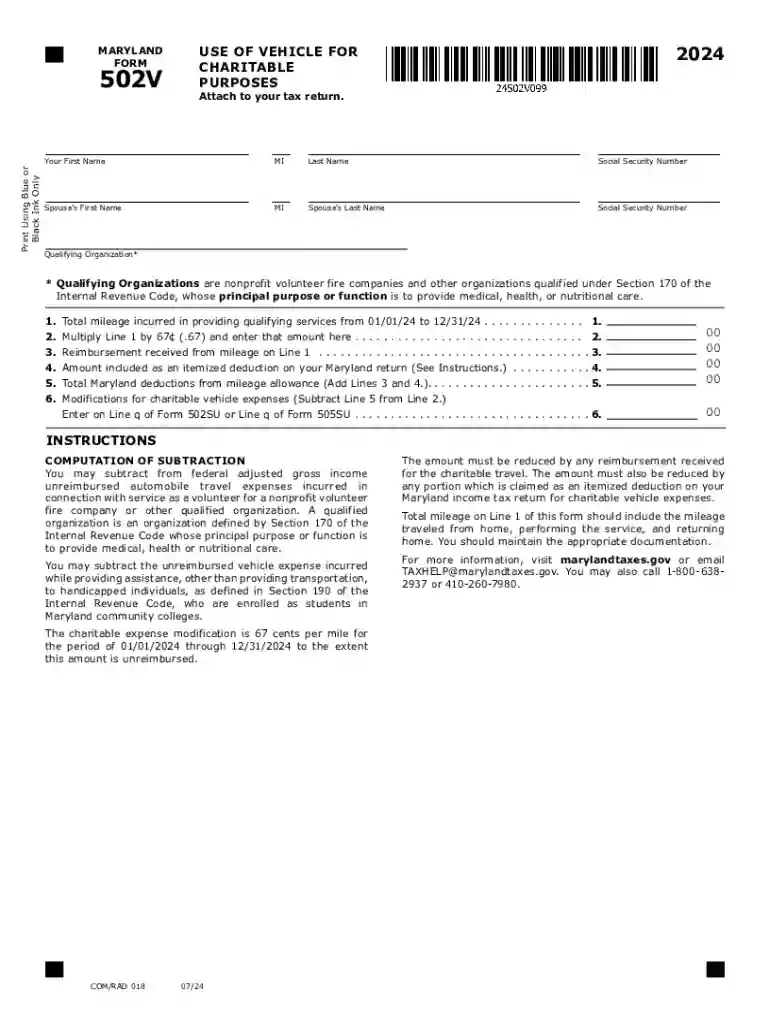
The 2024 Maryland Form 502V is specifically designed to assist taxpayers in reporting the use of vehicles for charitable purposes. This form is essential for individuals who volunteer their time and use their personal vehicles to support qualified charitable organizations. It helps in calculating the unreimbursed automobile travel expenses incurred during volunteer service. Such expenses are deductible, reducing overall taxable income, when adequately documented following form guidelines.
To effectively use the 2024 Maryland Form 502V, taxpayers should first compile all relevant mileage information. This includes the total number of miles driven specifically for volunteer activities. In addition to mileage, the form may require information about the organization served, the specific duties carried out, and any relevant dates. It's important to consistently log these activities to ensure accurate reporting and secure the potential tax deduction.
Gather Documents: Collect receipts, mileage logs, and any correspondence that validates the travel related to charitable services.
Enter Mileage Details: Carefully log each trip, documenting the date, purpose, destination, and total miles driven for each charitable activity.
Calculate Expenses: Use the standard mileage rate for charitable contributions to compute the total expense. This rate is subject to annual adjustments by the IRS.
Adjust for Reimbursements: Subtract any amounts you were reimbursed by the organization for your vehicle use.
Submit Form 502V: Once completed, include this form with your Maryland state tax return. Ensure all entries are accurate to avoid discrepancies and potential audits.
Not all vehicle use qualifies for deduction. To be eligible, the trips must be made to directly benefit a recognized charitable organization. Furthermore, the Internal Revenue Service states that only expenses not reimbursed by the organization can be deducted. The taxpayer must also maintain records to substantiate their claims, following proper documentation requirements.


Understanding the terminology on the form can clarify its use:
A few critical components need special attention:
The Internal Revenue Service outlines several specific provisions for claiming deductions related to charitable vehicle use. It's imperative to:
Typically, the Form 502V must be submitted alongside the taxpayer’s Maryland state return, usually by mid-April of the following year. It's crucial to verify specific filing deadlines annually, as they may vary or experience extensions. Early preparation is advised to ensure compliance with submission requirements.
Failing to comply with documentation requirements or incorrectly reporting mileage may lead to penalties. The Maryland tax authority can impose fines, disallow claimed deductions, or even trigger more extensive audits of taxpayer submissions. It emphasizes the importance of accurate and honest reporting.
We've got more versions of the 2024 Maryland Form 502V Use of Vehicle for Charitable Purposes form. Select the right 2024 Maryland Form 502V Use of Vehicle for Charitable Purposes version from the list and start editing it straight away!
At DocHub, your data security is our priority. We follow HIPAA, SOC2, GDPR, and other standards, so you can work on your documents with confidence.



Oct 5, 2018 To provide protections for certain sports medicine professionals, to reauthorize Fed- eral aviation programs, to improve aircraft safetyRead more
502V Use of Vehicle for Charitable Purposes Form and instructions for subtracting from the federal adjusted gross income certain unreimbursed automobile
by K Widner 2024 Derived from the Statute of Charitable Uses, a charitable use implicated a public purpose without private gain.28. Charitable Uses;


