
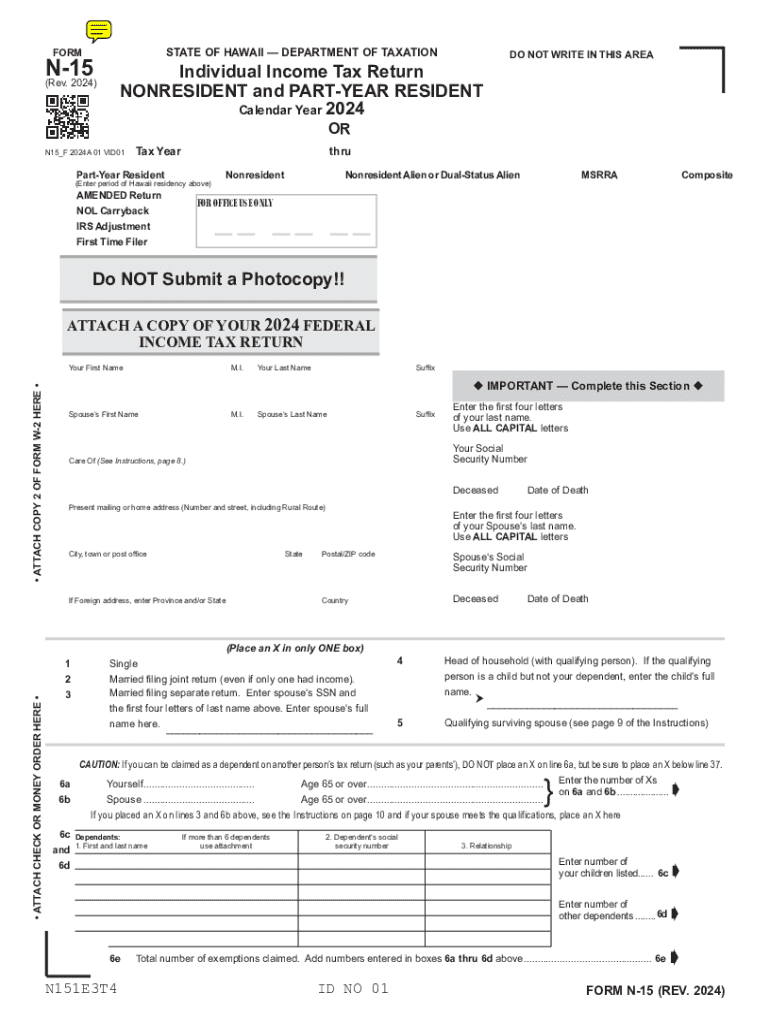







Definition & Meaning
The N-15 Rev 2024 NonResident and Part-Year Resident Income Tax Return Form is essential for individuals who have a tax obligation to the state while not being full-year residents. This form allows those who have lived in Hawaii part-time or earned income from Hawaiian sources to report their income accurately. It encompasses the income earned within the state and allows for the calculation of taxes owed.
Role in Tax Reporting
- Purpose: To ensure nonresidents and part-year residents fulfill their tax responsibilities within Hawaii.
- Target Group: Aimed specifically at those who are not full-time Hawaiian residents but have income generated from state sources.
- Relevance: It ensures that all taxable income earned or sourced from Hawaii is declared.
How to Obtain the N-15 Rev 2024 Form
Acquiring the N-15 form is a straightforward process, essential for complying with state tax regulations.
Access Methods
- Online from the Department of Taxation: The form is readily available for download from the Hawaii Department of Taxation's website.
- Tax Preparation Software: Programs like TurboTax and QuickBooks may offer direct access to the form.
- Professional Tax Services: CPAs or tax preparers usually have access to the N-15 forms.
Physical Forms
- Pick-Up Locations: Available at local tax offices if you prefer a hard copy.
- Request by Mail: Some might prefer to request a paper form, though this is less common in today's digital-first approach.
Steps to Complete the N-15 Rev 2024 Form
Filling out the N-15 form involves several key steps. Attention to detail is essential to ensure accurate tax filing.
Step-by-Step Guidance
- Personal Information: Provide basic personal details like name, Social Security number, and residency status.
- Income Reporting: Declare all income sourced from Hawaii, regardless of where it was earned.
- Deductions and Credits: Explore eligible deductions and credits to reduce taxable income.
- Tax Calculation: Follow instructions to compute the tax liability.
- Finalize and Sign: Ensure accuracy, sign the form, and prepare for submission.
Important Tips
- Double-Check Entries: Mistakes can delay processing or lead to further inquiries.
- Use Form Instructions: Reference the detailed instructions included with the form for guidance on each section.
Important Terms Related to the N-15 Form
Familiarity with key terms can aid in accurately completing the N-15 form.
Key Terms
- Nonresident: An individual who doesn't live in Hawaii but earns income there.
- Part-Year Resident: Someone who lives in Hawaii during part of the tax year.
- Taxable Income: The portion of income subject to state taxation.
- Deductions: Allowable amounts subtracted from gross income to reduce taxable income.
Common Confusions
- Resident vs. Nonresident: Understanding your designation is crucial as it affects filing requirements.
- Source of Income: Only income sourced from Hawaii must be reported.
Filing Deadlines / Important Dates
Adhering to deadlines is crucial for compliance.
Key Dates
- Filing Deadline: Generally, due by April 15 of the following year. If it falls on a weekend or holiday, the deadline is extended.
- Extension Requests: Available if more time is needed, typically providing an additional six months.
Failure to Comply
- Penalties: Late filing or payment may result in penalties and interest charges.
Form Submission Methods
Submissions can be made through several convenient channels.
Available Methods
- Online: Electronic filing through the Hawaii Department of Taxation website is the most efficient.
- Mail: Paper submissions can be sent via USPS to the designated tax office address.
- In-Person: Direct submission at public tax offices remains an option.
Pros and Cons
- Online Submission: Faster processing times and immediate confirmation.
- Mail/In-Person: Useful for those without internet access but potentially slower.
Legal Use of the N-15 Form
Understanding the legal implications of properly using the N-15 form can prevent future complications.
Related Legal Obligations
- Accurate Reporting: Mandated by law; failure to report accurately can result in audits or penalties.
- Record-Keeping: Retain copies of filed returns and supporting documents for at least three years.
Potential Consequences
- Compliance Assurance: Proper use guarantees fulfillment of state obligations and avoids legal disputes.
IRS Guidelines
While the N-15 form is state-specific, there are implications for federal taxation.
Federal Alignment
- Consistency: Ensure state filings align with federal returns for consistency.
- IRS Involvement: The IRS may reference state forms during federal audits.
Supplementary Resources
- IRS Publications: Provide additional context that might aid in understanding the interplay between state and federal filings.
By addressing these topics with clarity and detail, individuals can successfully navigate their obligations with the N-15 income tax return form.


