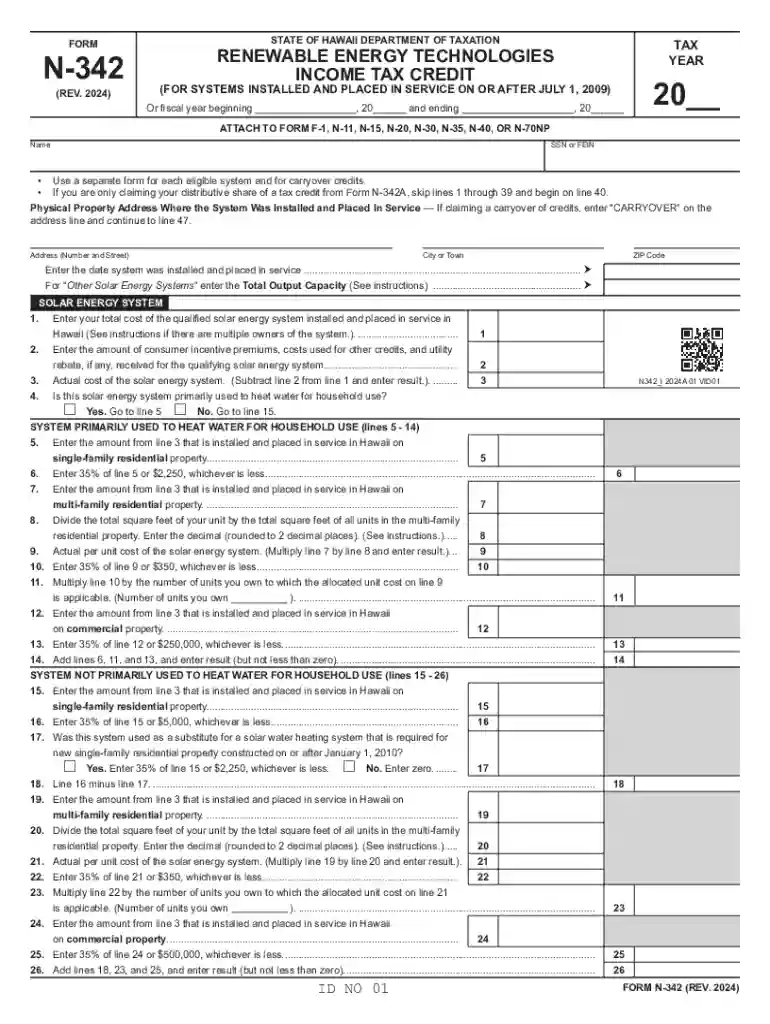
Form N-342, 2024, Renewable Energy Technologies Income Tax Credit For Systems Installed and Placed i-2026

Get Form
hawaii tax form n 342 Preview on Page 1

Here's how it works

01. Edit your hawaii tax form n 342 online
Type text, add images, blackout confidential details, add comments, highlights and more.

02. Sign it in a few clicks
Draw your signature, type it, upload its image, or use your mobile device as a signature pad.

03. Share your form with others
Send it via email, link, or fax. You can also download it, export it or print it out.

Definition and Purpose of Form N-342

Form N-342, 2024, is a state-specific document from Hawaii designed for taxpayers seeking the Renewable Energy Technologies Income Tax Credit. This form is used to claim tax credits for the installation and activation of renewable energy systems, such as solar and wind, in residential and commercial properties. Introduced to encourage sustainable energy practices, Form N-342 helps reduce the financial burden of adopting renewable technology through tax incentives. Completing this form accurately allows applicants to receive credits on state income taxes, contributing to cost savings and environmental sustainability.

Eligibility Criteria for Claiming Tax Credits

Eligibility for claiming tax credits with Form N-342 requires meeting specific criteria:

  • Installation Date: Systems must have been installed and made operational during the tax year 2024 or after July 1, 2009.
  • Type of Systems: Only qualified renewable energy systems, such as solar and wind, are eligible.
  • Property Type: The system can be installed in either residential or commercial properties.
  • Ownership and Usage: The system must be owned by the taxpayer seeking the credit, and it should be used within the property for which the credit is claimed.
decoration image ratings of Dochub

Specific Examples

  1. A homeowner installing a solar panel system on their property in December 2024 can apply for the credit.
  2. A business installing a wind turbine in July 2024 is eligible, provided the system is used at their commercial facility in Hawaii.

Key Elements of Form N-342

This form consists of several crucial sections that must be completed accurately:

  • Taxpayer Information: Includes personal and property details where the system is installed.
  • System Details: Information about the type of renewable energy system and its specifications.
  • Cost Breakdown: A detailed account of expenses incurred during installation and any subsequent maintenance.
  • Credit Calculation: Formulas and guidelines to determine the applicable tax credit based on system type and installation costs.
  • Attestations and Signature: Declarations confirming the accuracy of provided information with the taxpayer's signature.

How to Use and Complete Form N-342

To effectively complete the Form N-342, follow these steps:

  1. Gather Required Documents: Assemble all receipts, invoices, and installation agreements related to the renewable energy system.
  2. Identify Eligible Expenditures: Ensure all costs align with eligible categories such as equipment, labor, and permits.
  3. Calculate Credits: Use provided guidelines to calculate the tax credit amount applicable to your specific system.
  4. Fill in Taxpayer Information: Enter personal details and property location accurately.
  5. Ensure Accuracy: Double-check all entered data for correctness to avoid processing delays.
  6. Attestations and Submission: Complete the form with required signatures and submit through designated state channels.

Important Deadlines and Filing Instructions

Timeliness and correctness are crucial for successful submission of Form N-342:

  • Filing Deadline: Typically aligned with state income tax filing deadlines. The specific date may vary annually, so verify with Hawaii's Department of Taxation.
  • Submission: Ensure the form is complete, signed, and accompanied by necessary supporting documentation. Submissions can be made electronically or via traditional mail depending on state provisions.

Real-World Scenario

Consider a business owner who installed a solar heating system in their warehouse. By filing the Form N-342 on time with accurate details, they not only claim a tax credit but also ensure compliance with Hawaii state regulations.

State-Specific Considerations and Legal Guidelines

Hawaii's incentives for renewable energy reflect its commitment to sustainability. Legal obligations require precise adherence to installation and operation guidelines under state law. Awareness and compliance with Hawaii's specific tax regulations regarding renewable energy credits are essential for legal and financial benefits.

Considerations:

  • Be aware of local statutes influencing installation practices.
  • Maintain detailed records for audits or verification purposes by the state.

Alternatives and Related Forms

In some cases, alternative documentation may complement or substitute Form N-342:

  • Older Versions: Previous year’s versions can sometimes be referenced for historical data but verify updates applicable to the 2024 form.
  • Related Forms: Other state credits or federal initiatives may have separate forms. For instance, forms for federal investment tax credit programs can complement the benefits received under Form N-342.
be ready to get more

Complete this form in 5 minutes or less

Get form

Got questions?

We have answers to the most popular questions from our customers. If you can't find an answer to your question, please contact us.
Contact us
If you invest in renewable energy for your home such as solar, wind, geothermal, fuel cells or battery storage technology, you may qualify for an annual residential clean energy tax credit.
What is Form 5695? Form 5695 is the official IRS tax form you must use to claim the federal solar tax credit when you file your taxes. You can download a copy of Form 5695 (PDF) on the IRS website. The form is updated every year, so make sure you use the most recent version available.
The maximum credit you can claim each year is: $1,200 for energy efficient property costs and certain energy efficient home improvements, with limits on exterior doors ($250 per door and $500 total), exterior windows and skylights ($600) and home energy audits ($150)
Claiming the ITC is easy. To get started, youll first need your standard IRS 1040 Form, IRS Form 5695, Residential Energy Credits, and the instructions for Form 5695. The purpose of Form 5695 is to validate your qualification for renewable energy credits.
Manufacturer Certifications These are basically gold stars from your solar equipments manufacturers. They prove that your solar panels, inverters, and other components meet specific performance and quality standards. The IRS uses these certifications to verify that your system is legit and eligible for the tax credit.

Security and compliance

At DocHub, your data security is our priority. We follow HIPAA, SOC2, GDPR, and other standards, so you can work on your documents with confidence.
Learn more
ccpa2
pci-dss
gdpr-compliance
hipaa
soc-compliance
be ready to get more

Complete this form in 5 minutes or less

Get form

People also ask

Assuming you made an honest or reasonable mistake, you can expect the IRS to disallow the credit. This will probably result in an unpaid tax balance, along with audit penalties and interest. If you intentionally gave wrong information to the IRS, you could face the possibility of civil or criminal tax fraud charges.
You generally must have documentary evidence, such as receipts, canceled checks, or bills, to support your expenses. Additional evidence is required for travel, entertainment, gifts, and auto expenses.
Also use Form 5695 to take any residential energy efficient property credit carryforward from 2025 or to carry the unused portion of the residential clean energy credit for 2024.

Related links