
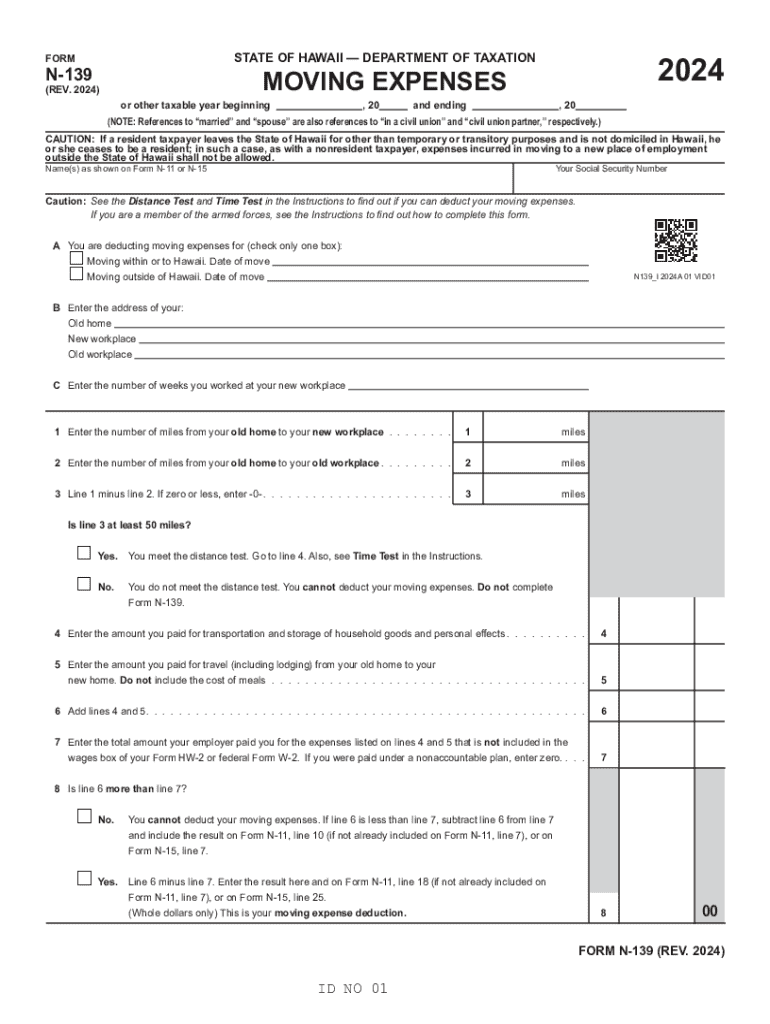







Definition and Purpose of the Form N-139, Rev 2024, Moving Expenses
Form N-139, Rev 2024, Moving Expenses is a tax form issued by the State of Hawaii's Department of Taxation. It is used by residents to deduct moving expenses incurred when starting a new job or transferring to a different location for work. The form serves as a guide to determine eligibility for deductions and specifies the types of expenses that can be written off. It is crucial for taxpayers aiming to reduce their taxable income by claiming qualified moving expenses, provided specific conditions are met.
Key Elements of the Form
- Deductible Expenses: Includes the cost of moving household goods, travel expenses, and other reasonable expenses related to the move.
- Eligibility Criteria: Taxpayers must meet specific criteria, such as the distance test (the new workplace must be at least 50 miles farther from the former residence than the former workplace was) and the time test (full-time employment status at the new location for a certain period).
- Exceptions: Includes rules specific to members of the armed forces and certain situations where expenses do not qualify for deductions.
How to Obtain the Form N-139, Rev 2024, Moving Expenses
Obtaining Form N-139 involves several straightforward steps:
- Online Access: The form is available for download on the Hawaii Department of Taxation’s official website. Ensuring you have the latest revision is critical, so verify the version is 2024.
- Local Tax Offices: Printed copies can be obtained from local tax offices across Hawaii for those who prefer paper.
- Tax Preparation Software: Compatible software such as TurboTax or QuickBooks may offer digital copies of the form. Ensure your software is updated to the latest tax year for accuracy.
Steps to Complete the Form N-139, Rev 2024, Moving Expenses
Filling out the Form N-139 accurately requires attention to detail and following these steps:
- Personal Information: Start with your full name, Social Security Number, and current address.
- Moving Expense Details: Itemize your moving expenses, including transportation, packing, and storage fees. Use receipts to verify amounts.
- Eligibility Verification: Complete sections verifying you meet the distance and time tests. Include relevant documentation if needed.
- Signature and Date: Ensure the form is signed and dated to validate the information provided.
Important Considerations
- Documentation: Retain all receipts and evidence of moving expenses for potential audits.
- Consultation: Consider consulting a tax professional if your situation involves complex circumstances.
Eligibility Criteria for Deductions
To qualify for moving expense deductions using Form N-139:


Distance and Time Tests
- Distance Test: The new work location must add an additional 50 miles from your old home than your old job location.
- Time Test: You must work full-time at the new job location for at least 39 weeks in the first year following the move. Exceptions apply to members of the armed forces or individuals retiring under certain conditions.
Exceptions
- Temporary Positions: Moves made for temporary job assignments do not qualify.
- Out-of-State Moves: Moving expenses leaving Hawaii permanently for non-temporary reasons are not deductible.
Examples of Using the Form N-139, Rev 2024, Moving Expenses
Case Study
- Scenario: John, a healthcare professional, relocates from Honolulu to Maui for a permanent job change. He incurs $4,500 in moving expenses.
- Application: John completes Form N-139, verifying he meets both the distance and time tests. He claims deductions for costs related to transporting household items and travel expenses for his family.
Examples
- Non-Qualifying Move: Jane moves to California for a two-month project. Her expenses are not deductible as it doesn't meet the state residency or time test requirements.
Filing Deadlines and Important Dates
- Annual Deadline: Form N-139 should be submitted along with your state tax return by April 15.
- Extensions: File for extensions through state tax services if additional time is required, ensuring that the form is filed within the extension period.
State-Specific Rules for the Form N-139, Rev 2024, Moving Expenses
The regulations governing moving expenses can vary by state, but Hawaii-specific rules must be followed when filling out Form N-139:
- Residency Requirements: Deduction eligibility requires the move to be within the state under specified conditions, highlighting the importance of maintaining or establishing a principal residence in Hawaii for deduction validity.
- Expense Limits: Certain categories of moving expenses may have caps based on changes in state tax law or economic conditions.
Penalties for Non-Compliance
Failing to comply with Form N-139 requirements can lead to penalties:
- Incorrect Information: Providing false or erroneous information may result in denial of deductions and potential fines.
- Audit Risks: Inaccuracies increase the risk of an audit by the Department of Taxation, necessitating careful documentation and adherence to guidelines.


