Instructions for Form 1023 (Rev December 2024)-2026

Get Form
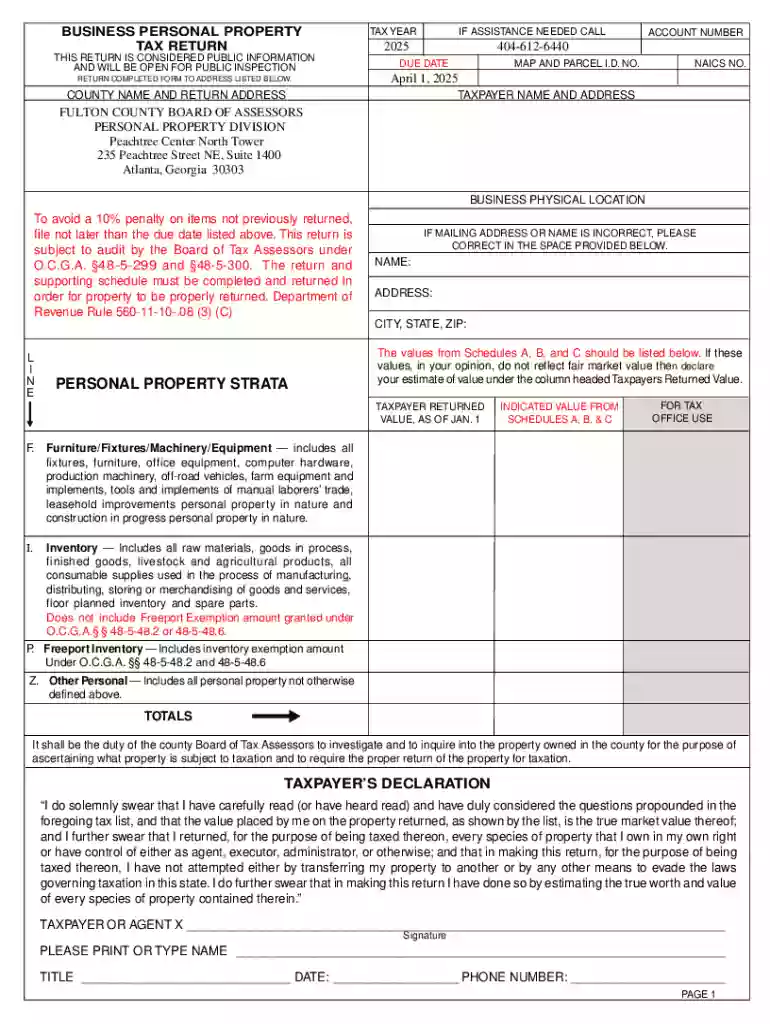
ga business property tax return Preview on Page 1

Here's how it works

01. Edit your ga business property tax return online
Type text, add images, blackout confidential details, add comments, highlights and more.

02. Sign it in a few clicks
Draw your signature, type it, upload its image, or use your mobile device as a signature pad.

03. Share your form with others
Send it via email, link, or fax. You can also download it, export it or print it out.

Definition & Purpose of Form 1023

Form 1023, formally known as the "Application for Recognition of Exemption Under Section 501(c)(3) of the Internal Revenue Code," is used by organizations in the United States to apply for tax-exempt status with the Internal Revenue Service (IRS). Obtaining this status is crucial for organizations seeking to be recognized as charitable entities eligible for tax-deductible donations. The form helps the IRS determine whether the applying entity meets the necessary criteria to be classified as a 501(c)(3) organization.

Key Components of Form 1023

  • Organizational Structure: Information about the entity's founding documents, governing structure, and operational dynamics.
  • Financial Data: Includes detailed accounts of past, current, and projected financial statements and sources of funding.
  • Organizational Activities: Descriptions of past, present, and planned operations that align with IRS definitions of charitable activities.
  • Compliance Information: Assurance that the organization complies with IRS nondiscrimination policies and restrictions on political activities.

How to Use the Instructions for Form 1023

The instructions for Form 1023 serve as a comprehensive guide to completing the application accurately. Understanding these instructions is crucial when filling out the form, as they provide detailed explanations for each section.

Step-by-Step Process

  1. Review the Organizational Checklist: Ensure that the organization meets all eligibility criteria.
  2. Prepare Documentation: Gather all necessary documents, including articles of incorporation and organizational bylaws.
  3. Complete Each Section Correctly: Follow the paragraph-specific guidance to fill out each part of the form accurately.
  4. Seek Professional Advice if Needed: Consider consulting with a tax professional or attorney for complex questions.

Where to Obtain the Instructions for Form 1023

The instructions for Form 1023 can be acquired in several ways, ensuring broad accessibility for applicants.

Access Methods

  • IRS Website: Direct download from the official IRS website ensures accessing the most current version.
  • Local IRS Offices: Hard copies may be available when visiting branch locations.
  • Professional Services: Tax professionals and legal advisors may provide copies as part of service offerings.

Steps to Complete Form 1023

Completing Form 1023 requires attention to detail and adherence to the prescribed steps. These steps ensure a complete and accurate application that maximizes the chances of approval.

Detailed Steps

  1. Determine Eligibility: Verify that the organization qualifies for 501(c)(3) status.
  2. Gather Necessary Documents: Prepare the organization's financial records, operational history, and legal documents.
  3. Fill Out the Form: Utilize the form instructions for precise completion of each section.
  4. Review for Accuracy: Double-check for completeness and correctness.
  5. Submit the Application: Use appropriate methods (online or mail) to send the application to the IRS.

Eligibility Criteria for Form 1023

Only organizations meeting specific criteria can apply for 501(c)(3) status using Form 1023.

decoration image ratings of Dochub

Criteria Breakdown

  • Purpose: Must be religious, charitable, scientific, educational, or literary.
  • Organizational Structure: Must be formally organized with governing documents.
  • Income and Asset Limitations: Restrictions on earning profits intended to benefit insiders or engage in lobbying.

Common Terms Related to Form 1023

Understanding key terms related to Form 1023 is crucial for proper comprehension and execution of the application process.

Key Terms

  • 501(c)(3): Refers to the section of the Internal Revenue Code providing tax exemption for specific nonprofit organizations.
  • Exemption: The status that allows an organization to operate without tax liability on income related to its exempt purposes.
  • Charitable Contribution: Donations made to the organization can be tax-deductible under specific IRS criteria.

Digital vs. Paper Submission

Organizations can choose between digital and paper submission methods based on convenience and preference.

Advantages of Each Method

  • Digital Submission: Faster processing times and electronic confirmations.
  • Paper Submission: Traditional method, useful for those preferring non-digital record-keeping.

Filing Deadlines & Important Dates

Timeliness is crucial when submitting Form 1023 to avoid penalties and ensure recognition of tax-exempt status.

Important Considerations

  • Submission Timeline: Applications should be submitted within 27 months of formation for retroactive exemption eligibility.
  • Processing Time: Awareness of average IRS processing times aids in planning organizational activities.
  • Important Updates: Stay informed about updates from the IRS that may impact submission protocols.

IRS Guidelines for Form 1023

Strict adherence to IRS guidelines is essential for a successful application process.

Key Guidelines

  • Accuracy: Ensuring all information is truthful and verifiable.
  • Completeness: Filling out every applicable section without omissions.
  • Compliance: Meeting IRS standards for organizational operations and purpose alignment.

Including detailed, practical examples and comprehensive explanations in each of these sections will help provide maximum utility for users completing or assisting with Form 1023.

be ready to get more

Complete this form in 5 minutes or less

Get form

Got questions?

We have answers to the most popular questions from our customers. If you can't find an answer to your question, please contact us.
Contact us
In either case, your organization will be on the IRS radar, and it could lose its exempt status entirely. Remember too, you are signing the application under penalty of perjury. If you have any expectation of more than $50,000 in revenue, you would be far wiser to file the full Form 1023 now.
Organizations must electronically file this form to apply for recognition of exemption from federal income tax under section 501(c)(3).
Before submitting Form 1023, the organization must consolidate the following attachments into a single PDF file: Organizing document (required) Amendments to the organizing document in chronological order (required if applicable) Bylaws or other rules of operation and amendments (if adopted)
If you file Form 1023, the average IRS processing time is 6 months. Processing times of 9 or 12 months are not unheard of. The IRS closely scrutinizes these applications, as the applicants are typically large or complex organizations.
How much is the user fee for an exemption application? The user fee for Form 1023 is $600. The user fee for Form 1023-EZ is $275. The user fees must be paid through Pay.gov when the application is filed.

Security and compliance

At DocHub, your data security is our priority. We follow HIPAA, SOC2, GDPR, and other standards, so you can work on your documents with confidence.
Learn more
ccpa2
pci-dss
gdpr-compliance
hipaa
soc-compliance

People also ask

Form 1023 requires the following information about an applying charity: Date of organizations creation and what country it was created under. Organizational structure. Organizing documents (e.g. articles of incorporation, trust agreement, articles of association)
The IRS defines bylaws as the internal operating rules of an organization. They do ask that you include bylaws in your 501(c)(3) application, but only if they are already adopted and approved. If you are just starting your nonprofit and have adopted your bylaws, then you should include them with your 1023 form.

Related links