
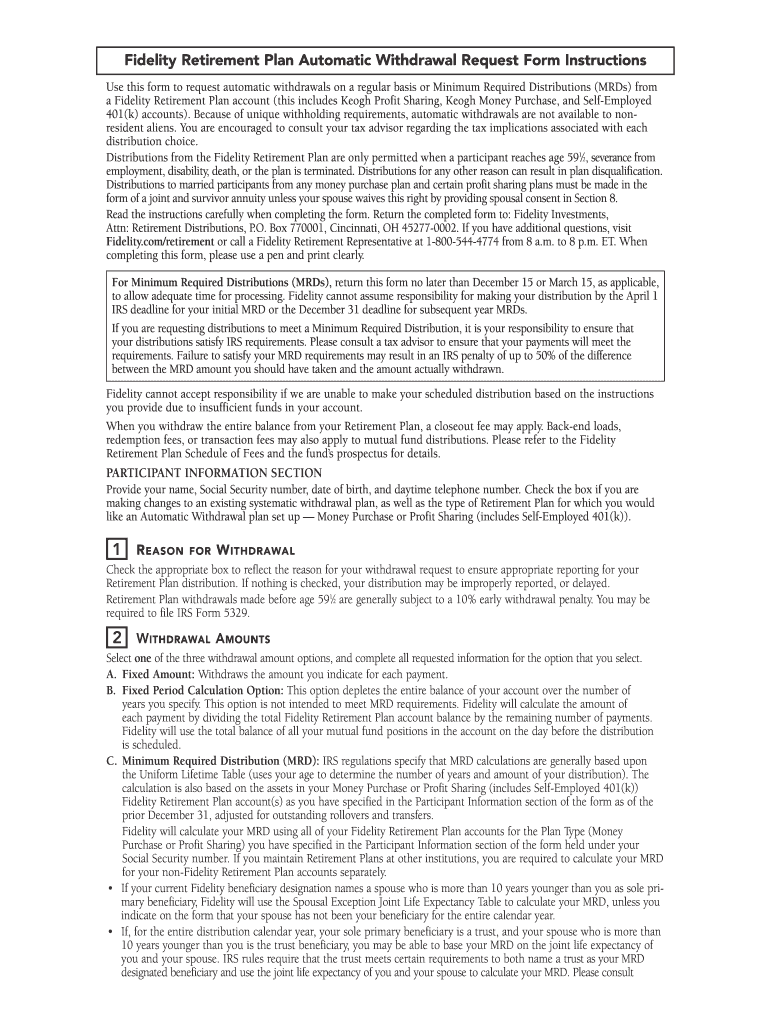







Definition and Meaning of the Fidelity Retirement Terms and Conditions of Withdrawal Form
The Fidelity retirement terms and conditions of withdrawal form governs the rules and procedures for withdrawing funds from a Fidelity retirement account, such as a 401(k) or other retirement plans. Understanding this form is crucial for participants looking to access their retirement savings during specific circumstances.
The form outlines the eligibility requirements, types of withdrawals available, and the implications of each withdrawal type, including taxes and penalties. It serves as both a request and an acknowledgment that the participant understands the consequences of their withdrawal decisions.
Key aspects of the form include:
- Withdrawal Types: Participants can typically request full withdrawals, partial withdrawals, or Minimum Required Distributions (MRDs). Each type may have different tax implications.
- Eligibility Criteria: Understanding when you can withdraw funds, such as upon reaching retirement age or experiencing financial hardship.
- Required Documentation: Additional documents might be necessary depending on the withdrawal type, such as proof of hardship for qualified withdrawals.
Grasping these elements is fundamental for anyone seeking to utilize their Fidelity retirement accounts effectively.
Steps to Complete the Fidelity Retirement Terms and Conditions of Withdrawal Form
Completing the Fidelity retirement terms and conditions of withdrawal form involves several clear steps to ensure accuracy and compliance with policies. Here’s a detailed outline of the process:
-
Gather Necessary Information:
- Collect your account number and personal identification.
- Determine the type of withdrawal you wish to make and gather any supporting documentation (for example, proof of financial hardship if applicable).
-
Access the Form:
- Download the form from Fidelity’s website or request a physical copy through customer service.
- Ensure you have the most up-to-date version to avoid complications.
-
Fill Out the Form:
- Input personal information accurately, including name, address, and Social Security number.
- Clearly specify the type of withdrawal and the amount you wish to withdraw.
-
Review Withdrawal Terms:
- Carefully read the terms and conditions section to understand the implications of your withdrawal. This section outlines any penalties or tax consequences.
-
Provide Necessary Signatures:
- Sign the form to confirm that you understand and agree to the withdrawal terms.
- If required, have the form notarized depending on the withdrawal type.
-
Submit the Form:
- Depending on Fidelity's instruction, submit the form either online, by mail, or in-person at a designated location. Choose the method that is most convenient for you and retains a copy for your records.
-
Track Your Request:
- After submission, follow up with Fidelity to ensure your request has been processed and to understand when to expect the funds.
This methodical approach helps to prevent delays and ensures compliance with Fidelity’s requirements.
Important Terms Related to the Fidelity Retirement Terms and Conditions of Withdrawal Form
Understanding key terminology associated with the Fidelity retirement terms and conditions of withdrawal form is essential for effectively navigating the withdrawal process. Familiarity with these terms will enable participants to make informed decisions regarding their retirement savings.
- Minimum Required Distribution (MRD): The minimum amount a retirement plan account owner must withdraw, starting at age 72, to avoid penalties.
- Hardship Withdrawal: A type of withdrawal permitted under specific circumstances, allowing participants to access funds before retirement age without facing standard penalties.
- Vesting: The process that determines an employee's entitlement to the benefits from their employer-contributed portion of the retirement account.
- Tax Consequences: Potential tax impacts that come with various types of withdrawals, such as income tax on distributions and possible early withdrawal penalties.
- Qualified Withdrawal: A withdrawal made under specific conditions that meet IRS guidelines, potentially resulting in favorable tax treatment.
Understanding these terms will empower participants to navigate their withdrawals more effectively and minimize unexpected pitfalls.
Legal Use of the Fidelity Retirement Terms and Conditions of Withdrawal Form
The legal context surrounding the Fidelity retirement terms and conditions of withdrawal form is significant, as it provides the framework for compliance with federal regulations governing retirement plans. In this context, certain legal principles and requirements should be considered:
- Compliance with ERISA: The Employee Retirement Income Security Act (ERISA) establishes rules governing pension plans in the private industry and protects participants by ensuring they receive plan benefits. Withdrawals must comply with these regulations.
- Tax Regulations: The Internal Revenue Service (IRS) imposes specific rules regarding the taxability of retirement withdrawals. Participants must adhere to these guidelines to avoid penalties or unintended tax ramifications.
- Withdrawal Agreement: When submitting the form, participants legally agree to the terms outlined, including acknowledgment of any potential tax consequences or penalties associated with early withdrawal.
- Audit Trail: Document retention and having a clear record of withdrawal approvals and denials is crucial for future compliance or audits. Participants should keep copies of submitted forms and correspondence.
Understanding the legal implications of the withdrawal form is vital to ensure adherence to applicable laws and to safeguard one's retirement savings from unintended consequences.
How to Obtain the Fidelity Retirement Terms and Conditions of Withdrawal Form
Acquiring the Fidelity retirement terms and conditions of withdrawal form is a straightforward process that can be completed through various channels. Here are the recommended methods:
- Fidelity Website: The most efficient way to obtain the form is through Fidelity’s official website. Navigate to the retirement documentation section where you can download a digital copy of the form as a PDF.
- Customer Service: For personalized assistance, contact Fidelity customer service through their hotline or chat support. Representatives can provide you with the form or guide you on completing it.
- Financial Advisor: If you work with a financial advisor, they can often provide not only the form but also guidance on the best strategy for making withdrawals based on your individual financial situation.
- Branch Locations: For those preferring face-to-face interactions, visiting a local Fidelity branch can provide access to the form along with in-person assistance.
Regardless of the method chosen, ensure that you are using the latest version of the withdrawal form to avoid complications.
Examples of Using the Fidelity Retirement Terms and Conditions of Withdrawal Form
Practical scenarios illustrate how the Fidelity retirement terms and conditions of withdrawal form is employed in real-life situations. Understanding these examples can inform participants about the withdrawal options available to them.
-
Example 1: Hardship Withdrawal: John, a 35-year-old employee, faces significant medical expenses. He applies for a hardship withdrawal using the form. He provides the necessary documentation proving financial need, submits the form, and successfully withdraws funds without incurring the standard early withdrawal penalty due to qualifying circumstances.
-
Example 2: Regular Withdrawal Post-Retirement: Mary, who is 70 years old, decides to take her Minimum Required Distribution. She fills out the withdrawal form, specifying the withdrawal amount based on IRS guidelines. She ensures she adheres to the IRS regulations to avoid penalties for non-compliance.
-
Example 3: Financial Planning Strategy: Carlos, preparing for his retirement, chooses to withdraw a portion of his Fidelity 401(k) to fund a new business venture. He carefully reviews the withdrawal terms with a financial advisor, completes the withdrawal form, and submits it along with a thorough explanation of his business plan.
These scenarios show that the withdrawal form enables participants to navigate various withdrawal types while adhering to legal and financial guidelines. Familiarity with such examples can help individuals prepare adequately for their specific situations.




