







Definition and Meaning
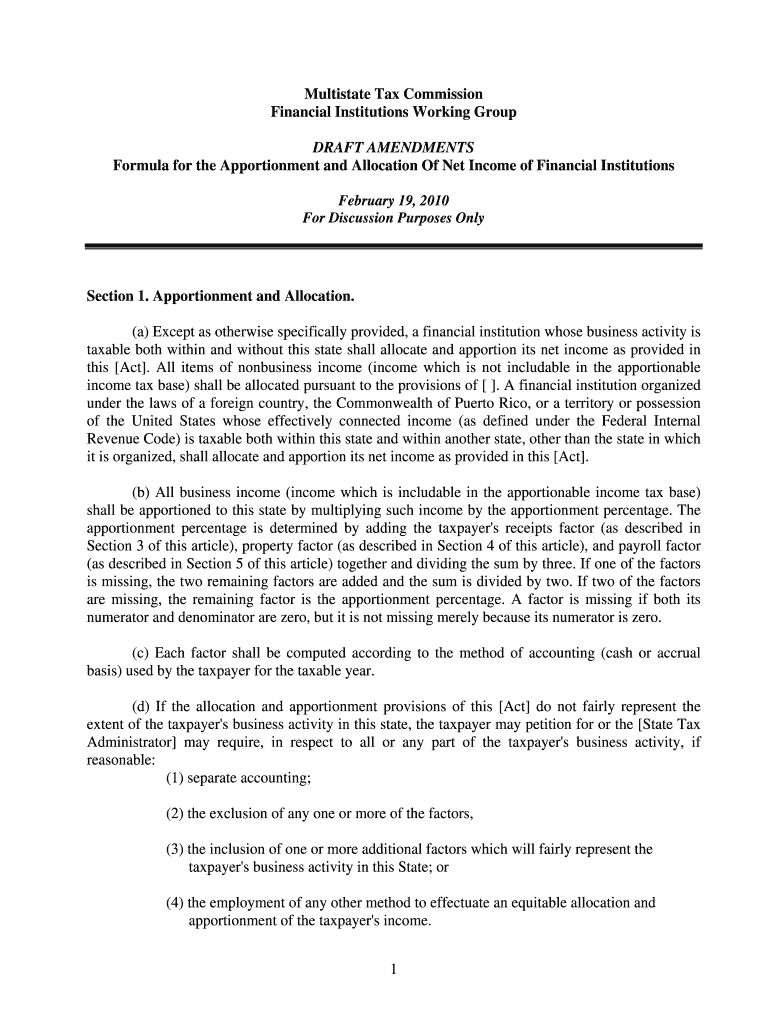
The Multistate Tax Commission Financial Institutions Working Group's Draft Amendments propose a formula for the apportionment and allocation of net income specifically for financial institutions. These amendments are designed to standardize how net income is allocated across states, ensuring a fair representation of a taxpayer's business activities. This formula considers several financial factors to ascertain the share of income taxable by each state, focusing on business and nonbusiness income allocation.
Key Elements of the Draft Amendments
The draft amendments outline specific factors used in calculating a financial institution's net income for state taxes:
-
Receipts Factor: Represents the total revenue a financial institution earns from various sources, adjusted for state-specific regulations concerning taxable transactions.
-
Property Factor: Includes all tangible and intangible properties owned by the institution, allocated to specific states based on usage and income generation.
-
Payroll Factor: Involves the total compensation paid to employees, calculated for each state where the institution operates.
These elements help taxpayers apportion their taxable income, reflecting business operations across different jurisdictions.
Steps to Complete the Formula
-
Gather Financial Data: Collect all relevant financial information, including receipts, property, and payroll data.
-
Calculate State-specific Factors: Determine the receipts, property, and payroll factors for each state using guidelines provided in the draft amendments.
-
Apply the Apportionment Formula: Use the factors calculated to distribute net income across states following the suggested amendments.
-
Verify and Adjust: Ensure the calculations meet all state requirements and adjust as necessary for accuracy.
Important Terms Related to the Amendments
Understanding key terminology is crucial for accurately applying the formula:
-
Apportionment: The process of dividing and allocating income across states based on a formula that considers multiple financial factors.
-
Allocation: Assigning income to a specific state where the income was earned.
-
Net Income: Total revenue minus expenses, depreciation, interest, and taxes, which serves as the basis for tax calculation.
These definitions align with the context of financial regulations guiding the proposed amendments.
Who Typically Uses the Formula
Primarily, financial institutions operating in multiple states utilize the draft amendments. These entities include:
-
Commercial Banks: Manage extensive interstate transactions requiring standardized tax apportionment.
-
Investment Firms: Allocate income based on diverse portfolios spread across various states.
-
Insurance Companies: Deal with state-specific regulations affecting income distribution across their operational footprint.
The formula aids these institutions in staying compliant with varied state tax laws.


State-Specific Rules and Differences
Each state may have unique guidelines affecting how the draft amendments apply:
-
California: Imposes specific rules on income allocation concerning property and payroll within state borders.
-
New York: Offers notable deductions for particular financial transactions considered nonbusiness income.
-
Texas: Distinguishes between different types of financial property, impacting the property factor calculation.
Understanding these variations ensures accurate application of the apportionment formula.
Legal Use and Compliance
The draft amendments provide a legal basis for income distribution across states, complying with the U.S. federal tax structure:
-
Conformance with the ESIGN Act: Ensures electronic documentation meets federal standards.
-
State Compliance: Aligns with individual state tax codes for apportioning financial institution income.
-
Audit Readiness: Offers a structured approach that withstands state tax audits, reducing the risk of penalties for non-compliance.
These guidelines offer a legal framework for transparent and fair tax practices.
Business Types That Benefit Most
Businesses with complex financial and geographical operations gain the most from these amendments:
-
Multinational Corporations: Require nuanced tax solutions to manage global income streams.
-
Large Banks: Benefit from standardized state-tax approaches, simplifying large-scale financial operations.
-
Regional Finance Companies: Gain from specific state-based tax allocations that mitigate potential overtaxing.
Understanding the detailed structure of these draft amendments helps painted a clearer picture of tax obligations and potential savings for diverse financial businesses.




