





Definition & Meaning
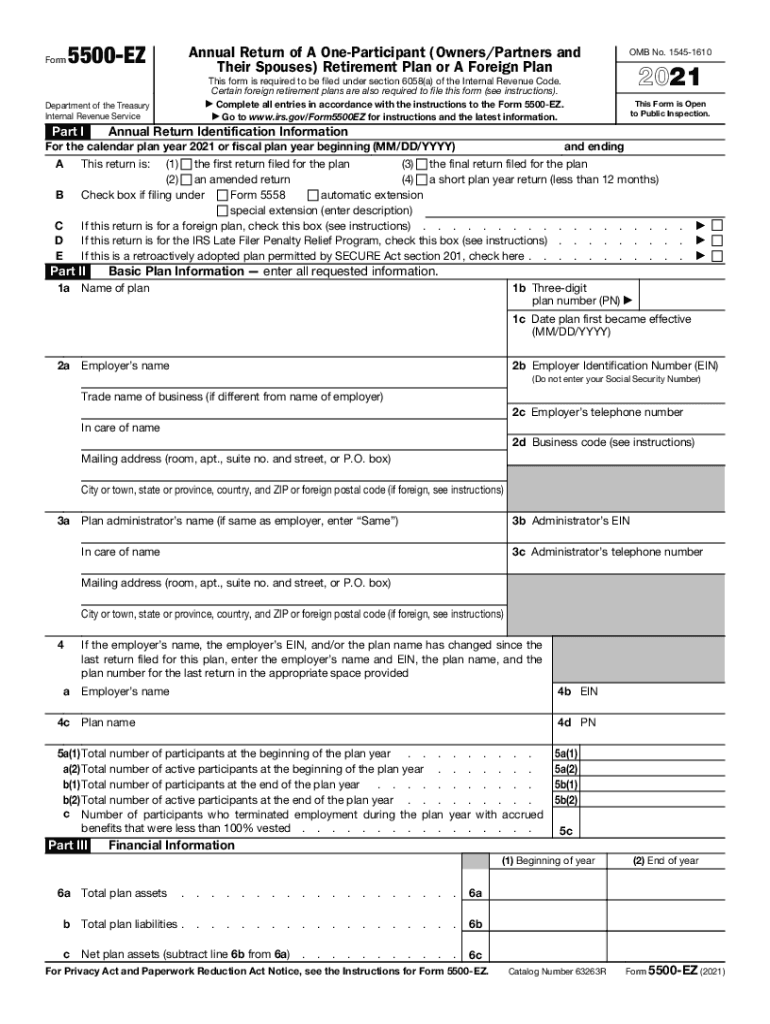
The Form 5500-EZ is a tax document required by the IRS for the annual return of a one-participant retirement plan or a foreign plan under section 6058(a) of the Internal Revenue Code. This form is essential for collecting specific data about the plan, including details about participant statistics, financial performance, and compliance. It is primarily used by sole proprietors or businesses with no common-law employees other than the owner(s) or their spouse(s).
Eligibility Criteria
To file the Form 5500-EZ, a retirement plan must meet specific eligibility criteria:
- It must be a one-participant plan, containing either a sole proprietor, a business owner, or the only common-law employee.
- Foreign plans must also file if they elect certain criteria under the IRS directives.
- Other retirement plans, like those covering multiple employees, must file different versions of Form 5500.

How to Obtain the 5500-EZ
The 5500-EZ form can be obtained through several methods to accommodate varying preferences and accessibility needs:
- IRS Website: The form is available for download directly from the official IRS website.
- Tax Software: Many tax preparation software platforms integrate this form, simplifying the filing process for users managing their taxes digitally.
- Tax Consultants: Qualified tax professionals can provide the form and offer assistance in completing it accurately, leveraging their access to forms and up-to-date regulatory knowledge.
Steps to Complete the 5500-EZ
Completing the 5500-EZ involves a structured approach to ensure compliance:
- Gather Information: Collect details about the plan, such as financial data, plan number, and participant statistics.
- Identify Sections: Navigate through key sections, including Identifying Information, Financial Information, and Plan Characteristics.
- Complete All Required Fields: Ensure that all mandatory fields are filled in accordance with IRS instructions.
- Review and Confirm: Verify all entries for accuracy before submission to preclude errors that could result in filing delays.
Filing Deadlines & Important Dates
Timely filing of Form 5500-EZ is crucial to avoid penalties. For calendar year plans, the due date is generally the last day of the seventh month after the plan year ends, typically July 31. Extensions may be requested via IRS Form 5558 if additional time is necessary. Being aware of this timeline can prevent late submissions and the associated fines.
Form Submission Methods
The Form 5500-EZ offers multiple submission methods, catering to different filer preferences:
- Paper Filing: Traditional method involving mail-in submission.
- Online Filing: Filers can utilize the IRS EFAST2 system for electronic submission, which is often quicker and more easily tracked than mailing.
Penalties for Non-Compliance
Failing to file the Form 5500-EZ timely can lead to penalties. The IRS imposes fines that can accumulate per day of delinquency. Additionally, non-compliance could trigger audits, adding complexity and expense to your tax situation. Understanding these consequences underscores the importance of timely and accurate filing.
Key Elements of the 5500-EZ
The 5500-EZ form consists of critical components, each providing vital information about the retirement plan:
- Identifying Information: Includes the plan name, number, and sponsor details.
- Financial Data: Encompasses contributions, distributions, and asset values.
- Compliance Questions: Ensures the plan meets all regulatory requirements and standards.
IRS Guidelines
The IRS provides comprehensive guidelines for completing the 5500-EZ, detailing each section's requirements and offering instructions on adhering to procedural and legislative standards. These guidelines support filers in meeting compliance obligations effectively and reducing errors.
Examples of Using the 5500-EZ
For instance, a sole proprietor with a retirement plan for themselves and their spouse would use the Form 5500-EZ to report the plan’s financial activities annually. Similarly, if a U.S. citizen establishes a foreign retirement plan under permissive IRS conditions, they may also need this form to fulfill federal reporting requirements. Each example highlights the form's application in real-world scenarios involving diverse taxpayer situations.




