Definition & Meaning
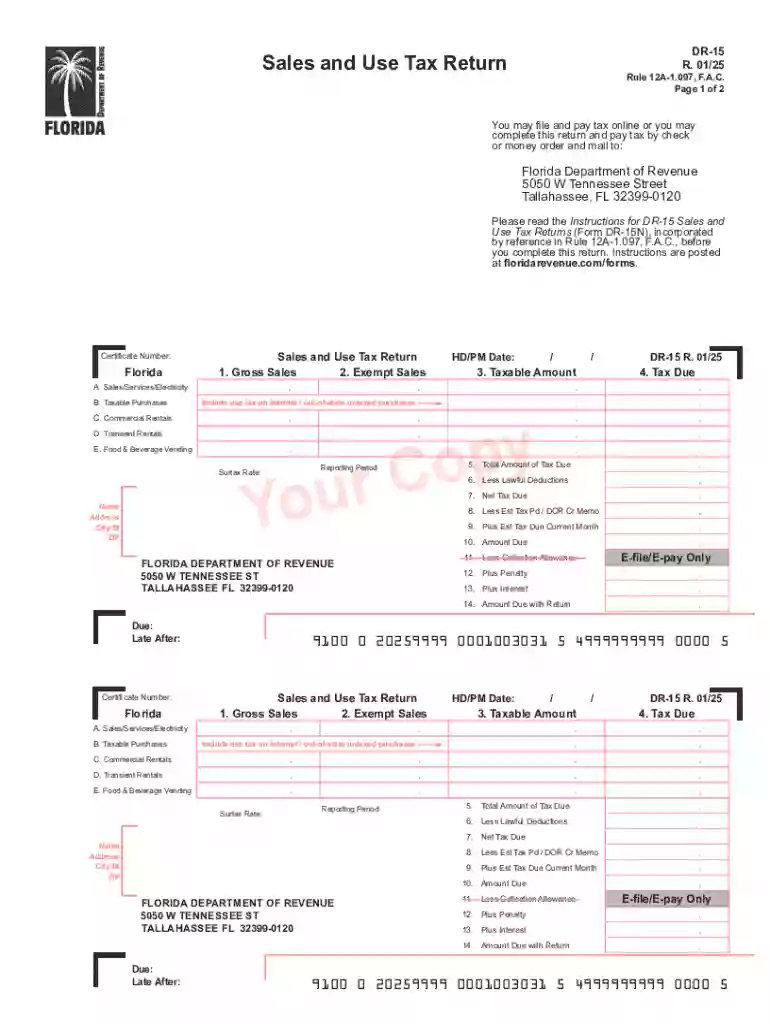
The DR-15 form is the Sales and Use Tax Return form used in the state of Florida. It serves as the primary documentation for businesses to report and pay sales tax on goods and services sold. The form enables businesses to calculate the tax due on their sales, allowing the Florida Department of Revenue to collect appropriate tax revenue.
How to Use the DR-15
- Gather Necessary Information: Collect all relevant sales data, including gross sales figures, taxable sales, and any exemptions or deductions.
- Fill Out Required Sections: Complete the form with the appropriate details like taxpayer information, total sales for the reporting period, and the calculated tax due.
- Report Taxable Sales: Detail the total amount of sales subject to Florida sales tax.
- Calculate Tax: Use the provided instructions to determine the tax amount owed.
- Review and Submit: Ensure all information is accurate before filing, either online or by mail, to the Florida Department of Revenue.
Steps to Complete the DR-15
- Section A: Input your business identification information, including Federal Employer Identification Number (FEIN) or Social Security Number.
- Section B: Enter gross sales and taxable sales figures. Include any resale or exempt sale amounts.
- Section C: Calculate deductions and exemptions to determine net taxable sales.
- Section D: Use the provided tax rate to calculate tax due on taxable sales.
- Section E: Add any applicable local discretionary sales surtax.
- Section F: Subtract any collection allowance for timely filing, if applicable.
- Final Totals: Determine the total amount to be paid and ensure correct addition.
- Submission: Decide on the mode of submission – online for faster processing or by mail.
Important Terms Related to DR-15
- Gross Sales: Total sales before any deductions or exemptions are applied.
- Taxable Sales: Portion of gross sales that is subject to taxes.
- Exempt Sales: Sales that do not require sales tax due to specific exemptions.
- Discretionary Sales Surtax: Additional county-specific sales tax.
State-Specific Rules for the DR-15
- The DR-15 is used exclusively in Florida and adheres to state-specific tax laws.
- Businesses must comply with both state sales tax rates and any local discretionary surtaxes.
- The form includes detailed instructions on how to allocate sales tax for different counties within the state.
Filing Deadlines / Important Dates
- The DR-15 must be filed monthly, quarterly, or annually depending on the business's tax filing frequency as dictated by the Florida Department of Revenue.
- Filing deadlines are typically the 20th of each month following the reporting period.
- For monthly filers, the deadline for the January return is February 20th, while quarterly filers must submit their returns by the 20th following the end of each quarter.
Form Submission Methods
- Online: The Florida Department of Revenue provides an online portal for filing the DR-15, offering convenience and quicker processing.
- Mail: Physical forms can be mailed to the Department of Revenue; however, this method may result in longer processing times.
- In-person: Submission can also be made in person at a local Department of Revenue office.
Penalties for Non-Compliance
- Failure to file or pay sales tax on time can result in penalties and interest based on the overdue amount.
- Late submission can lead to fines, calculated as a percentage of the tax owed, compounded monthly.
- Businesses found in repeated non-compliance may face further legal action by the state of Florida.
Software Compatibility
- The DR-15 form is compatible with popular tax software like TurboTax and QuickBooks, which facilitate easy filing and management of sales tax returns.
- These platforms often provide automated updates on tax rates and compliance requirements, aiding in accuracy during filing.
- Integration with accounting tools helps businesses maintain accurate financial records and streamlines the filing process by auto-filling recurring data.