




01. Edit your nebraska tax form online
Type text, add images, blackout confidential details, add comments, highlights and more.

Type text, add images, blackout confidential details, add comments, highlights and more.

Draw your signature, type it, upload its image, or use your mobile device as a signature pad.

Send nebraska tax form printable via email, link, or fax. You can also download it, export it or print it out.
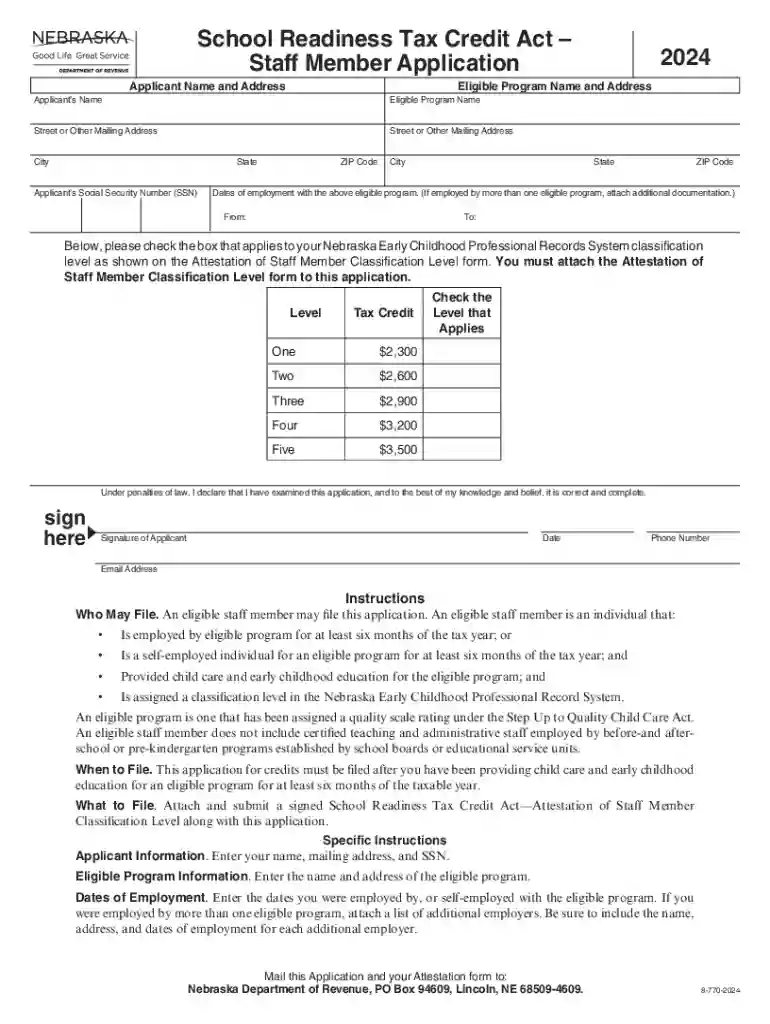
The "School Readiness Tax Credit Act Staff Member Application" is a document designed for staff members working in early childhood education programs in Nebraska. It serves as an application to receive tax credits offered by the state under the School Readiness Tax Credit Act. This form is crucial for educators seeking to benefit from state incentives aimed at improving the quality of education for young children. Tax credits associated with this application vary based on the applicant's classification level within the education system, thereby supporting different levels of professional advancement and responsibility.
Staff members eligible to complete the School Readiness Tax Credit Act Staff Member Application typically work within early childhood education programs. Eligibility is often contingent upon employment status, educational qualifications, and the fulfillment of specific program requirements designated by the Nebraska Department of Revenue. Applicants must provide accurate personal details, employment history, and demonstrate adherence to the educational or training standards set by the state. Ensuring eligibility is critical since incorrect or inadequate submissions could result in delays or denial of tax credit benefits.


Gather Necessary Information: Collect all relevant documents, such as proof of employment, identification, and educational qualifications. Ensure you have access to any prior tax information if it impacts your application.
Review Eligibility Requirements: Carefully review the eligibility criteria to verify you meet all requirements. Pay special attention to deadlines and required documentation that must be submitted alongside the application form.
Complete Application Sections: Fill out each section of the application thoroughly. This includes providing personal details, detailing employment history, and indicating your classification level. Mandatory fields should be given particular attention to avoid incomplete submissions.
Attach Supporting Documents: Ensure all required supporting documents are included, such as your employment verification letter and any professional certificates that establish eligibility for the specific tax credit.
Signature and Submission: Sign the completed form as required, following the instructions provided for electronic or physical submission to the Nebraska Department of Revenue. Verify all information for accuracy to prevent processing delays.
Applicants are required to submit various documents alongside the School Readiness Tax Credit Act Staff Member Application. These typically include:
These documents verify your eligibility and ensure the correct processing of the tax credit. Missing or incorrect documents can hinder the application process.
The application form can typically be obtained through:
Applicants can submit the form through several methods to suit different preferences:
Online Submission: This method is often preferred for its speed and convenience. It involves uploading the completed form and supporting documents directly through the Nebraska Department of Revenue's secure online portal.
Mailing: Physical copies of the application and documents can be mailed to the specified address of the Nebraska Department of Revenue. This option is beneficial for those more comfortable with traditional paper forms.
In-person: For those who prefer a hands-on approach, visiting a local government office or tax assistance center to submit the application in person might be an option.
Adhering to deadlines is crucial for the successful processing of the School Readiness Tax Credit Act Staff Member Application. The typical timeline includes:
Annual Application Period: Specific dates each year by when the completed form and all accompanying documents must be submitted.
Cut-off for Documentation: The last date to submit any additional required documents if initially overlooked or missing.
Creating and submitting this application involves adherence to various legal stipulations. Failure to comply with these can result in penalties or the rejection of the application. The submission must respect:
Applicants are advised to periodically check for any updates to legal requirements to ensure continued compliance.
Typical scenarios include:
Early Childhood Educators: A certified teacher within an early childhood program applies for credits based on their teaching classification and educational achievements.
Program Administrators: Administrative staff within qualifying establishments may also qualify, provided they meet the specific eligibility criteria laid out for non-teaching staff.
Tax credits can effectively reduce the tax burden for qualifying professionals, thereby acknowledging the essential role educators play in the state's educational objectives.
Understanding the fundamental components of the form will aid in efficiently guiding applicants through its completion:
We've got more versions of the nebraska tax form form. Select the right nebraska tax form version from the list and start editing it straight away!
At DocHub, your data security is our priority. We follow HIPAA, SOC2, GDPR, and other standards, so you can work on your documents with confidence.


Applicants that elect in an Application to provide specific amenity and quality features in every Unit at no extra charge to the tenant will be awarded pointsRead more
eDASH Update: Application submission for the School Readiness Tax Credit Act Staff Member Application, Form SR-3605, is currently closed.Read more


