




01. Edit your form 4684 online
Type text, add images, blackout confidential details, add comments, highlights and more.

Type text, add images, blackout confidential details, add comments, highlights and more.

Draw your signature, type it, upload its image, or use your mobile device as a signature pad.

Send irs form 4684 via email, link, or fax. You can also download it, export it or print it out.
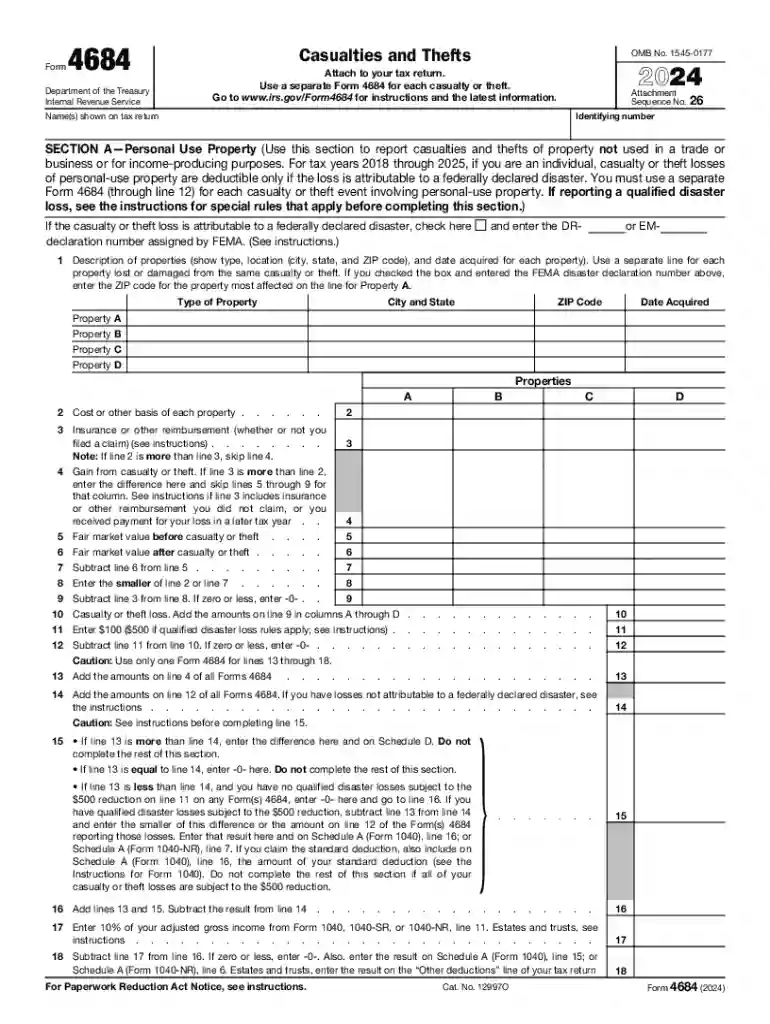
Form 4684, also known as "Casualties and Thefts," is a tax document utilized by individuals to report losses incurred from casualties and thefts of both personal use property and business or income-producing property. It is an essential tool for taxpayers seeking to claim deductions related to these types of losses, providing a structured approach to detailing properties affected and calculating the resultant financial loss or gain.
Casualty Losses: This refers to the damage, destruction, or loss of property due to sudden, unexpected, or unusual events such as natural disasters (e.g., hurricanes, earthquakes).
Theft Losses: These are instances where property is taken with the intent to deprive the owner of it permanently, such as burglary or similar crimes.
Form 4684 guides taxpayers through the calculation of these losses, especially following federally declared disasters, enabling them to make informed elections regarding their disaster loss deductions.
Successfully completing Form 4684 involves a detailed process that ensures accurate reporting and maximization of potential deductions. Below is a step-by-step approach:
Gather Documentation: Collect evidence of the casualty or theft, such as photographs, police reports, insurance claims, and other relevant documents.
Section A – Personal Use Property: Enter details of the damaged or stolen property, including the type, location, cause of the loss, and any insurance reimbursements.
Section B – Business Use Property: Provide information on business or income-producing property affected, including adjusted basis, fair market values before and after, and any recovery amounts.
Calculate Losses: Utilize the guidelines to determine the value lost. This involves computing adjusted basis, fair market values, and any deductible amount after insurance reimbursements.
Review IRS Publications: Refer to IRS publications like Publication 547, which provides a comprehensive guide on casualty, disaster, and theft losses.
This detailed procedure allows taxpayers to ensure that all relevant details are accurately captured and reported.
Acquiring Form 4684 is straightforward and can be achieved through several methods that align with modern digital conveniences and traditional practices:
Download from IRS Website: The IRS website offers downloadable PDF versions of Form 4684, allowing for easy access and printing.
Request by Mail: Taxpayers can request a paper version of the form directly from the IRS to be sent by mail.
Tax Preparation Software: Systems like TurboTax and TaxSlayer often include access to necessary tax forms, including Form 4684, as part of their package offerings.
Physical Locations: Many public libraries and post offices stock tax forms during filing season.
These diverse methods ensure that taxpayers can choose a retrieval option that aligns with their preferences.
Understanding who typically uses Form 4684 is crucial for taxpayers evaluating its relevance to their specific situations:
Individuals with Personal Property Claims: Typically, homeowners or renters affected by natural disasters or criminal activity.
Business Owners: Entities experiencing losses to business or income-producing assets.
Self-Employed Individuals: Those with business assets impacted by theft or casualty.
Investors: Individuals reporting losses related to investment properties or Ponzi-type investment schemes.
Knowing the categories of people who frequently rely on this form helps in understanding its applications and preparing for potential scenarios.
Form 4684 is structured to capture comprehensive details regarding losses and deductions. Key elements include:
Adjusted Basis: The original value of the asset adjusted for improvements or depreciation.
Fair Market Value: Assessed before and after the casualty or theft incident, crucial for calculating loss.
Insurance Reimbursement: Any claims received from insurance affecting total deductible amounts.
Disaster Loss Election: Opt to claim losses for a disaster in the previous tax year, warranting consultation with IRS guidelines.
Each of these elements is integral to filing and calculating financial impact accurately.
The legal use of Form 4684 involves strict adherence to IRS policies and understanding its implications on a tax return:
Compliance: Necessary when claiming deductions for losses to ensure all legal obligations are met.
Documentation: Essential for substantiating claims—lack of supporting evidence can result in denial of deduction eligibility.
Penalties: Non-compliance or fraudulent claims may lead to audits, penalties, or legal challenges.
Understanding the legal framework helps ensure that claims are legitimate and appropriately documented, securing rightful deductions.
Eligibility Criteria: Detailed in IRS publications, eligibility is often aligned with insurance coverage status and the nature of the event.
Documentation: A comprehensive record of the event and associated losses is required for validation.
Consult IRS Publications: Such as Publication 547 for detailed guidelines and examples regarding form completion and claim substantiation.
These guidelines lay the groundwork for maintaining compliance and maximizing legitimate taxpayer benefits.
Assembling requisite documents is critical for successful Form 4684 submission:
Property Valuation Evidence: Appraisals, purchase receipts, or market value assessments.
Insurance Documents: Statements confirming payouts or denial details.
Photographic Evidence: Visual proof of pre- and post-incident conditions.
Police Reports: If relevant to theft claims.
Ensuring all necessary documents are collected streamlines the process and supports claim legitimacy.
We've got more versions of the form 4684 form. Select the right form 4684 version from the list and start editing it straight away!
| Versions | Form popularity | Fillable & printable |
|---|---|---|
| 2025 | 4.3 Satisfied (47 Votes) | |
| 2024 | 4.5 Satisfied (24 Votes) | |
| 2023 | 4.7 Satisfied (38 Votes) | |
| 2022 | 4.6 Satisfied (32 Votes) | |
| 2021 | 4.8 Satisfied (133 Votes) | |
| 2020 | 4.4 Satisfied (190 Votes) | |
| 2019 | 4.1 Satisfied (33 Votes) | |
| 2018 | 4.2 Satisfied (106 Votes) | |
| 2017 | 4.3 Satisfied (250 Votes) | |
| 2016 | 4.3 Satisfied (175 Votes) | |
| 2015 | 4.3 Satisfied (54 Votes) | |
| 2011 | 4.3 Satisfied (199 Votes) | |
| 2010 | 4 Satisfied (60 Votes) |
At DocHub, your data security is our priority. We follow HIPAA, SOC2, GDPR, and other standards, so you can work on your documents with confidence.




Use Form 4684 to report gains and losses from casualties and thefts. You may deduct losses from fire, storm, shipwreck, or other casualty, or theft
Oct 24, 2024 Use Form 4684 to report gains and losses from casualties and thefts. Use a separate Form 4684 through line 12 for each casualty or theft.Read more


