




Definition & Purpose of Form 1099-INT
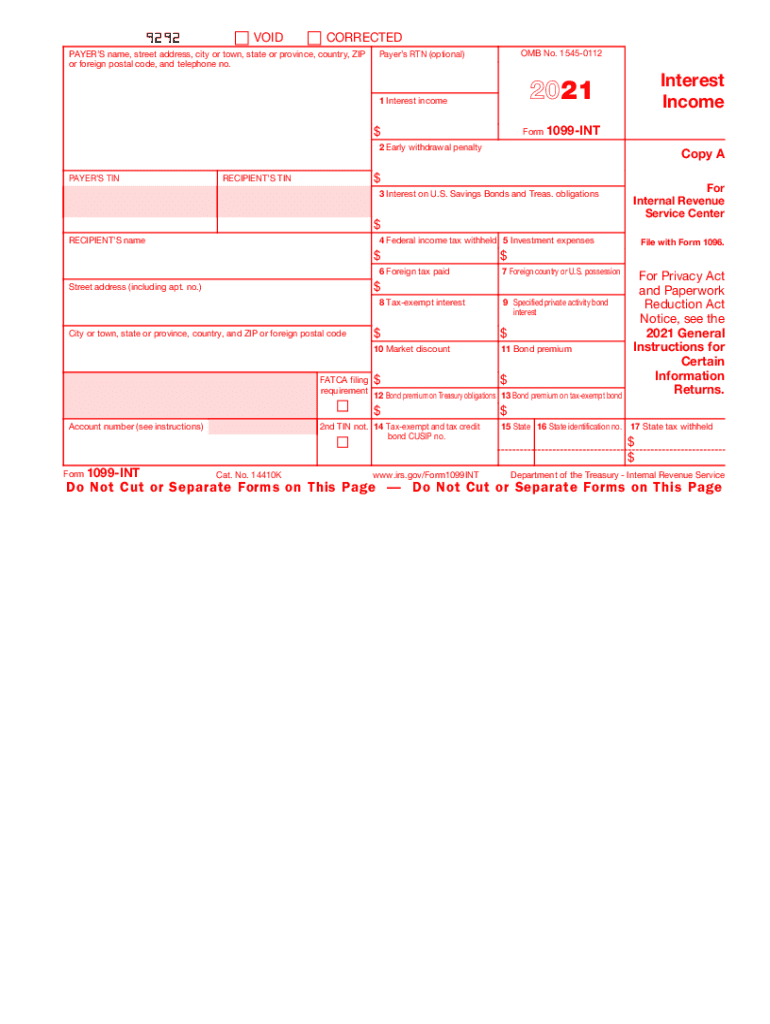
The Form 1099-INT is a tax document issued by financial institutions to taxpayers, reporting the total amount of interest income earned. This form is critical for accurately filing income taxes, as it informs the Internal Revenue Service (IRS) of all interest income sources. Primarily, the 1099-INT captures interest accumulated from various accounts, such as savings, CDs, or other investments. The recipients are usually required to include the interest shown on a 1099-INT on their federal tax returns. This ensures transparency between individuals and the IRS, maintaining compliance with tax regulations.
How to Use Form 2-INT
To effectively use Form 2-INT, you need to incorporate the reported interest into your income tax return. Here's a step-by-step guide:
-
Review the Form: Upon receipt, examine the details such as the interest amount and the payer’s information. Ensure these align with your known financial activity.
-
Report Interest Income: On your federal tax return, typically filed using Form 1040, include the interest amounts specified on each 1099-INT. Accurately entering these figures ensures that you comply with tax regulations.
-
Verify Tax Withheld: If any federal or state taxes were withheld, this information must be accurately reflected on your tax return.
-
File with Your Return: Always attach or electronically submit the 1099-INT alongside your tax documentation to provide comprehensive financial details.
Steps to Complete the 2-INT Form
Financial institutions primarily fill out Form 1099-INT before distributing it to taxpayers. However, if you ever need to issue this form, follow these steps:
-
Payer Identification: Provide the payer's name, address, and tax identification number (TIN).
-
Recipient Details: Enter the recipient's name, address, and TIN. Accuracy in this section is crucial to ensure proper tax reporting.
-
Interest Income: List the total interest paid to the recipient during the tax year in Box 1. This includes interest from savings accounts, certificates of deposit, and other investments.
-
Other Boxes: Complete additional sections as necessary, such as tax-exempt interest or foreign tax paid.
-
Distribute Forms: Send Copy A of the form to the IRS, while Copy B goes to the recipient. Ensure the forms are distributed by the specified deadline.
Who Typically Uses the 2-INT
Form 1099-INT is commonly used by both financial institutions and individuals. Institutions, such as banks and mutual funds, issue this form to account holders who earn over $10 in interest in a year. On the taxpayer side, individuals receiving interest income use this form to report their earnings to the IRS. Additionally, self-employed individuals, retirees, and students who have interest-generating accounts are typical recipients. The diversity of users signifies the form's broad relevance across various financial situations.


Filing Deadlines and Important Dates
Adhering to filing deadlines for Form 1099-INT is crucial for avoiding penalties. Generally, financial institutions must furnish the 1099-INT to recipients by January 31 of the year following the tax year in question. Moreover, they must also file Copy A with the IRS by February 28 if submitted on paper, or by March 31 if filing electronically. For individuals, the information from this form should be incorporated into their annual tax return by the April deadline for federal income tax filing. Precise timing ensures compliance and prevents legal or financial repercussions.
Penalties for Non-Compliance
Failure to submit or inaccurately reporting on Form 1099-INT can lead to significant penalties. Financial institutions may face penalties starting at $50 per form for missing deadlines, which increase the later the form is filed. Incorrect information, such as wrong TINs, can also incur fines. For individuals, neglecting to report interest income from a 1099-INT on their federal tax return can lead to additional taxes and interest on unpaid amounts. Therefore, compliance is not only a legal obligation but a financial prudence.
IRS Guidelines and Requirements
The IRS provides specific guidelines regarding the handling of Form 1099-INT to ensure the accurate reporting of interest income. Key requirements include:
-
Tax Identification Numbers (TIN): Both payer and recipient must provide valid TINs.
-
Electronic Filing Mandate: Financial institutions filing 250 or more 1099-INT forms must do so electronically.
-
Corrected Forms: The IRS requires submission of corrected forms if errors are identified post-submission.
Abiding by IRS standards helps mitigate errors and ensures smooth tax processing for all parties involved.
Digital vs. Paper Versions of Form 1099-INT
Both digital and paper versions of the 2-INT form are available, each offering different advantages:
-
Digital Version: Allows for streamlined, electronic submission and faster processing. It's particularly useful for entities dealing with large volumes.
-
Paper Version: Suitable for those who prefer traditional filing methods, though it may involve longer processing times and higher mailing costs.
Each option has its place depending on the size and infrastructure of the issuing entity, as well as personal preferences concerning data handling and filing methods.