
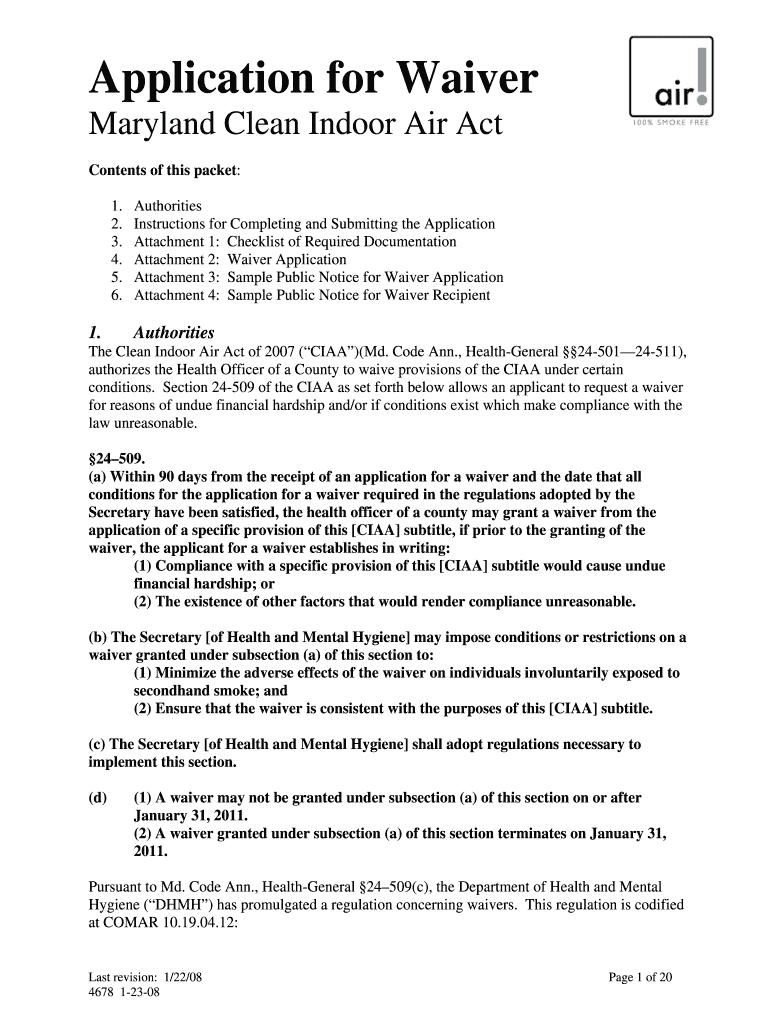







Definition & Meaning
The "Application for Waiver - IDEHA - ideha dhmh maryland" is a form used to request an exemption under the Maryland Clean Indoor Air Act (CIAA). This waiver allows organizations to apply for exceptions to standard compliance regulations due to specific circumstances such as financial hardship or impracticality of immediate compliance. The Maryland Department of Health and Mental Hygiene (DHMH) is responsible for processing these applications, ensuring that public health considerations are balanced with the applicant's needs.
How to Use the Application for Waiver - IDEHA - ideha dhmh maryland
To effectively use this application form, applicants must first assess their eligibility based on the criteria set by the Maryland Clean Indoor Air Act. The form involves providing detailed information about the reasons for seeking a waiver, demonstrating eligibility through documentation, and illustrating how the waiver will not negatively impact public health standards. This comprehensive understanding ensures that applicants can accurately complete and submit their requests.
Steps to Complete the Application for Waiver - IDEHA - ideha dhmh maryland
-
Determine Eligibility: Review the conditions that may justify a waiver, such as financial hardship or specific operational challenges.
-
Gather Required Documents: Collect necessary documents, including financial statements, operational descriptions, and any previous compliance attempts.
-
Complete the Form: Fill in sections detailing the nature of your business, the specific waiver requested, and your justification with supporting evidence.
-
Review and Confirm: Double-check all information for accuracy and completeness to avoid delays in processing.
-
Submit the Application: Send the completed form and documents to the Maryland Department of Health and Mental Hygiene through the specified method.
-
Follow Up: Contact the department to confirm receipt and inquire about the application status if no response is received within the expected timeframe.
Eligibility Criteria
Applicants must meet specific criteria to qualify for a waiver under the CIAA. These criteria often involve demonstrating that compliance with the current regulations imposes an undue burden or that unique circumstances justify an exemption. Documentation supporting claims of financial or operational hardship must be comprehensive and include quantifiable evidence.


Required Documents
The application requires several important documents:
- Detailed financial records demonstrating hardship
- A comprehensive statement addressing why the waiver is necessary
- Previous attempts and plans for compliance
- Any additional evidence supporting special circumstances
Each piece of documentation must be current and relevant to the claims made within the application.
Legal Use of the Application for Waiver - IDEHA - ideha dhmh maryland
Applying for a waiver under the IDEHA must adhere strictly to state laws and regulations. Any misuse, such as providing false information or misleading documentation, can lead to penalties, including fines or legal action. Applicants should be aware that waiver approval is subject to the state's evaluation of public health implications.
Key Elements of the Application for Waiver - IDEHA - ideha dhmh maryland
- Applicant Information: Basic details including name, contact information, and business type.
- Waiver Request Description: A clear outline of the waiver being sought and justification.
- Impact Analysis: Explanation of the potential impact of non-compliance on the applicant.
- Supporting Evidence: Comprehensive documentation to substantiate the waiver request.
These elements ensure that the application is both comprehensive and compliant with legal standards.
Form Submission Methods (Online / Mail / In-Person)
- Online: Many applicants choose to submit their forms electronically through the IDEHA online system for convenience.
- Mail: Submissions via postal mail must be sent to the address provided on the form instructions.
- In-Person: If preferred, applicants can hand-deliver their forms to the designated office.
Each submission method has its own processing times, which applicants should consider when timing their applications.
Penalties for Non-Compliance
Non-compliance with the stipulations of the Maryland Clean Indoor Air Act, either through failing to apply for necessary waivers or misusing the application process, may result in penalties. Such sanctions can include fines, operational restrictions, or other legal actions imposed by the state. Understanding these penalties is crucial for any applicant seeking a waiver to ensure full compliance with legal requirements.




