
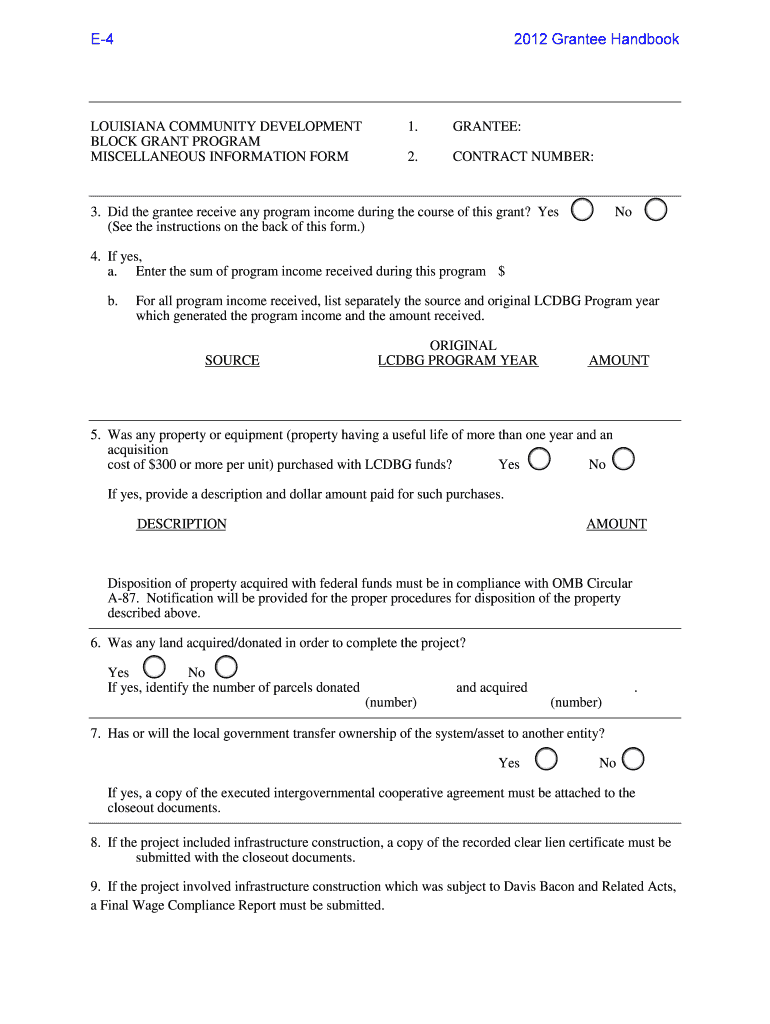







Definition & Purpose of the E-4: Miscellaneous Information Form - Louisiana
The E-4: Miscellaneous Information Form - Louisiana is an essential document used within the framework of the Louisiana Community Development Block Grant (LCDBG) Program, specifically included in the 2012 Grantee Handbook. Its purpose is to collect and organize various types of information related to grantee responsibilities. This can include details on program income, property transactions, land acquisition, and compliance with federal regulations. The information gathered through this form ensures grantees adhere to required standards and regulations in the course of undertaking infrastructure projects and related activities.
Key Areas Addressed by the Form
- Program Income: Captures details about income generated through the grant program to determine if the funds are being used appropriately.
- Property and Equipment Purchases: Ensures all purchases are documented and align with program guidelines.
- Land Acquisition Requirements: Records any land acquisition actions to verify they comply with legal and federal requirements.
- Ownership Transfer of Assets: Facilitates monitoring of asset transferal, ensuring all procedures meet compliance standards.
How to Obtain the E-4: Miscellaneous Information Form - Louisiana
The E-4 form can be accessed through several avenues, dependent on your role within the program. Generally, it can be sourced from the administrative offices involved in managing the Louisiana CDBG Program. For digital access, reaching out to the official program's website or contacting the relevant state department is recommended.
Detailed Steps for Acquisition
- Visit the Louisiana CDBG Program website. Check for downloadable resources or contact links.
- Interact with Local Authorities. Direct queries to local government officials or administrative contacts.
- Request from Program Coordinators. Utilize contact information available in LCDBG Program documentation to request the form.
Steps to Complete the E-4: Miscellaneous Information Form - Louisiana
Completing the E-4 form requires attention to detail in ensuring all provided information accurately reflects program activities. Each section of the form corresponds to a different aspect of program management, necessitating thorough completion.
Step-by-Step Instructions
- Review the Form Requirements: Understand what information each section requires.
- Gather Necessary Data: Collect data involving program income, property transactions, and compliance records.
- Fill in Details Accurately: Use clear, precise language in each form field.
- Validate Information: Double-check entries before submission to ensure compliance.
- Prepare Supporting Documents: Attach required documentation to verify the information provided within the form.
- Submit Following Guidelines: Ensure submission method (online, mail, or in person) aligns with program settings.
Why You Should Use the E-4: Miscellaneous Information Form - Louisiana
The E-4 form is vital for managing compliance and ensuring transparency in the utilization of community development funds. It helps grantees maintain organized records and facilitates smooth audits and evaluations of projects.
Benefits of Using the Form
- Ensures Legal Compliance: Keeps project activities aligned with federal and state requirements.
- Enhances Transparency: Allows for clear tracking of funds and assets.
- Facilitates Audit Processes: Provides organized data for external reviews.
- Promotes Accountability: Holds grantees responsible for accurate reporting.
Key Elements of the E-4: Miscellaneous Information Form - Louisiana
Comprising several critical sections, the E-4 form demands a comprehensive understanding of each element. These elements are integral in ensuring the form fulfills its purpose across multiple project management aspects.
Detailed Examination of Elements
- Income Reporting Fields: Focused on capturing data related to funds generated during the program.
- Property Acquisition Sections: Include fields for recording all property-related transactions.
- Compliance Verification: Requests documentation that proves adherence to regulations.
- Asset Transfer Information: Requires logging of all asset movements.
State-Specific Rules for the E-4: Miscellaneous Information Form - Louisiana
Understanding Louisiana's unique state requirements is crucial for completing the E-4 form effectively. These rules frame the procedures and information demands of the form.
Louisiana-Specific Requirements
- Regulatory Compliance: Aligns with specific state laws related to infrastructure projects.
- Tax Obligations: Details pertinent to state tax laws affecting grant usage.
- Land Use Policies: Includes considerations for local zoning and land use regulations.
Examples of Using the E-4: Miscellaneous Information Form - Louisiana
Practical examples provide clarity on how the E-4 form is filled out in real-world scenarios, depicting common issues and their resolutions.
Case Study Illustrations
- Urban Development Initiative: Use in documenting income from a city revitalization project.
- Infrastructure Upgrade Project: Demonstrates tracking of asset purchases and compliance documentation.
- Rural Land Acquisition: Example of how land purchase logistics are managed using the form.
Required Documents for the E-4 Form Submission
To complete the E-4 form submission process, certain documents are required. These are necessary for substantiating the information recorded on the form and ensuring all activities are well-documented and compliant.
List of Necessary Documents
- Financial Statements: Proof of income and expenditure related to the program.
- Property Deeds: Documentation of any land transaction records.
- Compliance Certificates: Verification of adherence to federal and state regulations.
- Project Reports: Detailed descriptions of funded projects and activities conducted.
By selecting and detailing these blocks, the content provides comprehensive coverage of the E-4: Miscellaneous Information Form - Louisiana, offering clear guidance on its purpose, acquisition, and completion within the regulatory framework.




