





Definition and Meaning
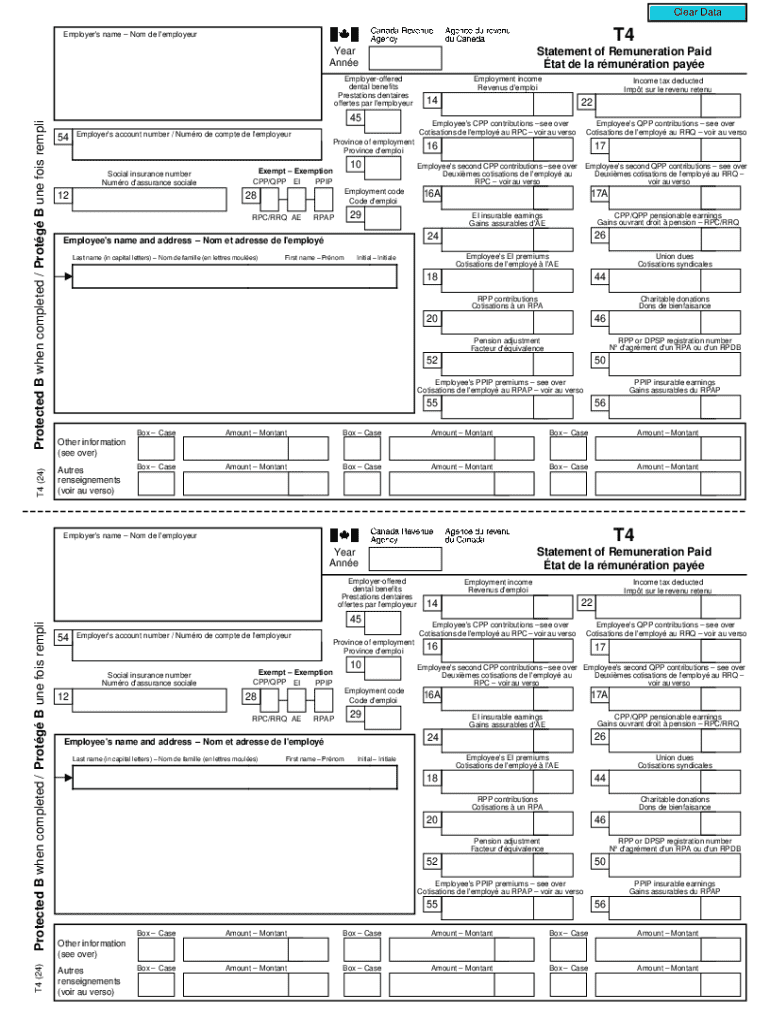
The T4 Statement of Remuneration Paid is an official tax document in Canada that employers use to report the total annual remuneration paid to an employee. This slip includes information about income tax deductions, contributions to the Canada Pension Plan (CPP) or Quebec Pension Plan (QPP), as well as Employment Insurance (EI) premiums. The primary purpose of the T4 slip is to assist employees in accurately reporting their income and deductions when filing their tax returns. This form is comparable to the W-2 form used in the United States for tax reporting.
Key Elements of the T4 Statement of Remuneration Paid
The T4 slip contains several key components that employees must understand:
- Employer Information: Includes the employer's business name and address.
- Employee Details: Features the employee's name and social insurance number (SIN).
- Income Details: Shows the total employment income before deductions.
- Tax Deductions: Lists the income tax, CPP/QPP contributions, and EI premiums deducted.
- Other Information: May include union dues, charitable donations, and taxable benefits.
Each of these elements plays a crucial role in accurately reflecting the employee's financial situation for the tax year.
How to Use the T4 Statement of Remuneration Paid
Employees use the T4 slip primarily for filing their annual tax returns. The information contained within the T4 guides the calculation of total taxable income and helps determine whether additional taxes are owed or if a refund is due. Here are the essential steps:
- Obtain the T4 Slip: Ensure that the employer has provided the T4 slip by the end of February of the following tax year.
- Review Contents: Check all the details on the slip for accuracy, including personal and income information.
- Utilize for Tax Filing: Use the T4 information to complete the income section of the Canadian income tax return.
- Retain for Records: Keep a copy of the T4 for future reference in case of audits or discrepancies.
Steps to Complete the T4 Statement of Remuneration Paid
While employers complete the T4, understanding this process enhances the employee's capacity for verification and accuracy in personal records. Here's a simplified breakdown:
- Gather Employee Data: Collect accurate personal details of each employee, ensuring the SIN is correct.
- Calculate Earnings and Deductions: Summarize the annual income paid and deductions made throughout the year.
- Fill Out the T4 Slip: Enter all relevant information into the correct fields on the form.
- Distribute to Employees: Provide copies to employees by the end of February.
- Submit to the CRA: Send electronic or paper versions to the Canada Revenue Agency (CRA) by the end of February.
Obtaining the T4 Statement of Remuneration Paid
Employees generally acquire their T4 slip directly from their employer. However, in certain situations, additional steps may be needed:
- Direct Request: If not received by the end of February, request the T4 directly from the employer.
- Access on Employer Portal: Some companies allow access to T4 slips through their online portals.
- Reach Out to CRA: In case of discrepancies or non-receipt, contact the CRA for further assistance.
Who Issues the T4 Form
The responsibility for issuing the T4 slip falls on employers who have had employees during the fiscal year. Whether the business is a sole proprietorship or a large corporation, all employers must prepare and distribute the T4 statements to their employees and submit them to the CRA by the specified deadline.
Filing Deadlines and Important Dates
Adhering to deadlines is crucial for both employers and employees:
- End of February: Employers must provide T4 slips to employees by the last day of February.
- Tax Filing Deadline: Canadian tax returns, utilizing the T4 slip, must be filed by April 30.
- Late Filing Consequences: Missing these deadlines can result in penalties, with potential interest charges on late payments.
Legal Use of the T4 Statement
A completed T4 slip holds significant legal weight. It confirms the amounts reported to the CRA and the employee's compliance with tax laws. Any errors or omissions can lead to audits, reassessments, and potential legal implications. Employers are legally obliged to ensure the accuracy and timely distribution of these documents.
Digital vs. Paper Version of T4
In recent years, digital distribution of T4 slips has become more common due to convenience and efficiency. Differences include:
- Digital T4: Accessible through secure company portals or via email, reducing paper use and speeding up access.
- Paper T4: Traditional method, still necessary for those without access to digital means.
Both forms carry equal legal validity, provided they are compliant with CRA regulations.