




01. Edit your form online
Type text, add images, blackout confidential details, add comments, highlights and more.

Type text, add images, blackout confidential details, add comments, highlights and more.

Draw your signature, type it, upload its image, or use your mobile device as a signature pad.

Send it via email, link, or fax. You can also download it, export it or print it out.
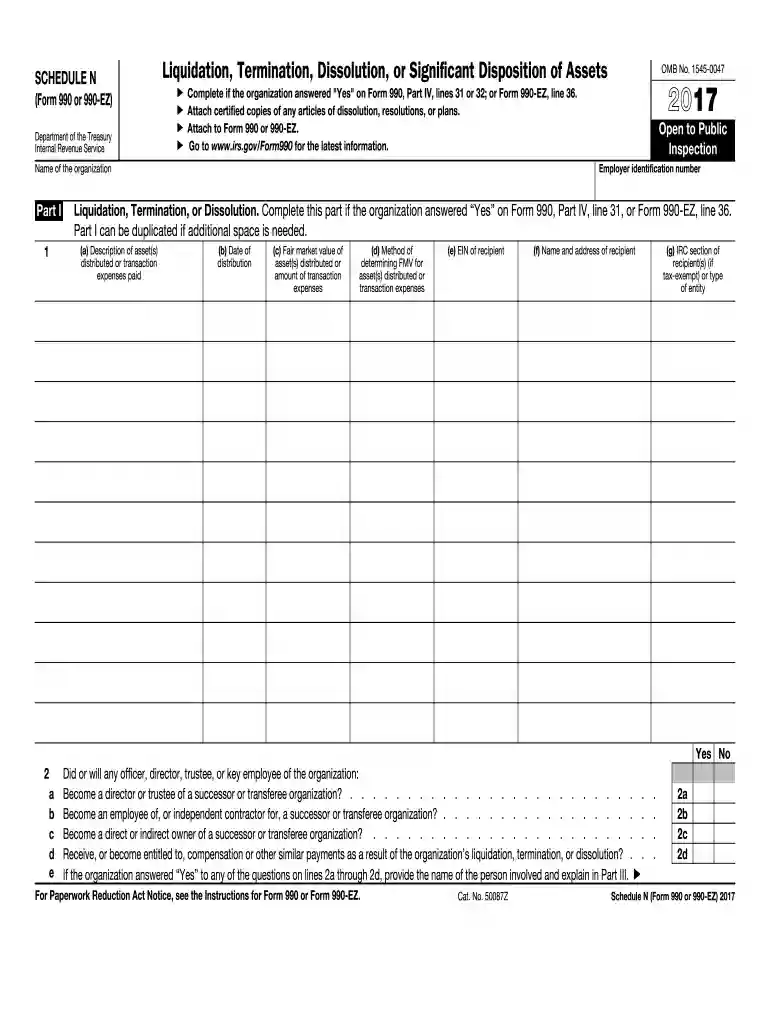
Schedule N is a critical IRS form for organizations undergoing liquidation, termination, dissolution, or significant asset disposition. This document records the closure activities of these entities, ensuring transparency and compliance with federal tax obligations. It captures details about distributed assets, including their fair market value, and helps in documenting the organization’s adherence to legal requirements.
Nonprofit organizations use Schedule N when engaging in structural changes like dissolution or asset disposition. This includes charities, educational institutions, and other tax-exempt entities under IRS scrutiny. Completing this form ensures these organizations report their end-of-life or substantial changes comprehensively, fulfilling legal transparency and accountability.


This form includes sections for:
Schedule N must be filed alongside Form 990 or 990-EZ, typically due on the 15th day of the 5th month after the end of the organization’s accounting period. Late submissions may incur penalties, making timely filing critical.
The IRS provides detailed instructions for completing Schedule N, emphasizing the importance of accuracy and completeness. Organizations should consult these guidelines to ensure compliance and avoid errors which could lead to penalties.
Failure to file Schedule N, or inaccuracies in the form, can result in penalties ranging from financial fines to the risk of losing tax-exempt status. Organizations must ensure that they meet all reporting obligations to maintain credibility and legal compliance.
Organizations need comprehensive documentation, including:
Schedule N can be filed with the IRS via mail, alongside Form 990 or 990-EZ. Some organizations may also submit electronically if such facilities are available for them, facilitating a more streamlined process.
Schedule N must be used strictly for reporting purposes to the IRS. Any misuse or misrepresentation can lead to significant legal implications and affect an organization’s legal standing and operations.
Tax preparation software like TurboTax and QuickBooks may support Schedule N, allowing for easier completion and filing. It's crucial to ensure that such tools are updated to reflect IRS regulations for the 2017 tax year.
Organizations must disclose all relevant information regarding asset disposition and organizational changes comprehensively, to meet IRS transparency and accountability standards.
We've got more versions of the 2017 Schedule N (Form 990 or 990-EZ ) Liquidation, Termination, Dissolution, or Significant Disposit form. Select the right 2017 Schedule N (Form 990 or 990-EZ ) Liquidation, Termination, Dissolution, or Significant Disposit version from the list and start editing it straight away!
| Versions | Form popularity | Fillable & printable |
|---|---|---|
| 2025 | 4.2 Satisfied (31 Votes) | |
| 2024 | 4.9 Satisfied (26 Votes) | |
| 2023 | 4.7 Satisfied (22 Votes) | |
| 2022 | 4.6 Satisfied (43 Votes) | |
| 2021 | 4.8 Satisfied (133 Votes) | |
| 2020 | 4 Satisfied (38 Votes) | |
| 2019 | 4.4 Satisfied (127 Votes) | |
| 2018 | 4.4 Satisfied (264 Votes) | |
| 2017 | 4.3 Satisfied (120 Votes) | |
| 2016 | 4.3 Satisfied (142 Votes) | |
| 2015 | 4.4 Satisfied (58 Votes) |
At DocHub, your data security is our priority. We follow HIPAA, SOC2, GDPR, and other standards, so you can work on your documents with confidence.



dissolution, termination, or DocHub disposition of net assets during the year? If Yes, complete applicable parts of Schedule N Schedule O (Form 990 or
Part I Liquidation, Termination, or Dissolution. Complete this part if the organization answered Yes on Form 990, Part IV, line 31, or Form 990-EZ, line 36.Read more


