01. Edit your 605c self attestation form online
Type text, add images, blackout confidential details, add comments, highlights and more.

Type text, add images, blackout confidential details, add comments, highlights and more.

Draw your signature, type it, upload its image, or use your mobile device as a signature pad.

Send 605c fcra via email, link, or fax. You can also download it, export it or print it out.
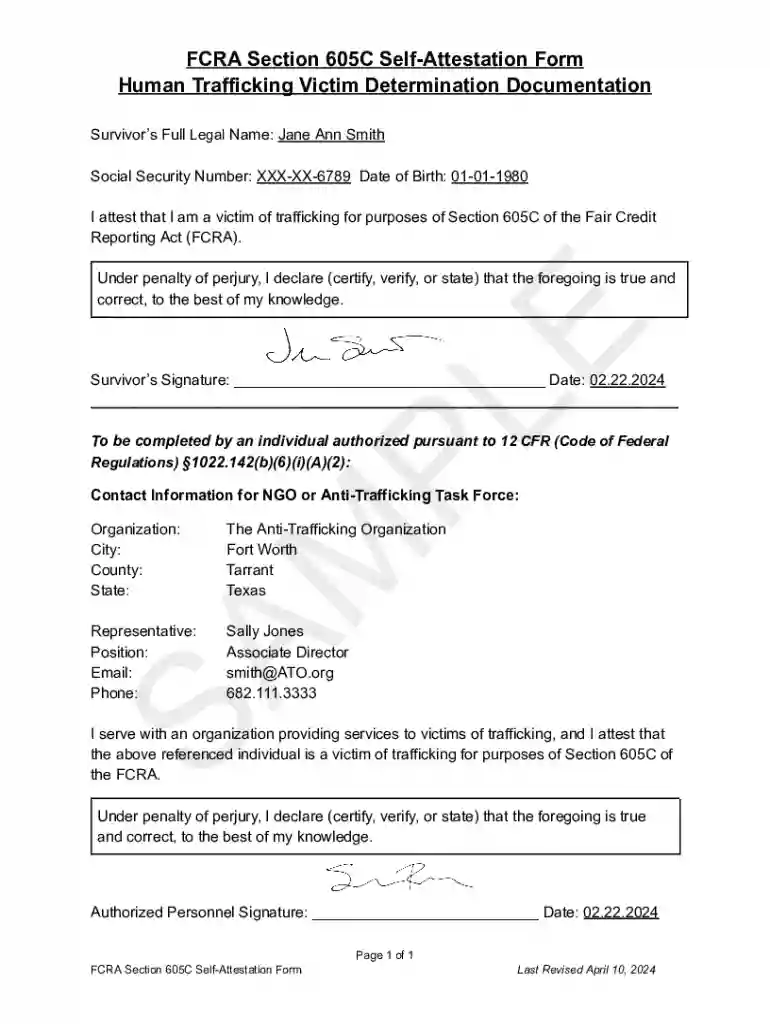
The SAMPLE FCRA Section 605C Self-Attestation Letter docx is a form aligned with the Fair Credit Reporting Act (FCRA) designed to assist individuals in affirming their status as victims of human trafficking. The letter serves a dual purpose: providing evidence of victimization and facilitating the individual's access to necessary support and rights under the FCRA. When completed, this document acts as a legal attestation, affirming the person's circumstances under penalty of perjury and requiring confirmation by an authorized representative from a recognized anti-trafficking organization.
The document comprises several essential components vital for its proper execution:
Personal Information Section: Here, the individual provides personal details, including full name, date of birth, and specific identifiers which help establish their identity.
Victim Declaration: This segment involves a sworn statement made by the individual, affirming their experience of human trafficking.
Authorized Verification: An advocate or representative from a certified anti-trafficking organization needs to verify the individual's claims, adding credibility to the form.
Signatures: Both the individual and the verifying representative must sign the document to attest to its accuracy and authenticity.
Utilizing the form requires meticulous attention to detail:
Fill Personal Details: Start by entering your full name, contact information, and any additional identifiers as requested.
Complete the Declaration: Clearly state your experience and circumstances, providing enough detail to substantiate your claim, while ensuring its accuracy and honesty.
Obtain Verification: Reach out to a reputable anti-trafficking organization to have a representative verify and sign off on your declaration.
Review and Sign: Carefully review the document for completeness and accuracy before signing. Ensure the representative's signature is also in place.
Obtaining the document can be straightforward with these methods:
Download from Official Portals: Some federal or anti-trafficking websites may offer direct download options for such forms.
Request from Advocacy Groups: Anti-trafficking organizations could have the form readily available for their clients or can assist in its preparation.
Contact Legal Advisors: Legal experts familiar with victims’ rights can provide this form and guide its completion.
The FCRA Section 605C Self-Attestation Letter offers legal leverage for trafficking survivors:
Consumer Reporting Protection: The completed document assists in disputing incorrect information on credit reports related to human trafficking experiences.
Access to Services: Serves as a formal declaration, potentially easing access to various support services burdened by legal processes.
Eligibility Requirements Adherence: Ensure all personal claims align with the FCRA's standards to uphold legal validity.
Completing the form entails a step-by-step process:
Personal Information Entry: Fill in all required fields with your accurate and current personal information.
Draft the Declaration Statement: Write a thorough but concise account of your experience, detailing why you qualify under FCRA guidelines.
Consult with a Verifying Agent: Choose a qualified individual who can vouch for your statement. This could be a counselor, caseworker, or legal representative experienced with trafficking cases.
Finalize and Sign: Ensure both you and the representative sign the form. Double-check all details to confirm comprehensiveness.
This form is primarily utilized by:
Human Trafficking Survivors: Individuals seeking validation of their experiences for legal and corrective measures.
Anti-Trafficking Organizations: Groups assisting survivors with documentation needed for legal protection and support services.
Legal Practitioners: Lawyers specializing in victim advocacy often guide clients in using this form effectively.


Though the FCRA is a federal statute, nuances may exist at the state level regarding its application:
Verification Requirements: Some states may necessitate additional verification from local entities or impose stricter regulatory norms.
Legal Recourse and Support Services: Vary by state, potentially affecting how support services are accessed post-form submission.
Reporting Processes: States could implement unique protocols for submitting or utilizing the form based on local law enforcement collaborations.
Understanding key terminology ensures proper form use:
FCRA: Stands for Fair Credit Reporting Act, which protects credit information accuracy and privacy.
Self-Attestation: Personal declaration under legal oath regarding one's truthful recounting of experiences.
Authorized Representative: An individual with the authority to authenticate someone's claims, generally affiliated with an official organization.
Anti-Trafficking Organization: Non-profit or governmental agencies dedicated to tackling human trafficking and aiding victims.
At DocHub, your data security is our priority. We follow HIPAA, SOC2, GDPR, and other standards, so you can work on your documents with confidence.