







Definition and Purpose of Income and Assets Form
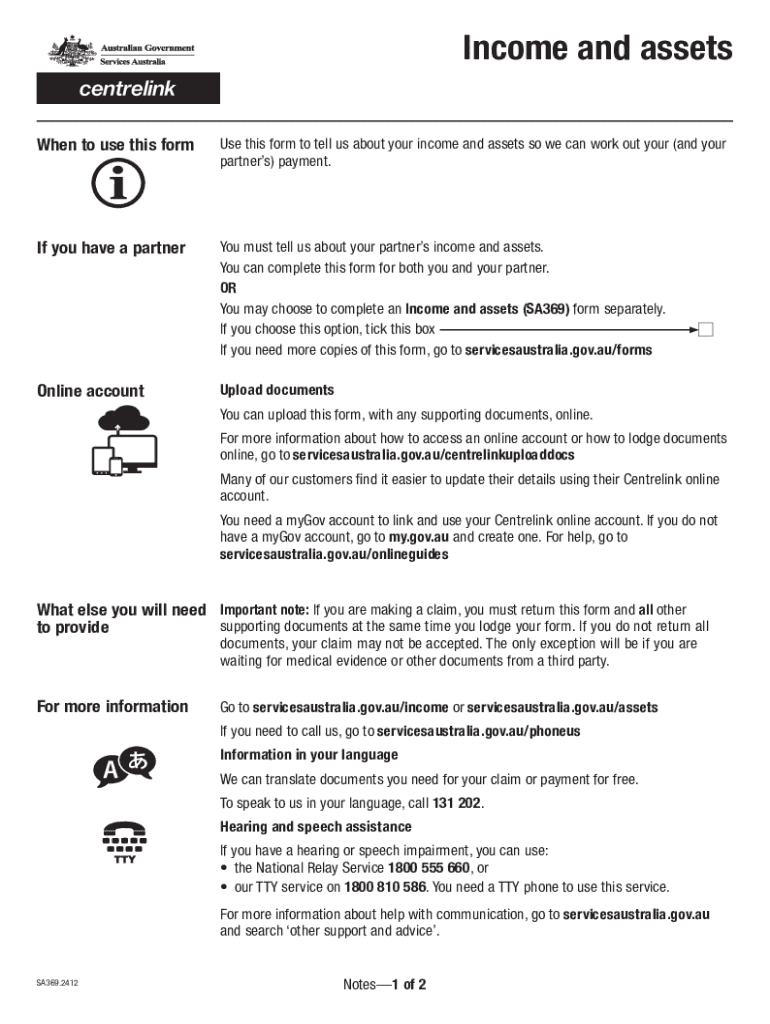
The "Income and Assets" form, often referred to as SA369, is a crucial document required by Services Australia. It plays a fundamental role in determining the eligibility of an individual or couple for various payments and benefits. The form entails detailed information about your income and assets, including employment income, superannuation, business interests, and other financial holdings. Accurately filling out this form ensures that Services Australia can assess your financial situation comprehensively, minimizing the risk of claim rejection due to incomplete or incorrect information. In its essence, the form aims to provide a clear snapshot of your financial status to facilitate a fair assessment.
Key Elements of the Income and Assets Form
Several critical sections in the form capture your financial situation:
- Employment Income: Details of your current job, including salary, bonuses, and any other employment-related income.
- Business Interests: Information about any businesses you own or have a stake in, including profits, losses, and salary drawn, if applicable.
- Superannuation and Retirement Funds: The balance of your superannuation accounts, contributions, and any other retirement savings.
- Financial Assets: This includes details about any savings accounts, investments, shares, or term deposits.
- Real Estate Holdings: Information about various real estate properties, including investment properties and their corresponding rental income.
Completing these sections with precision is critical for a successful application process.
How to Use the Income and Assets Form
The Income and Assets form serves as a comprehensive tool to declare your financial status. Use this form to:
- Assess Eligibility: Determine if you qualify for benefits from Services Australia.
- Submit Claims: Provide a structured declaration of your finances, mandatory for claim processing.
- Avoid Discrepancies: Ensure accurate reporting to prevent potential disputes or errors that could impact your eligibility.
By understanding the form's requirements, you can ensure that the information provided aligns with Services Australia's criteria, leading to a smoother processing experience.
Step-by-Step Completion Process
- Gather Required Documents: Collect all financial statements, pay slips, investment records, and any relevant evidence of income and assets.
- Fill Out Sections Sequentially: Begin with personal details before moving to specific financial sections.
- Review and Cross-Check: Verify all entered information against your financial documents.
- Consult Guidelines: Refer to Services Australia’s guidelines for any clarification needed regarding particular sections.
- Submit for Evaluation: Once complete, submit the form following the prescribed method of your preference: online, by mail, or in-person.
Each step ensures your submission is both accurate and complete.
Required Documents for the Income and Assets Form
Completing the Income and Assets form necessitates providing a series of supporting documents. These include:
- Recent Pay Slips: To verify your employment income.
- Bank Statements: To cross-check your financial asset declarations.
- Investment Portfolios: Details about stocks, bonds, or managed funds.
- Property Valuations: Recent appraisals or municipal assessments of owned properties.
- Superannuation Statements: Current balance and recent contributions.
These documents collectively substantiate your declared income and assets, forming a reliable basis for eligibility assessment.
Legal Use of the Income and Assets Form
The form is a legally binding document, ensuring that all declarations you make can be used for further verification by Services Australia. The legal implications of filling this form include:
- Accurate Representation: By submitting this form, you affirm that the provided information is truthful and complete.
- Compliance with Law: Failure to accurately complete the form or submission of misleading information may result in legal action.
- Protection of Privacy: All information is handled according to privacy laws, ensuring your data is secure and used only for assessing eligibility.
Understanding these legal nuances protects you from inadvertent violations and enhances compliance.
Eligibility Criteria for Utilizing the Form
Eligibility to complete and submit the Income and Assets form is contingent upon:
- Citizenship or Residency: Typically required for Australian citizens or permanent residents.
- Income Thresholds: There are specific income levels beyond which certain benefits may not be applicable.
- Age Requirements: Some benefits that use this form have age-related eligibility criteria.
- Life Events: Specific life circumstances, such as parenthood or disability, that may necessitate assessment.
Aligning with these criteria ensures that your submission is both relevant and acknowledged by Services Australia.


Common Scenarios and Use Cases
- Self-employed Individuals: Detailed documentation of business incomes and payable taxes.
- Retirees: Focus on superannuation and pension income to determine eligibility for senior benefits.
- Students: Declaring part-time income while studying to access specific educational or training allowances.
Knowledge of these scenarios aids in recognizing the necessity of accurate declarations in these particular circumstances.
Submission Methods for the Income and Assets Form
This form can be submitted through various methods to suit individual preferences:
- Online Submission: Easiest and fastest method via the online portal.
- Mail-In Submission: Send completed forms and documents to the designated address.
- In-Person Submission: Visit a designated Services Australia office for personal assistance in submission.
Ensuring submission via these routes provides options for those with different levels of accessibility and preference for interaction.
State-Specific Rules for Income and Assets
Each state may have unique considerations concerning the filling and submission of the Income and Assets form. While the federal guidelines apply universally:
- State-Specific Benefits: Some benefits may vary depending on state-specific legislations or special programs.
- Additional Documentation: Certain states may require supplementary documents to validate certain claims.
Familiarizing yourself with these state-specific rules enhances compliance and reduces the likelihood of processing delays.




