2009 Geology and Natural Hazards of the-2026

Get Form
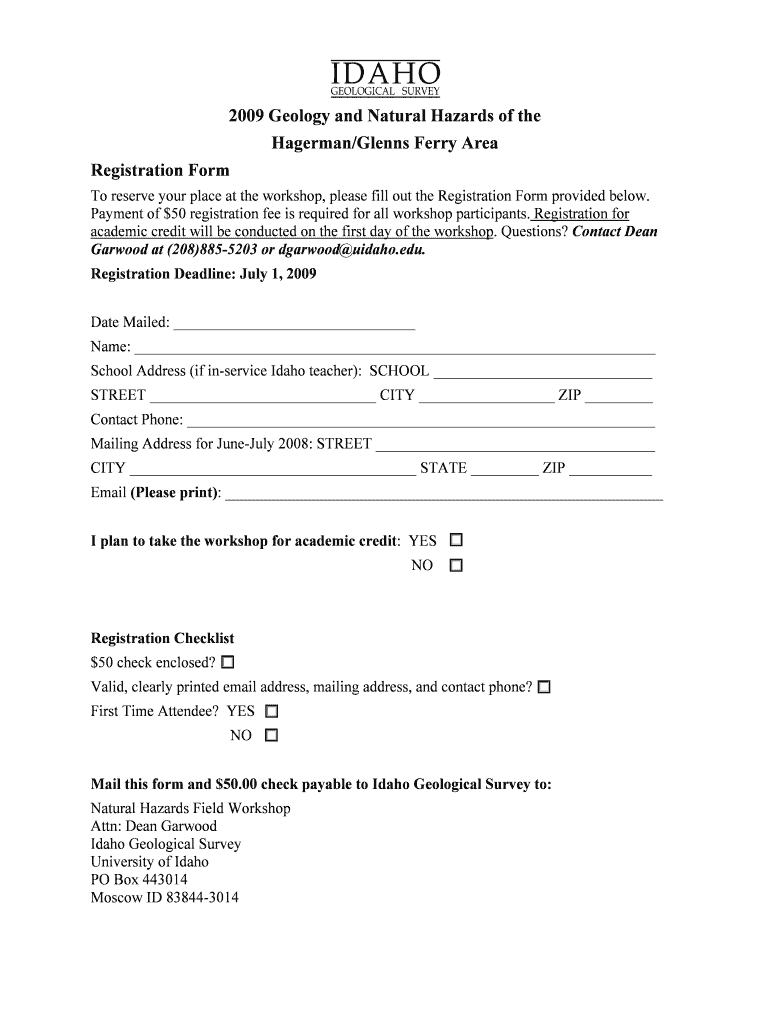
2009 Geology and Natural Hazards of the Preview on Page 1

Here's how it works

01. Edit your form online
Type text, add images, blackout confidential details, add comments, highlights and more.
02. Sign it in a few clicks
Draw your signature, type it, upload its image, or use your mobile device as a signature pad.
03. Share your form with others
Send it via email, link, or fax. You can also download it, export it or print it out.

How to use or fill out 2009 Geology and Natural Hazards of the Registration Form

Form edit decoration
9.5
Ease of Setup
DocHub User Ratings on G2
9.0
Ease of Use
DocHub User Ratings on G2
  1. Click ‘Get Form’ to open it in the editor.
  2. Begin by entering your name in the designated field. Ensure that it is clearly printed for accurate identification.
  3. If you are an in-service Idaho teacher, fill out your school address, including the street, city, and zip code.
  4. Provide your contact phone number in the appropriate field to facilitate communication regarding the workshop.
  5. Fill out your mailing address for June-July 2008, ensuring all details are correct, including street, city, state, and zip code.
  6. Clearly print your email address to receive important updates about the workshop.
  7. Indicate whether you plan to take the workshop for academic credit by selecting 'YES' or 'NO'.
  8. Review the registration checklist to confirm that you have enclosed a $50 check and provided valid contact information.
  9. Finally, mail this form along with your payment to the specified address for processing.

Start filling out your registration form today using our platform for free!

be ready to get more

Complete this form in 5 minutes or less

Get form

Got questions?

We have answers to the most popular questions from our customers. If you can't find an answer to your question, please contact us.
Contact us
The geology of Chile is a characterized by processes linked to subduction, such as volcanism, earthquakes, and orogeny. The building blocks of Chiles geology were assembled during the Paleozoic Era when Chile was the southwestern margin of the supercontinent Gondwana.
Natural hazards such as earthquakes, volcanoes and landslides can occur without warning and cause damage to health, homes and livelihoods. The Earth beneath our feet is constantly shifting and moving, sometimes ever so slowly, but sometimes swiftly and violently with catastrophic and immediate results.
Fast facts: 2021 and 2010 Haiti earthquakes 2010 earthquake: A powerful 7.1 magnitude quake devastated the capital, claiming 300,000 lives. Location: The epicenters of the 2021 and 2010 earthquakes were approximately 63 miles apart and along the same fault line. Vulnerability: Haiti remains prone to natural disasters.
Natural geological hazards, such as earthquakes, landslides and volcanic eruptions, and their associated impacts and risks are of key concern to lives and livelihoods, including long-term economic growth.
Natural hazards can be classified into several broad categories: geological hazards, hydrological hazards, meteorological hazards, and biological hazards.

People also ask

Landslides of all kinds, including seismically-triggered landslides, debris flows, mud flows, and rock falls. Mineral hazards such as asbestos, radon, and mercury. Volcanic hazards, such as ash fall, lava flows, lahars, pyroclastic flows, toxic gases, and volcanic landslides.
Geological natural hazards are for example earthquakes, land slides, sinkholes, volcanic eruptions and tsunamis. Geological natural hazards such as earthquakes and volcanic eruptions are triggered by activities taking place in the earths interior.

Related links