




01. Edit your schedule se online
Type text, add images, blackout confidential details, add comments, highlights and more.

Type text, add images, blackout confidential details, add comments, highlights and more.

Draw your signature, type it, upload its image, or use your mobile device as a signature pad.

Send it via email, link, or fax. You can also download it, export it or print it out.
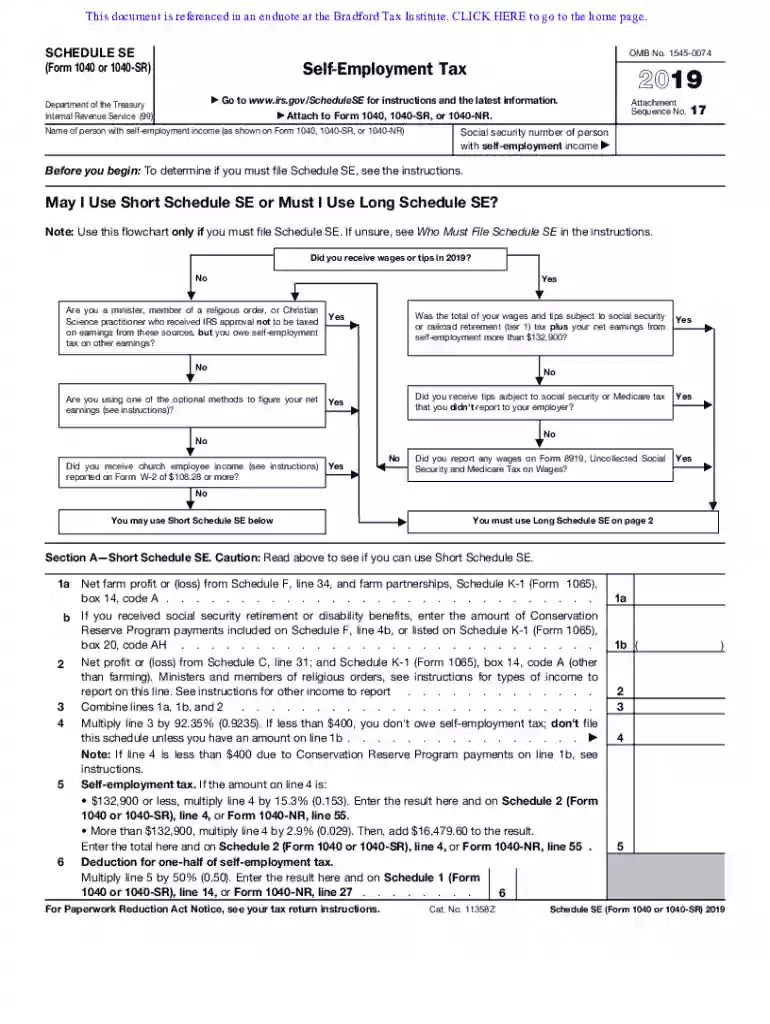
Schedule SE, or Self-Employment Tax, is a tax form used to calculate the tax due on net earnings from self-employment for individuals residing in the United States. This form is essential for those who operate as sole proprietors, partners in a partnership, or members of a limited liability company (LLC) that is treated as a partnership for tax purposes. The purpose of Schedule SE is to determine the amount of self-employment tax an individual owes, which covers Social Security and Medicare taxes. This is vital for ensuring that self-employed individuals meet their tax responsibilities similar to employees who have these taxes withheld from their pay.
To effectively use Schedule SE, individuals need to follow a sequence of detailed steps. Begin by calculating your net earnings from self-employment, which is the income you have earned from your business activities minus any allowable business expenses. This calculation is crucial as it forms the foundation of the self-employment tax computation. Next, you'll complete the sections on Schedule SE that apply to your specific situation. These sections will guide you through the process of calculating the Social Security and Medicare portions of your self-employment tax. Finally, the calculated tax should be reported on Form 1040, your annual income tax return, to finalize your tax liability.
Calculate Net Earnings: Start by determining your net earnings from self-employment. This involves reviewing your business income and expenses, typically summarized on Schedule C (Profit or Loss from Business).
Determine Applicable Tax Rate: Two primary tax rates apply: 12.4% for Social Security and 2.9% for Medicare. For high-income earners, an additional Medicare tax rate may apply.
Fill Out Schedule SE Sections: Enter your net earnings and applicable rates into the corresponding sections of Schedule SE. Forms are divided into Short and Long Versions based on your total earnings.
Compute Total Self-Employment Tax: Use the information from your entries to compute the total self-employment tax owed.
Record on Form 1040: Transfer the computed self-employment tax amount to the designated line on your Form 1040.
Review for Errors: Double-check your calculations and ensure all entries are correct for accurate reporting.
Schedule SE includes several key elements that facilitate accurate self-employment tax calculations. These elements consist of:
Net Earnings Calculation: The process of determining net earnings involves considering total income and allowable business expenses.
Tax Rate Application: Applying the correct tax rates ensures accurate Social Security and Medicare tax calculations.
Short and Long Versions: Depending on your total net earnings, you may be required to use either the short or long version of the form. The short version is for those with lower net earnings, while the long version caters to higher earnings and includes additional calculations for complex situations.
Adjustments and Deductions: Certain adjustment options and deductions available to self-employed individuals, including half of the self-employment tax being deductible on Form 1040, can reduce overall tax liability.
Eligibility to use Schedule SE primarily depends on your status as a self-employed individual in the U.S. This includes:


The IRS provides comprehensive guidelines to assist taxpayers in accurately completing Schedule SE. Key deadline information includes:
Annual Filing Deadline: Schedule SE is due at the same time as Form 1040, usually by April 15 each year for calendar-year taxpayers.
Quarterly Estimated Payments: Self-employed individuals may need to make estimated tax payments quarterly to prepay their anticipated self-employment tax.
Numerous software platforms, like TurboTax and QuickBooks, provide compatibility with Schedule SE, streamlining the tax filing process. These programs guide users through form completion with intuitive prompts, reducing errors and improving accuracy. Integration features allow direct access to IRS forms and updating capabilities for any tax law changes.
Schedule SE is primarily used by self-employed individuals, including sole proprietors and freelancers, to settle their tax obligations. However, it is also applied by:
Understanding the terminology associated with Schedule SE is crucial for accurate form completion. These terms include:
A lot of software applications are available out there for document editing and signing. DocHub is one of the most in-demand online solutions that comply with all security and compliance standards and ensures your electronically signed documentation is legally enforceable. All you need to try it out is to register an account, upload your schedule se, provide the required information, and click Sign. Generate your electronic signature by typing, drawing it, uploading its picture to your template, or scanning a unique QR code.
Document editing with DocHub is equally convenient on desktop and mobile devices. You just need an internet browser to edit your schedule se on Android. Open our website and sign in to access the tools you need. Add your document and introduce your intended changes. Next, you can keep your form in your document storage or send it out right away.
At DocHub, your data security is our priority. We follow HIPAA, SOC2, GDPR, and other standards, so you can work on your documents with confidence.
Rita BentleySimulation 14A: Using Form 1099-INT to Complete Schedule C-EZ, Schedule SE, and Form 1040. Belinda RussellSimulation 7B: Completing a Tax Return ...
Use Schedule SE (Form 1040) to figure the tax due on net earnings from self-employment. The Social Security Administration uses the information from ...
Serializability is a property of a transaction schedule (history). It relates to the isolation property of a database transaction.


