
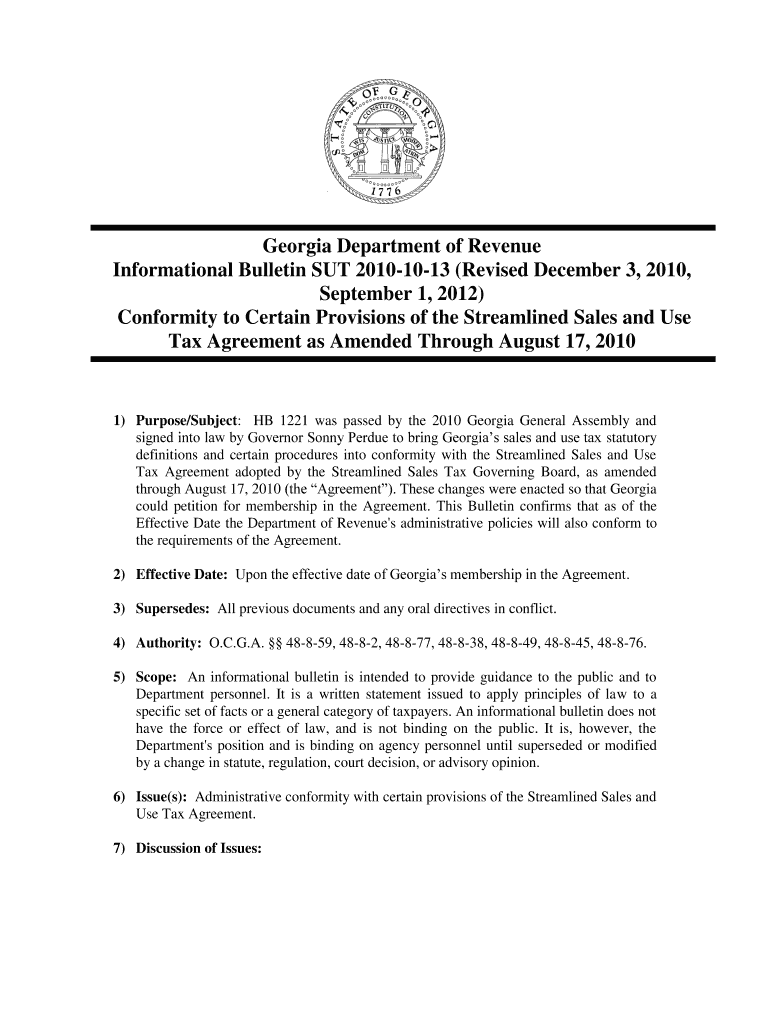







Definition and Meaning
The Informational Bulletin SUT 2010-10-13 issued by the Georgia Department of Revenue outlines the state's adoption of the Streamlined Sales and Use Tax Agreement. This document serves as an official update detailing modifications in sales and use tax laws, definitions, and administrative procedures prompted by the passage of House Bill 1221. Through the bulletin, both public entities and departmental personnel receive guided knowledge necessary for compliance with Georgia’s amended tax regulations.
Key Elements of the Informational Bulletin
The bulletin covers several critical areas regarding sales tax regulations:
- Seller Registration: Instructions are provided for businesses on how to register under the new framework.
- Tax Rate Databases: Details on accessing and utilizing updated taxation rates are included to ensure accurate transactional calculations.
- Consolidated Returns: Insights into submitting consolidated tax returns for businesses with multiple locations.
- Exemption Administration: Guidelines are provided for businesses looking to manage tax-exempt sales efficiently.
- Telecommunications Compliance: Specific rules are applied to telecommunications services, reflecting unique compliance requirements.
Each element ensures all parties understand their responsibilities under the revised tax system.
How to Use the Informational Bulletin
Users of the bulletin can effectively align their business practices with the state's taxation requirements by:
- Reviewing Seller Responsibilities: Businesses must review how seller responsibilities and obligations have shifted to meet new standards.
- Utilizing Tax Rate Data: Access appropriate databases for the most current tax rates applicable to different product categories.
- Preparing Consolidated Returns: Identify methods and requirements for preparing returns that encompass all business locations.
- Understanding Exemption Criteria: Recognize criteria that classify transactions as tax-exempt and document processes accordingly.
Through these steps, businesses can ensure compliance and facilitate smooth tax operations.
Steps to Complete the Bulletin
Completing or adhering to guidelines provided in the bulletin involves several steps:
- Identify Applicability: Determine if your business is affected by the changes outlined in the bulletin.
- Gather Required Information: Collect all necessary data about your business, including sales, exemptions, and prior tax filings.
- Implement Changes: Update business processes to reflect new tax rates and exemption criteria.
- Communicate with Stakeholders: Inform all relevant parties, including accountants and auditors, of the necessary changes.
- Monitor Compliance: Regularly check that all tax practices remain compliant with state laws.
Who Typically Uses the Informational Bulletin
This bulletin is crucial for:
- Business Owners: To understand new tax obligations and align operations accordingly.
- Accountants and Tax Professionals: For guidance in advising clients on sales and use tax compliance.
- Legal Advisors: To interpret changes in state tax law and their implications.
These stakeholders rely on the bulletin for accurate, updated tax information relevant to their operations.


Legal Use of the Informational Bulletin
The bulletin provides legal insight into tax regulations, offering:
- Interpretative Guidance: Helping practitioners understand complex legal text related to tax law.
- Compliance Assurance: Ensures that businesses' tax practices are aligned with state legal expectations to avoid penalties.
- Dispute Resolution Tool: The document can be a reference in cases of legal or administrative disputes regarding tax compliance.
By adhering to the guidance stated, businesses can safeguard against non-compliance repercussions.
State-Specific Rules for the Bulletin
The bulletin is tailored to Georgia’s laws and includes:
- Local Tax Rate Applications: Detailed guidelines on applying varied local tax rates.
- Regions with Specific Rules: Information on particular regions within Georgia that may have additional tax provisions.
- Amendment Updates: Notices of any future amendments to Georgia's tax laws as they relate to the Streamlined Sales and Use Tax Agreement.
Understanding these specificities ensures adherence to local governance beyond federal regulations.
Examples of Using the Informational Bulletin
Practical scenarios illustrating the use of the bulletin include:
- Retailers Updating Systems for New Tax Rates: A retail business adjusts its sales systems to apply new tax rates on various goods it sells throughout Georgia.
- Service Providers Implementing Exemption Changes: A telecommunications provider aligns service fees with updated exemption criteria.
- Multi-State Corporations Managing Compliance: A business with operations in multiple states adopts the bulletin for consistent tax compliance across state lines while adhering to Georgia's additional regulations.
These examples reflect real-world applications where the bulletin acts as a vital resource for successfully navigating state tax requirements.




