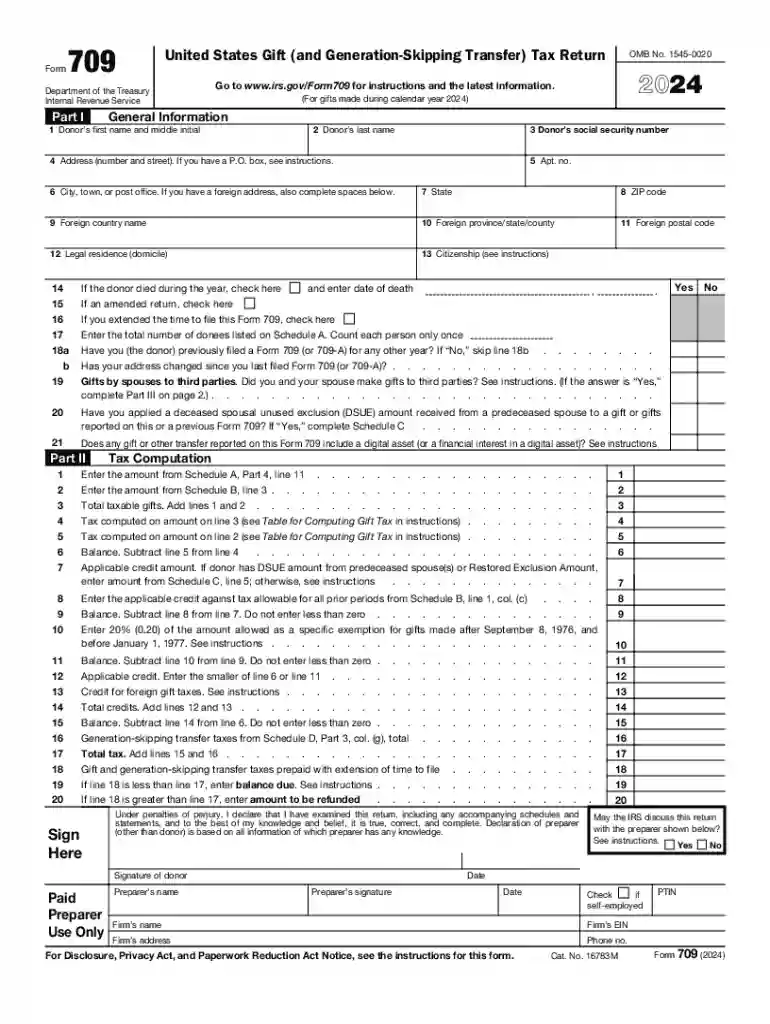
2024 Form 709 United States Gift (and Generation-Skipping Transfer) Tax Return-2026

Get Form
form 709 Preview on Page 1

Here's how it works

01. Edit your form 709 online
Type text, add images, blackout confidential details, add comments, highlights and more.

02. Sign it in a few clicks
Draw your signature, type it, upload its image, or use your mobile device as a signature pad.

03. Share your form with others
Send irs gift limit 2024 via email, link, or fax. You can also download it, export it or print it out.

Definition and Meaning of Form 709

Form 709, officially known as the United States Gift (and Generation-Skipping Transfer) Tax Return, is a document used by individuals in the U.S. to report taxable gifts and generation-skipping transfers. It is typically used to disclose gifts that exceed the annual exclusion limit, which is adjusted annually based on inflation. The form is essential for both individuals and legal representatives of estates to ensure compliance with federal tax regulations and avoid unnecessary tax liabilities. Additionally, it captures pertinent information regarding the donor, donee, and the nature of the gifts, ensuring that all parties abide by the legal requirements of the Internal Revenue Service (IRS).

Key Elements of Form 709

Form 709 is comprised of several key sections designed to capture detailed information about gifts and generation-skipping transfers:

  • General Information: This section requires details about the donor, including personal and contact information.
  • Tax Computation: Here, donors calculate the taxes owed on gifts that exceed the annual exclusion.
  • Schedule A: Specifically for listing all gifts made within the tax year, it separates different types of gifts, such as those to individuals and trusts.
  • Schedule B: Details prior year gifts and any applicable deductions or cumulative credits.
  • Generation-Skipping Transfers: A separate schedule is dedicated to these transactions, reporting any applicable taxes due.

Steps to Complete Form 709

  1. Gather Information: Collect all necessary documents, including records of gifts, valuations, and prior tax returns.
  2. Complete General Information: Fill out the introductory section with the donor's details.
  3. List Gifts in Schedule A: Enter each gift along with its value and the recipient's information.
  4. Calculate Tax in the Tax Computation Section: Determine any taxes owed after accounting for the annual exclusion and applicable credits.
  5. Report Generation-Skipping Transfers: Detail these specific transfers and compute any taxes owed.
  6. Review and Sign: Ensure accuracy and completeness before signing and dating the form.

Filing Deadlines and Important Dates

Form 709 must be filed annually if you exceed the annual gift exclusion limit. The default deadline for submission is April 15, coinciding with the traditional U.S. income tax deadline. Extensions can be requested using IRS Form 4868, providing an additional six months, which extends the deadline to October 15. It is crucial to adhere to these timelines to avoid penalties and interest on any taxes owed.

Required Documents for Submission

To successfully complete Form 709, you will need:

  • Records of all gifts given, including descriptions and valuations
  • Documentation supporting the determination of fair market values
  • Previous years' tax returns if applicable, to evaluate annual exclusions and cumulative credits
  • Any statements or legal documents related to generation-skipping transfers
  • Tax identification numbers for both donor and recipients

Legal Use and Compliance of Form 709

Using Form 709 correctly is crucial to comply with the IRS regulations concerning gift and generation-skipping transfer taxes. It ensures that donors correctly report and pay taxes on gifts exceeding the annual exclusion. Failure to file or incorrect reporting can result in penalties or additional interest charges. The form also covers legal aspects of gift splitting between spouses, requiring both parties' consent.

IRS Guidelines for Form 709

The IRS provides specific guidelines and instructions for completing Form 709, which detail:

  • Annual Exclusion Amount: The allowable per-person gift amount without incurring a tax obligation.
  • Lifetime Exemption: An aggregate threshold under which your gifts may avoid taxation.
  • Generation-Skipping Transfer Tax: Rules to prevent the avoidance of gift taxes through skipped generational gifts.
  • Spousal Gift Splits: Directions on equalizing gift amounts between married couples.

Examples and Scenarios Involving Form 709

Consider the following illustrative scenarios:

  • An individual gifts $20,000 to a grandchild. The excess over the annual exclusion is reported using Form 709.
  • A couple chooses to split a $60,000 financial gift for tax purposes, which requires the use of Form 709 to reflect the gift accurately.
  • An estate administers a generation-skipping transfer to a beneficiary that bypasses immediate offspring, requiring detailed reporting on both the gift and GST tax implications.

Penalties for Non-Compliance with Form 709

Failing to file Form 709 when required can result in significant penalties. These include:

  • Late Filing Penalities: Imposed if the form is not filed by the due date or extended date.
  • Inaccurate Reporting: Severe penalties can be levied for understated gift values or intentional non-disclosure.
  • Interest on Unpaid Taxes: Interest accrues on any unpaid taxes from the original due date of the return until full payment is made.

Understanding and properly completing Form 709 is vital for maintaining compliance and optimizing tax obligations related to gifts and transfers.

be ready to get more

Complete this form in 5 minutes or less

Get form

Got questions?

We have answers to the most popular questions from our customers. If you can't find an answer to your question, please contact us.
Contact us
The following individuals are generally required to file Form 709: Donors who have made gifts exceeding the annual exclusion limit: If you have given gifts to any one individual that total more than the annual exclusion limit for the tax year, you must file Form 709.
The IRS also has the right to assess other penalties or interest for all of the years from the date of the gift tax filing to the current date, if the IRS Form 709 was not filed. For this reason, Form 709 has a section to report non-gift transactions.
Generally, Form 709: U.S. Gift (and Generation-Skipping Transfer) Tax Return is required if any of the following apply: An individual makes one or more gifts to any one person (other than his or her citizen spouse) that are more than the annual exclusion for the year.
No, you do not have to report money you receive as a gift as income. While any gift may be taxable, the recipient of the gift does not have to pay the gift tax. And the person who gives you the gift only needs to file a gift tax return if its more than the $18,000 annual exclusion.
The federal estate tax applies to the transfer of property at death. The gift tax applies to transfers made while a person is living. The generation-skipping transfer tax is an additional tax on a transfer of property that skips a generation.

Security and compliance

At DocHub, your data security is our priority. We follow HIPAA, SOC2, GDPR, and other standards, so you can work on your documents with confidence.

Learn more
ccpa2
pci-dss
gdpr-compliance
hipaa
soc-compliance
be ready to get more

Complete this form in 5 minutes or less

Get form

People also ask

The annual gift exclusion for 2024 is $18,000. See Annual Exclusion, later. For gifts made to spouses who are not U.S. citizens, the annual exclusion has increased to $185,000.
What Can Trigger a Gift or Estate Tax Audit? Here are some of the common factors that can lead to gift or estate tax audits: Total estate and gift value: Generally speaking, gift and estate tax returns are more likely to be audited when there are taxes owed and the size of the transaction or estate is relatively large.
Unless you made a taxable gift valued at more than $18,000 to an individual or entity in 2024 or more than $19,000 in 2025, you dont need to fill out Form 709. If you did, you may just need to report the gift.

irs form gift tax