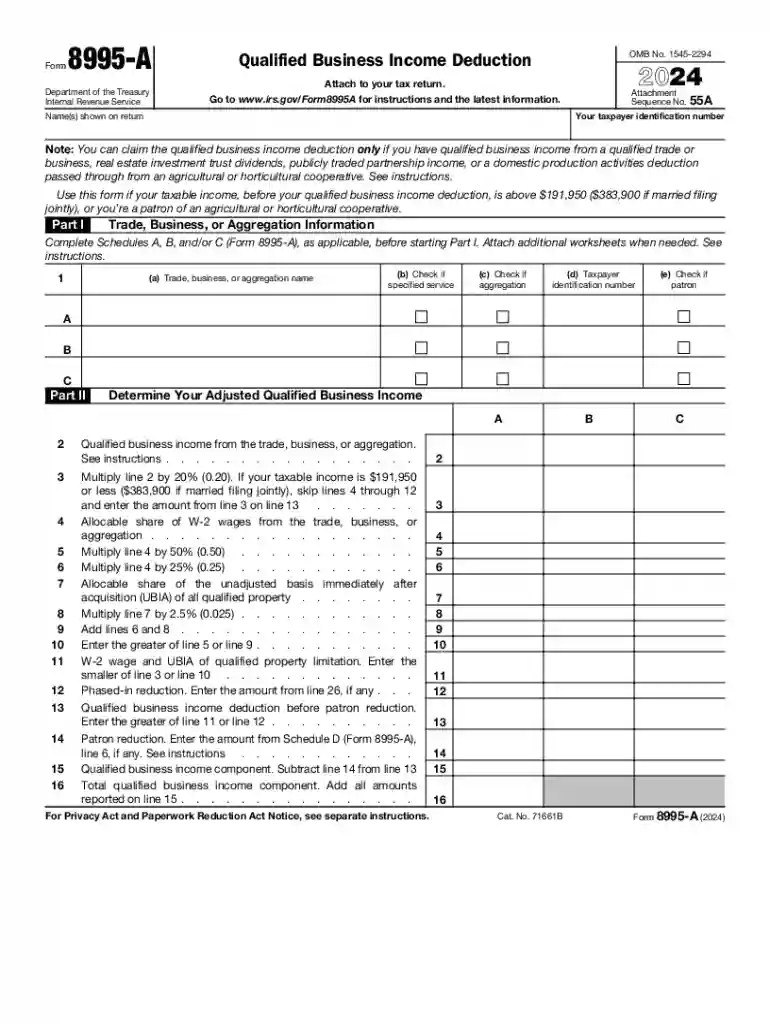
2024 Form 8995-A Qualified Business Income Deduction-2026

Get Form
2024 Form 8995-A Qualified Business Income Deduction Preview on Page 1

Here's how it works

01. Edit your form online
Type text, add images, blackout confidential details, add comments, highlights and more.

02. Sign it in a few clicks
Draw your signature, type it, upload its image, or use your mobile device as a signature pad.

03. Share your form with others
Send it via email, link, or fax. You can also download it, export it or print it out.

Definition and Purpose of the 2024 Form 8995-A

Form 8995-A is utilized by U.S. taxpayers to claim the Qualified Business Income Deduction (QBI) for the tax year 2024. This tax form is essential for individuals with qualified business income from various sources, whose taxable income meets or exceeds specific thresholds. It assists taxpayers in reporting trade or business details, computing adjusted qualified business income, and determining the qualifying deduction amount. The form streamlines the filing process, ensuring accurate calculation and compliance with IRS regulations.

Obtaining the 2024 Form 8995-A

To access the 2024 Form 8995-A, taxpayers can visit the IRS website or consult their tax preparation software, as most platforms include this form. Alternatively, the form can be sourced from authorized tax professionals who provide assistance during tax filing season. It is important to ensure that the form reflects the correct tax year and is filled out using up-to-date information provided by the IRS.

Eligibility Criteria for Using Form 8995-A

Eligibility to file Form 8995-A revolves around several criteria, primarily focusing on the type of income and taxpayer status:

  • Type of Income: Individuals must have qualified business income from U.S. trades or businesses.
  • Taxable Income Thresholds: Eligibility is contingent on surpassing IRS-specified income thresholds. Check current IRS guidelines for exact figures.
  • Business Structure: Those operating through sole proprietorships, partnerships, S corporations, and certain trusts and estates may qualify.
  • Excluded Entities: Specified service trades or businesses may have limitations based on income levels.

Understanding these criteria ensures taxpayers can take full advantage of the QBI deduction.

decoration image ratings of Dochub

Steps to Complete the 2024 Form 8995-A

  1. Gather Necessary Documents: Collect all relevant business income records, expense reports, and prior tax year returns.
  2. Calculate Qualified Business Income (QBI): Accurately compute QBI by subtracting business expenses from total business revenue.
  3. Determine QBI Deduction: Utilize the form to apply the applicable percentage and phase-in limitations specific to your income.
  4. Complete Residual Sections: Fill in information related to wages, W-2 forms, and any specified service trades or businesses.
  5. Review Before Submission: Double-check the entire form for accuracy to prevent filing errors.

Following these steps can help achieve an accurate and compliant submission.

Important Terms Related to the 2024 Form 8995-A

Understanding key terms is essential for correctly completing the form:

  • QBI: Refers to the net amount of qualified items of income, gain, deduction, and loss connected with any trade or business.
  • Threshold Amount: The point at which phase-in of limitations begins based on filing status.
  • W-2 Wages: Total wages paid to employees, impacting the calculation of the deduction.
  • Unadjusted Basis Immediately after Acquisition (UBIA): Original cost of business property for QBI purposes.

Familiarity with these terms aids in navigating the form efficiently.

Who Typically Uses the 2024 Form 8995-A

Form 8995-A is commonly utilized by a variety of taxpayers including, but not limited to:

  • Self-Employed Individuals: Owners of sole proprietorships performing independent contracting work.
  • Owners of Partnerships and S Corporations: Specifically those who report business income on personal returns.
  • Trusts and Estates: When these entities possess qualified business income, they may file form 8995-A.
  • Specified Service Trades or Businesses: Entities providing services, taking into account income level restrictions.

Knowing who uses the form helps identify its relevance to your situation.

decoration image

Examples of Using the 2024 Form 8995-A

Consider the following scenarios where Form 8995-A is applicable:

  • Self-Employed Tech Consultant: Earned $150,000 with deductible expenses of $50,000, resulting in QBI of $100,000. Use Form 8995-A to determine if the deduction applies.
  • Small Business Owner with Multiple Employees: With a wage report via W-2 forms, the deduction is calculated in part based on total wages paid.
  • Partnership In a Consulting Business: Requires careful allocation of QBI among partners based on their respective shares.

These examples illustrate the diverse applicability of the form across different business types.

IRS Guidelines and Compliance

The IRS stipulates strict guidelines for completing Form 8995-A, ensuring that taxpayers adhere to regulations regarding QBI deduction claims. Key aspects include:

  • Following detailed instructions on the form to ensure compliance
  • Adhering to documentation requirements for income and expenses
  • Maintaining accurate records in case of IRS inquiries or audits

Staying informed of IRS updates and regulations is crucial for compliance and avoiding penalties.

Filing Deadlines and Important Dates for 2024 Form 8995-A

Deadlines for the form are typically aligned with general tax filing dates in the U.S.:

  • April 15: Regular filing deadline for most taxpayers
  • October 15: Extended deadline for those who have filed for an extension
  • Estimated Tax Deadlines: Quarterly deadlines may affect taxpayers with estimated payments impacted by QBI

Understanding these dates ensures timely submission and reduces the risk of late penalties.

be ready to get more

Complete this form in 5 minutes or less

Get form

Got questions?

We have answers to the most popular questions from our customers. If you can't find an answer to your question, please contact us.
Contact us
If you are self-employed or own a small business and file Form 1040 (Individual Income Tax Return), you can claim the QBI deduction. To calculate and honor this deduction, you must complete Form 8995 or Form 8995-A.
You can file Form 8995 if your 2024 total taxable income (before the qualified business income deduction) is below $197,300 for single filers or $394,600 for married filing jointly. If your income exceeds these amounts, or if youre part of a cooperative, youll need to use Form 8995-A.
How to qualify for the QBI deduction. If your total taxable income that is, not just your business income but other income as well is at or below $197,300 for single filers or $394,600 for joint filers in 2025 you may qualify for the 20% deduction on your taxable business income.
What income is not eligible for QBI deduction? According to the IRS, income not eligible for the qualified business income deduction includes income earned through a C corporation or by providing services as an employee not eligible for the deduction.
Income earned through a C corporation or by providing services as an employee is not eligible for the deduction. For more information on what qualifies as a trade or business, see Determining your qualified trades or businesses in the Instructions for Form 8995-A or Form 8995.

Security and compliance

At DocHub, your data security is our priority. We follow HIPAA, SOC2, GDPR, and other standards, so you can work on your documents with confidence.
Learn more
ccpa2
pci-dss
gdpr-compliance
hipaa
soc-compliance

People also ask

Form 8995 is a critical tax document for small business owners and operators of pass-through entities such as sole proprietorships, partnerships, LLCs, and S corporations. The form is used to calculate and claim the Qualified Business Income (QBI) deduction, also known as the pass-through or Section 199A deduction.
For tax year 2023 (filed in 2024), you qualify for the QBI deduction if you are self-employed and your taxable income falls below $182,100 for individuals, or $364,200 for joint returns, as well as certain taxpayers with higher business income.

Related links