




01. Edit your ab63 alternative form online
Type text, add images, blackout confidential details, add comments, highlights and more.

Type text, add images, blackout confidential details, add comments, highlights and more.

Draw your signature, type it, upload its image, or use your mobile device as a signature pad.

Send business tax application ab63 via email, link, or fax. You can also download it, export it or print it out.
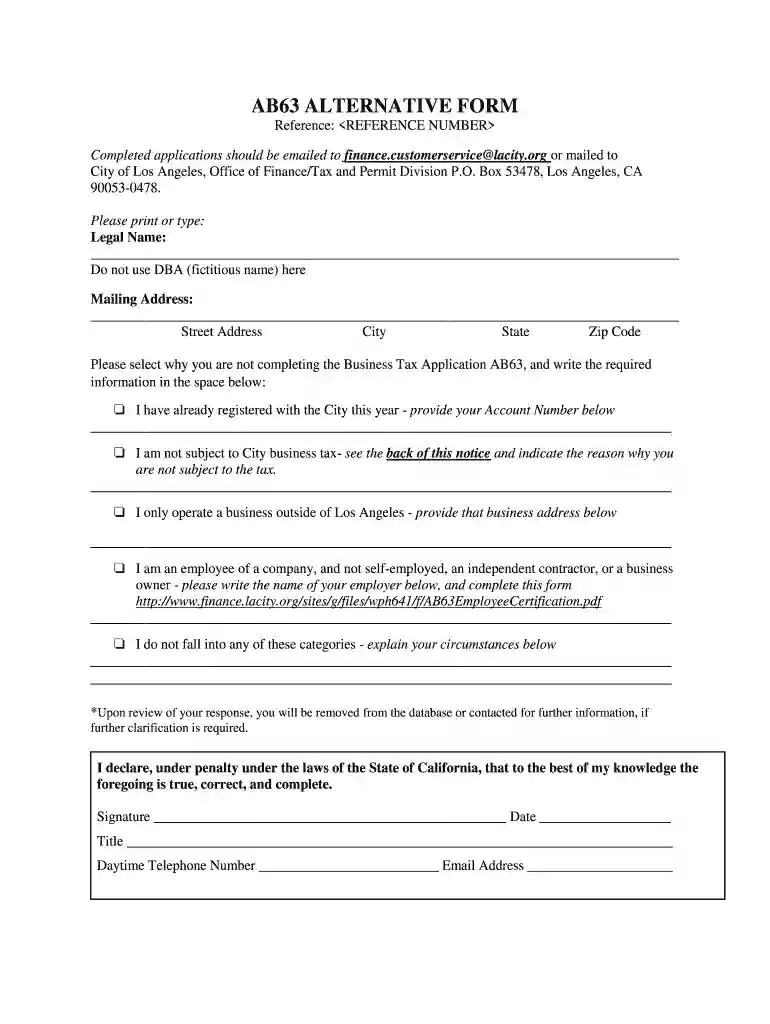
The AB63 Alternative Form pertains to the City of Los Angeles and serves as a declaration by individuals or businesses claiming exemption from the city business tax. It is essential for applicants to understand both the form itself and the contextual requirements necessary for its effective use.
The main purpose of the AB63 alternative form is to certify an individual or business's exemption from the City of Los Angeles business tax. This form must be filled out accurately to ensure compliance with local tax regulations. Individuals and businesses can use the form to indicate their eligibility based on specific exemptions outlined by the city, which could include minors, nonprofits, and certain small businesses.
Completing the AB63 form requires gathering and inputting several pertinent pieces of information, including:
Each of these sections plays a crucial role in determining eligibility, and all claims should be supported with relevant documentation where necessary.
The AB63 alternative form allows for several categories under which a business might be exempt from the business tax. Some of the general exemptions include:
Understanding these categories helps applicants properly assess their eligibility and reduces the risk of filing incorrectly.
Once completed, the AB63 alternative form needs to be submitted in the following manner:
This careful approach to submission ensures compliance and helps prevent any delays or issues in processing the exemption request.
After submitting the form, applicants can monitor the status of their submission. It's advisable to:
Ensuring follow-up is crucial in maintaining communication with tax authorities, which aids in any potential clarifications or additional information requests.
Understanding the implications of the AB63 Alternative Form is critical for compliance with local tax regulations. Incorrectly claiming exemption can result in penalties, including back taxes or fines.
Individual or business entities should approach the AB63 alternative form with thorough understanding and diligence to avoid complications.
The AB63 alternative form serves as an integral part of the tax process for businesses in Los Angeles, allowing for necessary exemptions from city business tax. Proper understanding and completion of this form ensures compliance with local tax regulations and safeguards against potential penalties.
We've got more versions of the ab63 alternative form form. Select the right ab63 alternative form version from the list and start editing it straight away!
At DocHub, your data security is our priority. We follow HIPAA, SOC2, GDPR, and other standards, so you can work on your documents with confidence.
Sep 11, 2019 Students will demonstrate how to properly create and format computerized damage estimates in each estimating software platform and develop.Read more
These types of businesses must complete the AB63 Alternative Form: ❖ Childcare provider for less than 8 children. ❖ 501C3 Non-Profit Business pleaseRead more


