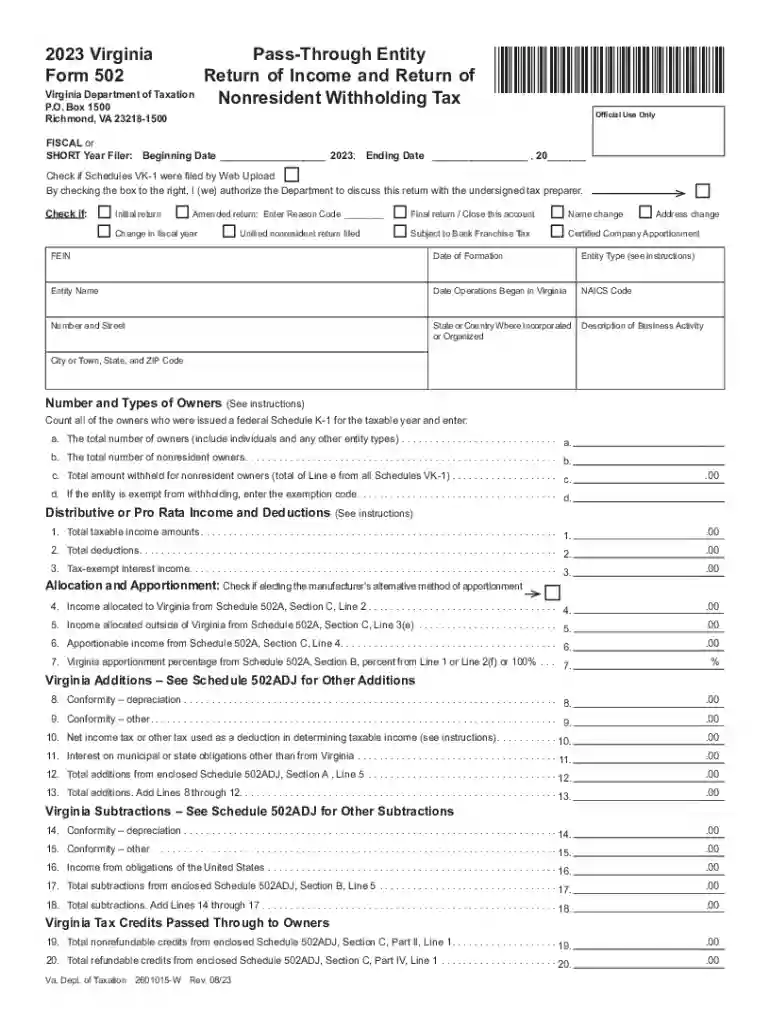
Draft 2023 Form 502 - Pass-Through Entity Return of Income and Return of Nonresident Withholding Tax-2026

Get Form
Draft 2023 Form 502 - Pass-Through Entity Return of Income and Return of Nonresident Withholding Tax Preview on Page 1

Here's how it works

01. Edit your form online
Type text, add images, blackout confidential details, add comments, highlights and more.

02. Sign it in a few clicks
Draw your signature, type it, upload its image, or use your mobile device as a signature pad.

03. Share your form with others
Send it via email, link, or fax. You can also download it, export it or print it out.

Definition and Purpose of Draft 2023 Form 502

Draft 2023 Form 502 is designed for pass-through entities to report income and nonresident withholding tax in Virginia. This tax form is essential for entities such as partnerships, S corporations, and LLCs taxed as partnerships. It captures financial activities and compliance with state tax regulations for the given fiscal year.

Key Components of Draft 2023 Form 502

  • Entity Information: Requires the legal name, federal employer identification number (FEIN), and type of organization.
  • Income Allocation: Details how income is distributed among owners or members.
  • Deductions: This section outlines allowable deductions that reduce taxable income.
  • Tax Calculations: Involves computations of due taxes and applicable credits or penalties.

Steps to Complete Draft 2023 Form 502

  1. Gather Required Documents: Collect financial statements, ownership details, and past tax returns.
  2. Fill in Entity Information: Input basic entity details such as name, address, and FEIN.
  3. Calculate and Allocate Income: Distribute income among owners as per their share.
  4. Deduction Entries: Accurately list all eligible deductions to minimize taxable income.
  5. Final Tax Computation: Determine total tax liability, accounting for withholding and eligible credits.
  6. Review and Submit: Double-check entries, then submit via the chosen method of filing.

Important Dates and Deadlines

  • Filing Deadline: Typically, the form must be filed by March 15, but exact dates can vary annually. Verify current deadlines and potential extensions.

Who Should Use Draft 2023 Form 502

Entities structured as pass-through organizations in Virginia must file this form. Key users include:

  • Limited Liability Companies (LLCs): Taxed as partnerships.
  • S Corporations: Must report share of income.
  • General Partnerships: Required to disclose income distribution among partners.

Legal Use of Draft 2023 Form 502

Filing Form 502 is a legal obligation for applicable Virginia pass-through entities. Non-compliance can lead to penalties, making timely and accurate filing critical. The form serves as an official declaration of income, deductions, and credits to the Virginia Department of Taxation.

Important Terms Related to Draft 2023 Form 502

  • Withholding Tax: Tax withheld from nonresident members' share of Virginia income.
  • Deductions: Allowable reductions to taxable income.
  • Pass-Through Entity: A business that passes its income through to its owners for tax purposes.
  • Credits: Tax relief measures that can be deducted from the entity’s tax obligation.

How to Obtain Draft 2023 Form 502

The form can be acquired via the Virginia Department of Taxation's website or requested directly through mail. Using online platforms ensures access to the latest version of the form.

Software Compatibility and Filing Methods

Draft 2023 Form 502 can be filled using tax software such as TurboTax or QuickBooks, which are compatible with Virginia state tax forms.

  • Online Submission: Offers convenience and quicker processing.
  • Mail: Traditional option suitable for those preferring physical submission.

Penalties for Non-Compliance

Failing to accurately complete and file Draft 2023 Form 502 can result in penalties. Entities may incur fines for late filing, incomplete information, or inaccuracies in tax calculations. Understanding reporting requirements and adhering to deadlines is crucial to avoid such issues.

be ready to get more

Complete this form in 5 minutes or less

Get form

Got questions?

We have answers to the most popular questions from our customers. If you can't find an answer to your question, please contact us.
Contact us
An electing PTE must file Form 502PTET to compute the Virginia income tax at the entity level. The checkbox on Form 502PTET, Page 1 must be marked in order to confirm the election and docHub the consent of eligible owners. Once Form 502PTET is filed, the election is binding for that taxable year.
The PTE is required to withhold 5% of the share of taxable income from Virginia sources that is allocable to each nonresident owner. The amount of withholding tax may be reduced by any tax credits that were earned by the PTE and allowable by the Code of Virginia that pass through to nonresident owners.
Eligibility Criteria Partnerships, S corporations, and multi-member LLCs taxed as such are generally eligible to opt for state PTET. Conversely, sole proprietorships, single-member LLCs taxed as sole proprietorships, C corporations, most trust structures, and LLCs taxed as C corporations are typically ineligible.
S Corporations, Partnerships, and Limited Liability Companies. Every pass-through entity (PTE) that does business in Virginia or receives income from Virginia sources must file an annual Virginia income tax return on Form 502 or Form 502PTET.
How to File and Pay - Elective Pass-Through Entity Tax (PTET) (Form 502 PTET) PTEs can choose to pay Virginia income tax at the entity level, transferring the tax liability from the eligible owners of the entity to the entity itself.

Security and compliance

At DocHub, your data security is our priority. We follow HIPAA, SOC2, GDPR, and other standards, so you can work on your documents with confidence.
Learn more
ccpa2
pci-dss
gdpr-compliance
hipaa
soc-compliance
be ready to get more

Complete this form in 5 minutes or less

Get form

People also ask

Eligible owners of a PTE are: Natural persons who are subject to Virginia income tax, or. Estates or trusts subject to Virginia income tax.
Business income from pass-throughs is generally not taxed at the entity level. Instead, the companys owners pay tax on that income through their own individual returns. Because the SALT cap applies to individual income, individual owners of pass-through companies lost access to the full deduction.
In short, a key benefit of PTET is that eligible pass-through entities can avoid the $10,000 SALT deduction cap on deducting state and local taxes on federal individual tax returns.

Related links