




01. Edit your form online
Type text, add images, blackout confidential details, add comments, highlights and more.

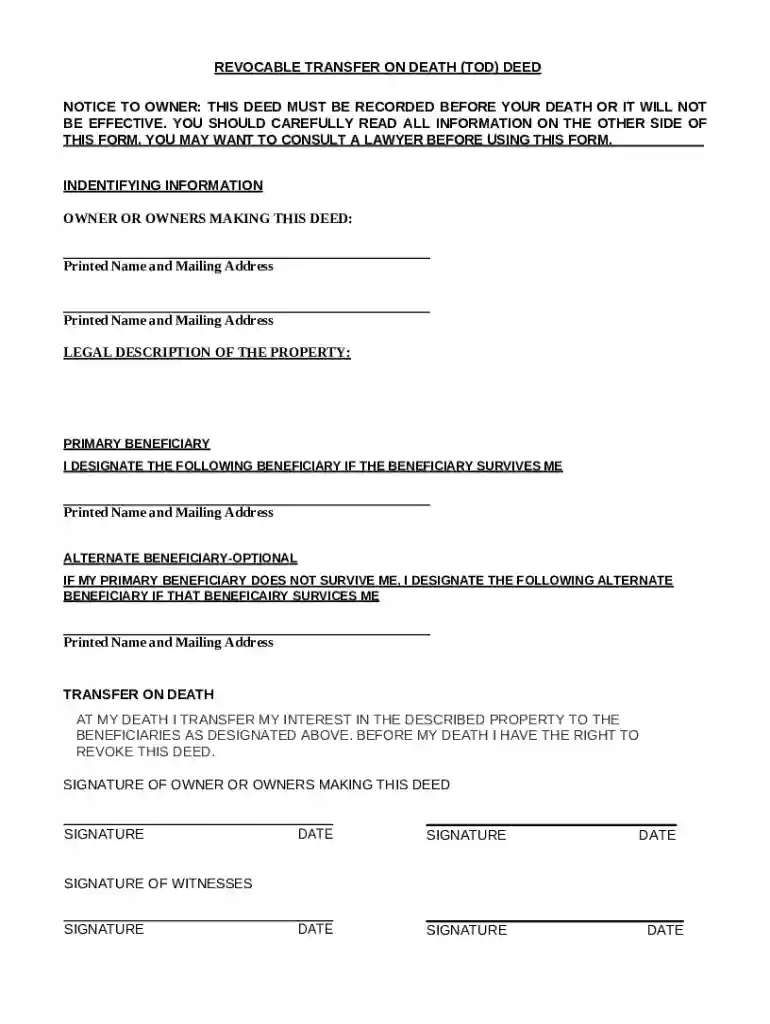
Type text, add images, blackout confidential details, add comments, highlights and more.

Draw your signature, type it, upload its image, or use your mobile device as a signature pad.

Send it via email, link, or fax. You can also download it, export it or print it out.
A Revocable Transfer on Death Deed, often referred to as a form-TOD-deed, is a legal document that allows property owners to transfer their real estate to designated beneficiaries upon their death, bypassing the probate process. This deed becomes effective only after the death of the property owner, allowing them to maintain control over the property during their lifetime. By using a form-TOD-deed, property owners can ensure a smooth transition of ownership, reduce legal complexities for heirs, and avoid the length and expense of probate proceedings. It is essential to understand that the deed must be appropriately recorded and, in some cases, executed in compliance with specific state regulations to be valid.
When utilizing a form-TOD-deed, property owners must carefully follow several steps to ensure its legality and effectiveness. Firstly, the deed should be accurately filled out with all necessary information, including the names and contact details of the primary and any alternate beneficiaries. It’s crucial to clearly specify the property being transferred, providing the legal description exactly as it appears on the existing deed. Once completed, the form should be signed in the presence of a notary public. It’s recommended to consult with a legal professional to confirm compliance with state-specific requirements and ensure that the document reflects your wishes accurately. Finally, the deed must be recorded with the appropriate county recorder’s office to take effect upon the owner’s death.
Gather Information: Begin by collecting the necessary details about your property and beneficiaries. This includes legal property descriptions and beneficiary identification.
Fill Out the Deed: Enter the pertinent information into the form, ensuring all fields are completed accurately. This may include specific instructions for any conditions tied to the transfer.
Notarization: Sign the deed in the presence of a notary public. This step is crucial for the deed’s legality and must adhere to state-specific notarization laws.
Record the Deed: Once signed and notarized, submit the deed to the appropriate county recorder’s office. Recording the document is vital as it validates the transfer intention, ensuring the property is transferred to the named beneficiaries upon death.
Retain Copies: Keep a copy of the recorded deed for your records, and inform beneficiaries of the deed’s existence and location.
The form-TOD-deed comprises several critical elements to ensure its validity and execution:
The form-TOD-deed is a versatile tool for estate planning, providing a straightforward means to transfer property upon death outside the court system. As a legally binding document, it offers advantages like avoiding probate, reducing legal costs, and expediting the inheritance process. However, it remains essential to comply with state-specific statutes governing its use. The deed should only be employed when the property owner has a clear plan for asset distribution and recognizes that it does not substitute for a comprehensive estate plan where other assets are involved.
State laws can vary significantly concerning the form-TOD-deed, with requirements differing in terms of notarization, filing, and revocation. For example, some states might require witnesses in addition to notarization, while others might have specific mandates about recording within certain timeframes to maintain validity. Property owners should consult local resources or legal experts to understand their state's particular guidelines. This ensures the deed's enforceability and aligns with regional regulations, safeguarding the beneficiaries and the intent of asset transfer.
Consider a scenario where Sarah, a single homeowner in California, wishes to transfer her residence to her two children upon her passing. By using a form-TOD-deed, she can accomplish this without the need for her children to undergo the probate process. As another example, John in Texas records a TOD deed to ensure his family farm transitions seamlessly to his nephew, ensuring continuity in farm management. These examples reflect how individuals across various states can leverage the form-TOD-deed to streamline asset distribution, maintain privacy, and adhere to their estate planning strategies.
While traditionally, a TOD deed might be completed using physical copies, digital versions are increasingly prevalent, offering convenience and accessibility. Digital platforms, such as DocHub, provide tools for electronically completing, signing, and storing TOD deeds, which can significantly reduce time and logistical hurdles. However, despite the advantages of a digital format, recording requirements typically necessitate submission of physically signed and notarized documents. Consequently, while digital formats assist in preparing the document, final steps usually involve converting to a tangible copy for ultimate submission and recording.
To successfully record a form-TOD-deed, ancillary documents may be necessary, including:
By compiling these documents ahead of time, property owners can facilitate a smoother execution and recording process, minimizing delays and ensuring the TOD deed’s timely acceptance.
We've got more versions of the form-TOD-deed form. Select the right form-TOD-deed version from the list and start editing it straight away!
| Versions | Form popularity | Fillable & printable |
|---|---|---|
| 2024 | 4.7 Satisfied (34 Votes) |
At DocHub, your data security is our priority. We follow HIPAA, SOC2, GDPR, and other standards, so you can work on your documents with confidence.


Jun 30, 2025 Use this deed to transfer the residential property described below directly to your named beneficiaries when you die. YOU SHOULD CAREFULLY READ.Read more
This is also called a transfer-on-death deed, Naming a transfer-on-death beneficiary allows you to choose someone to inherit your home, may offer tax benefits,


