




01. Edit your form 3800 online
Type text, add images, blackout confidential details, add comments, highlights and more.

Type text, add images, blackout confidential details, add comments, highlights and more.

Draw your signature, type it, upload its image, or use your mobile device as a signature pad.

Send 3800 via email, link, or fax. You can also download it, export it or print it out.
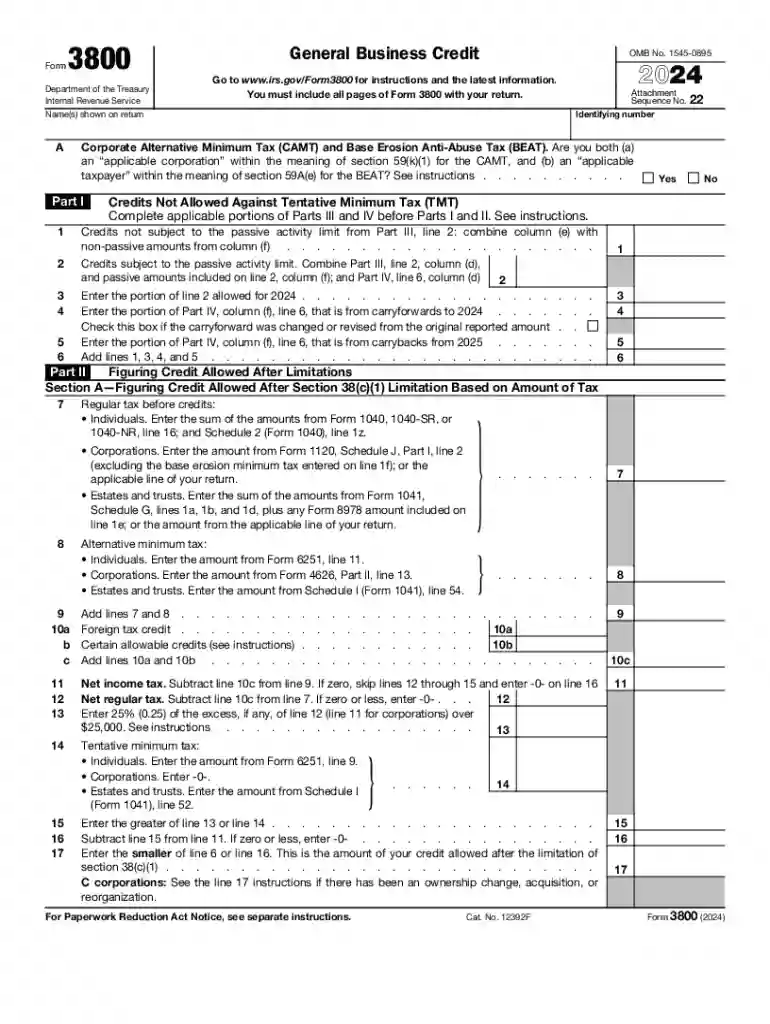
Form 3800, the General Business Credit, is a vital document issued by the Internal Revenue Service (IRS) in the United States. It serves as a comprehensive method for taxpayers to summarize and report various business credits. These credits are essential as they can significantly reduce a business's total tax liability, providing financial relief and encouraging economic activities aligned with government priorities. Credits included in Form 3800 can range from investment credits to energy efficiency initiatives. Understanding the strategic importance of this form can aid businesses of all sizes in optimizing their tax strategy and ensuring compliance with federal fiscal policies.
Businesses can obtain Form 3800 through multiple channels, ensuring accessibility for all users. The IRS website is the primary platform where the form can be downloaded in both PDF and interactive formats. Additionally, tax preparation software such as TurboTax and QuickBooks includes access to Form 3800, streamlining the integration with a business's financial data. It's important to ensure that the downloaded form is the latest version to reflect current tax laws and regulations. For those preferring a physical copy, local IRS offices and some public libraries may offer printed versions.
Gather Required Information: Before starting, collect all relevant documentation related to eligible credits. This may include financial records, previous year carryover credits, and any IRS notices or publications related to specific credits.
Determine Eligible Credits: Review the list of business credits applicable for the current tax year. Common credits include the investment credit, research activities credit, and low-income housing credit.
Complete Individual Credit Forms: Each specific credit requires its form (e.g., Form 3468 for the Investment Credit), which should be filled out prior to Form 3800.
Summarize on Form 3800: Transfer data from individual credit forms to Form 3800, ensuring accuracy in the calculation of total allowable credits.
Apply Limitations: The total credit amount may be subject to limitations based on taxable income, which must be calculated to determine the allowable credit for the year.
Review and Submit: Double-check all entries for accuracy and attach Form 3800 with your regular business tax return for submission by the appropriate deadline.
Part I: Current Year Business Credits: This section requires details on all the different types of business credits a taxpayer is claiming.
Part II: Allowable Credit: Here, the total allowable credit for the current year is calculated, considering any income limitations.
Part III: Carryforward and Carryback: This section accommodates credits from previous years or any that can be carried forward to future years.
Familiarity with these key sections is crucial for the seamless completion of the form.
Eligibility for the business credits listed on Form 3800 depends on specific factors, including business activities, investments made, and compliance with industry regulations. For example:
Each credit has distinct eligibility requirements that must be thoroughly reviewed and substantiated with documentary evidence.


Form 3800 is predominantly utilized by businesses, regardless of their size or structure. This encompasses:
Ultimately, any taxpayer eligible for multiple general business credits will rely on Form 3800.
Compliance with the correct filing of Form 3800 ensures that a business can benefit fully from tax credits without jeopardizing its standing with the IRS. Non-compliance can result in financial penalties, increased scrutiny from tax authorities, and the potential loss of credit accrual benefits. Additional costs may include interest on unpaid taxes attributable to incorrect credit application. Proper understanding and utilization of Form 3800 not only optimize business tax strategy but also safeguard against unnecessary financial burdens and legal challenges.
Form 3800 is widely supported by major tax preparation software, which facilitates efficient preparation. Platforms like TurboTax and QuickBooks offer seamless integration, enabling the automatic transfer of financial data to the form. This not only minimizes manual entry errors but also ensures compliance with IRS requirements. For businesses managing large volumes of financial data, leveraging these software solutions can significantly enhance accuracy and expedite the filing process. Such tools offer invaluable support for modern business tax management.
The IRS sets specific guidelines and dates for filing Form 3800. Typically, Form 3800 should be filed together with the business's annual tax return. For most businesses, this deadline falls on March 15th for partnerships and S-corporations, and April 15th for C-corporations. It's crucial to adhere to these deadlines to avoid penalties and interest. If a filing extension is necessary, the IRS allows businesses to request it, adjusting the deadlines accordingly. Keeping apprised of these guidelines ensures compliance and optimal utilization of available tax credits.
We've got more versions of the form 3800 form. Select the right form 3800 version from the list and start editing it straight away!
At DocHub, your data security is our priority. We follow HIPAA, SOC2, GDPR, and other standards, so you can work on your documents with confidence.






The general business credit consists of the following: do not file Form 3800. Instead, file only the applicable credit form. enter on line 15 the total of the
8 days ago Our income tax calculator enables you to easily calculate your net wage, which remains after deducting all taxes and contributions.


