Definition & Meaning
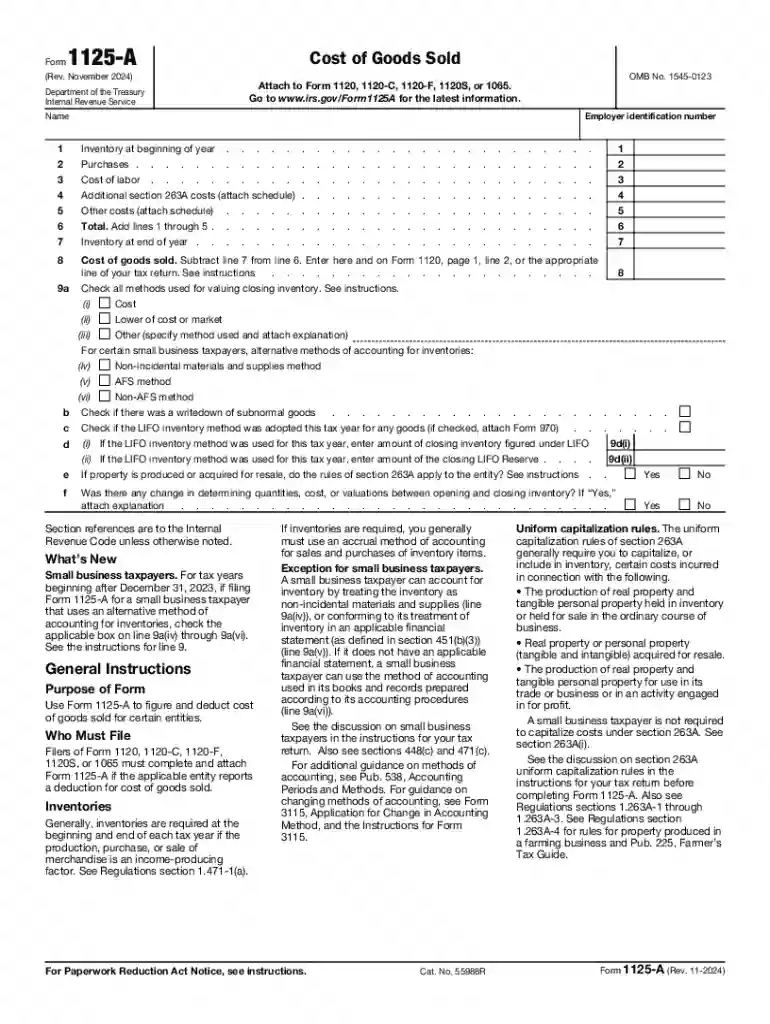
Form 1125-A, Cost of Goods Sold, is a tax document used by certain businesses to calculate and report the cost of goods sold (COGS) on their tax returns. This form is vital for entities that deal in inventory and need to deduct these costs from their gross income to determine their taxable income. The form assists in outlining inventory costs, purchases, labor, and other expenses associated with the production or procurement of goods.
Key Aspects of Form 1125-A
- Purpose: To report COGS, which is deducted from gross receipts to determine gross profit.
- Coverage: Includes details on beginning and ending inventory, purchases, labor, materials, and any indirect costs.
- Application: Mainly used by manufacturing, wholesale, and retail companies.
Steps to Complete the Form 1125-A
Filling out Form 1125-A requires accurate accounting of your inventory and related costs. Here's a step-by-step guide:
- Determine Inventory Levels: Begin by calculating your inventory at the start and end of the tax year.
- Purchases and Production Costs: Record all purchases and costs associated with producing the goods sold.
- Add Additional Costs: Include direct labor costs and any other costs that can be attributed to the production process.
- Calculate Total COGS: Use the sums from the above steps to compute the total COGS, which reduces your taxable income.
- Attach to Tax Return: Submit the completed form with your tax return, such as Form 1120 or 1065.
Important Terms Related to Form 1125-A
Understanding specific terminology is essential for accurately filling out Form 1125-A:
- Inventory: The raw materials, work-in-process goods, and finished products that a business holds for sale.
- Direct Labor: Wages for workers directly involved in the production of goods.
- Indirect Costs: Overhead expenses related to production that are not directly traceable to a specific product.
Legal Use of Form 1125-A
Compliance with tax regulations requires understanding the legal implications of Form 1125-A.
Regulations
- Uniform Capitalization Rules: Under section 263A, some costs must be capitalized into inventory rather than being expensed.
- Filing Requirements: Must be attached to the corresponding tax form for all entities with business operations involving inventory.
Consequences of Misuse
Failure to accurately complete or submit Form 1125-A can result in:
- Penalties: Misreporting costs may lead to substantial fines.
- Audits: Incorrect filings may trigger IRS audits, increasing scrutiny of your financial records.
Applicable Entity Types
- Manufacturers: Who convert raw materials into finished goods.
- Retailers: Who sell goods directly to consumers.
- Wholesalers: Who sell goods in bulk at discounted prices to retailers or other merchants.
IRS Guidelines
The IRS provides specific guidelines for completing Form 1125-A, which outline how to properly report COGS.
Key Instructions
- Inventory Methods: Acceptable methods include FIFO, LIFO, and the specific identification method.
- Documentation: Maintain thorough records of all inventory and related costs throughout the year.
- Alternative Accounting Methods: Small businesses may have the option to simplify their reporting under certain conditions.
Filing Deadlines / Important Dates
Proper timing is crucial to avoid penalties related to Form 1125-A.
- Submission Date: Typically follows the deadline of the primary business tax return it's attached to, e.g., March 15 for calendar year partnerships.
- Extensions: Businesses may be eligible for extensions, but must be filed by the extended deadline.
Required Documents
Collecting and maintaining the correct documentation streamlines the completion and submission of Form 1125-A.
Necessary Records
- Inventory Listings: Detailed information on inventory costs.
- Invoices and Receipts: For all purchases and labor costs.
- Payroll Records: Supporting documentation for direct labor costs allocated to COGS.
Business Entity Types (LLC, Corp, Partnership)
Understanding what type of business entity you operate can influence how you use Form 1125-A.
Implications for Different Entities
- Corporations (C-Corps/S-Corps): Typically required to report COGS in their corporate tax returns.
- Partnerships: Use Form 1065 in conjunction with Form 1125-A to report business income.
- LLCs: May need to file separately depending on whether they are treated as corporations or partnerships for tax purposes.