




01. Edit your form 8858 online
Type text, add images, blackout confidential details, add comments, highlights and more.

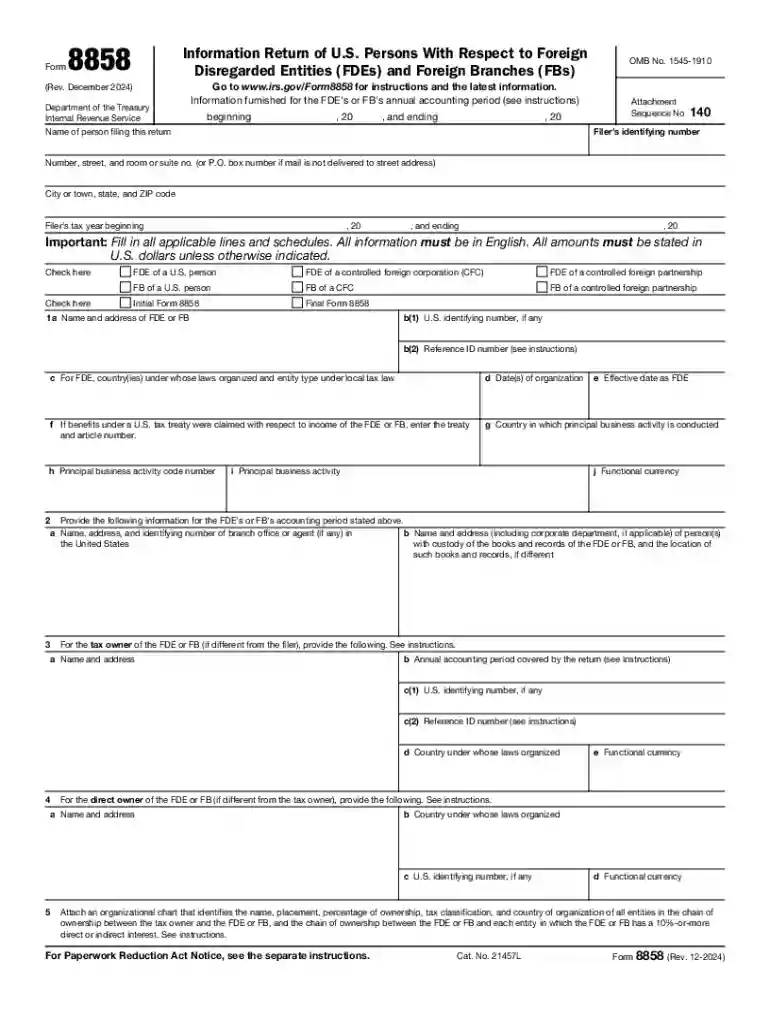
Type text, add images, blackout confidential details, add comments, highlights and more.

Draw your signature, type it, upload its image, or use your mobile device as a signature pad.

Send irs form 8858 via email, link, or fax. You can also download it, export it or print it out.
Tax Form 8858 serves as an information return mandated by the U.S. Internal Revenue Service. It is required for U.S. persons who have interests in foreign disregarded entities (FDEs) and foreign branches (FBs). The primary purpose of Form 8858 is to ensure compliance with U.S. tax regulations concerning foreign entities by capturing comprehensive information on income, expenses, ownership, and other relevant financial data. This form helps the IRS maintain transparency in international financial activities of U.S. taxpayers, mitigating the risk of tax evasion in foreign territories.
The form includes essential sections that U.S. persons must address to report their foreign entity-related activities accurately:
Tax Form 8858 is used primarily by U.S. individuals who own or are involved with foreign disregarded entities or branches. To utilize the form effectively, one should:
The process of completing Form 8858 involves several key steps:
Understanding specific legal and technical terms associated with Form 8858 is crucial:
Timely submission of Tax Form 8858 is essential to avoid penalties. The form must be filed alongside the tax return of the U.S. person in charge of the foreign entity. Here are the critical timelines:
Failure to file Form 8858 correctly or on time can result in severe penalties:
Individuals or entities that interact with foreign disregarded entities or branches are required to use Form 8858. Typical users include:
By understanding these essential components and processes, filers can ensure compliance with IRS regulations and avoid potential penalties associated with tax reporting errors involving foreign disregarded entities.
We've got more versions of the form 8858 form. Select the right form 8858 version from the list and start editing it straight away!
At DocHub, your data security is our priority. We follow HIPAA, SOC2, GDPR, and other standards, so you can work on your documents with confidence.




T 22.51:8858/INST./. Schedule M (Form 8858), transactions between foreign disregarded entity of a foreign tax owner and the filer or other related entities.Read more
Jun 27, 2026 Form 8858 Title Information Return of U.S. Persons With Respect to Foreign Disregarded Entities (FDEs) Transactions Between Foreign Disregarded


