




01. Edit your ee savings bonds current value online
Type text, add images, blackout confidential details, add comments, highlights and more.

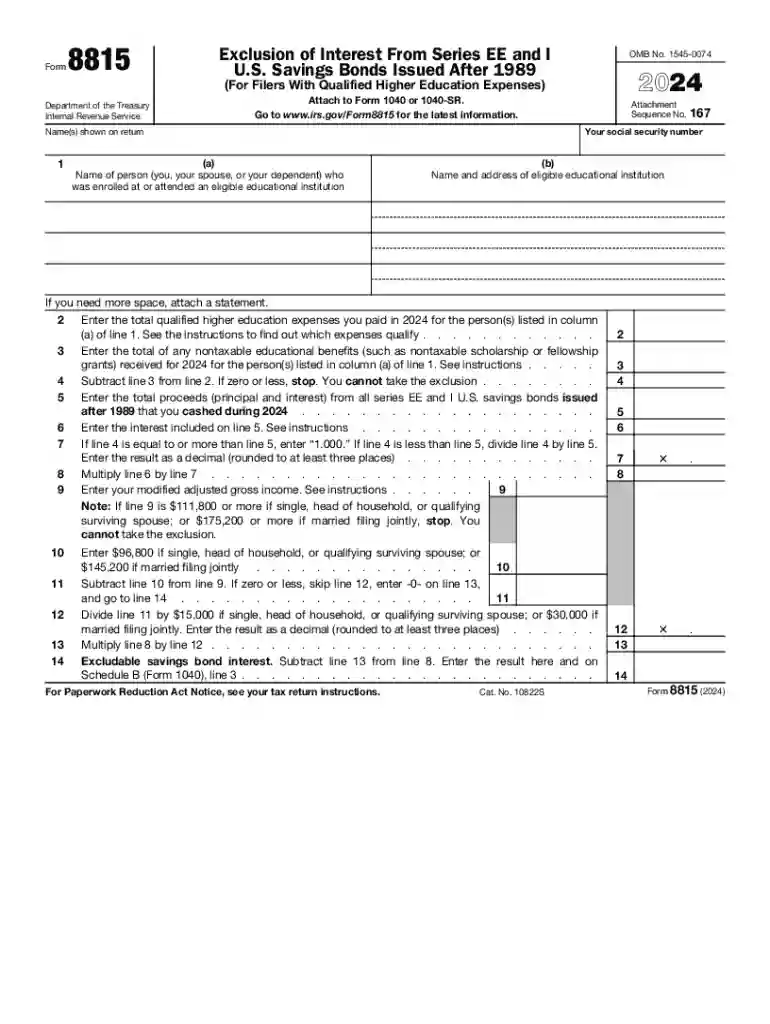
Type text, add images, blackout confidential details, add comments, highlights and more.

Draw your signature, type it, upload its image, or use your mobile device as a signature pad.

Send ee bonds value calculator via email, link, or fax. You can also download it, export it or print it out.
Form 8815, officially known as "Exclusion of Interest From Series EE and I U.S. Savings Bonds Issued After 1989," is integral in calculating the exclusion of interest for taxpayers with qualified higher education expenses. This form allows you to exclude interest from specific U.S. savings bonds from taxable income, provided that the bonds are used to fund educational costs. Understanding the role of Form 8815 is crucial for taxpayers seeking to minimize their tax liability while supporting educational expenses.
Eligibility for using Form 8815 hinges on several factors primarily involving the taxpayer's financial situation and educational expenses. Understanding these criteria helps ensure compliance and correct form usage, thus preventing possible errors during filing.


Accessing Form 8815 is a straightforward process that can be completed through various methods. Knowing where to locate this form ensures that taxpayers can begin the exclusion process promptly.
Completing Form 8815 involves several specific steps that require detailed information about your bonds and educational expenses. Following the process correctly ensures the proper exclusion of bond interest.
Understanding common terminology related to Form 8815 is essential for accurately processing the form. These terms clarify the conditions and components needed to complete the process correctly.
Form 8815 is legally binding, allowing taxpayers to reduce taxable income by reporting qualified exclusions legitimately. Ensuring the legal use of Form 8815 involves understanding compliance and reporting obligations.
The IRS provides specific guidelines for Form 8815, which offer clarity on its application and handling. Adhering to these guidelines is crucial for any taxpayer intending to use this form for interest exclusions.
Meeting filing deadlines is critical for utilizing Form 8815 benefits within the allowable tax year. Missing these deadlines can result in penalties or denial of the interest exclusion.
We've got more versions of the ee savings bonds current value form. Select the right ee savings bonds current value version from the list and start editing it straight away!
| Versions | Form popularity | Fillable & printable |
|---|---|---|
| 2025 | 4.9 Satisfied (20 Votes) | |
| 2024 | 4.7 Satisfied (46 Votes) | |
| 2023 | 4.9 Satisfied (33 Votes) | |
| 2022 | 4.4 Satisfied (45 Votes) | |
| 2021 | 4.8 Satisfied (82 Votes) | |
| 2020 | 4.3 Satisfied (58 Votes) | |
| 2019 | 4.4 Satisfied (155 Votes) | |
| 2018 | 4 Satisfied (43 Votes) | |
| 2017 | 4.3 Satisfied (115 Votes) | |
| 2016 | 4.1 Satisfied (34 Votes) | |
| 2015 | 4.2 Satisfied (52 Votes) | |
| 2014 | 4.1 Satisfied (61 Votes) | |
| 2013 | 4.1 Satisfied (42 Votes) | |
| 2012 | 4 Satisfied (52 Votes) | |
| 2011 | 4 Satisfied (28 Votes) |
At DocHub, your data security is our priority. We follow HIPAA, SOC2, GDPR, and other standards, so you can work on your documents with confidence.



Form 8815 is used to figure the amount of interest you can exclude from your income when you file your income tax return.
Mar 30, 2026 Form 8815 is used to figure the amount of interest you can exclude from your income when you file your income tax return.


