




01. Edit your 8801 tax form online
Type text, add images, blackout confidential details, add comments, highlights and more.

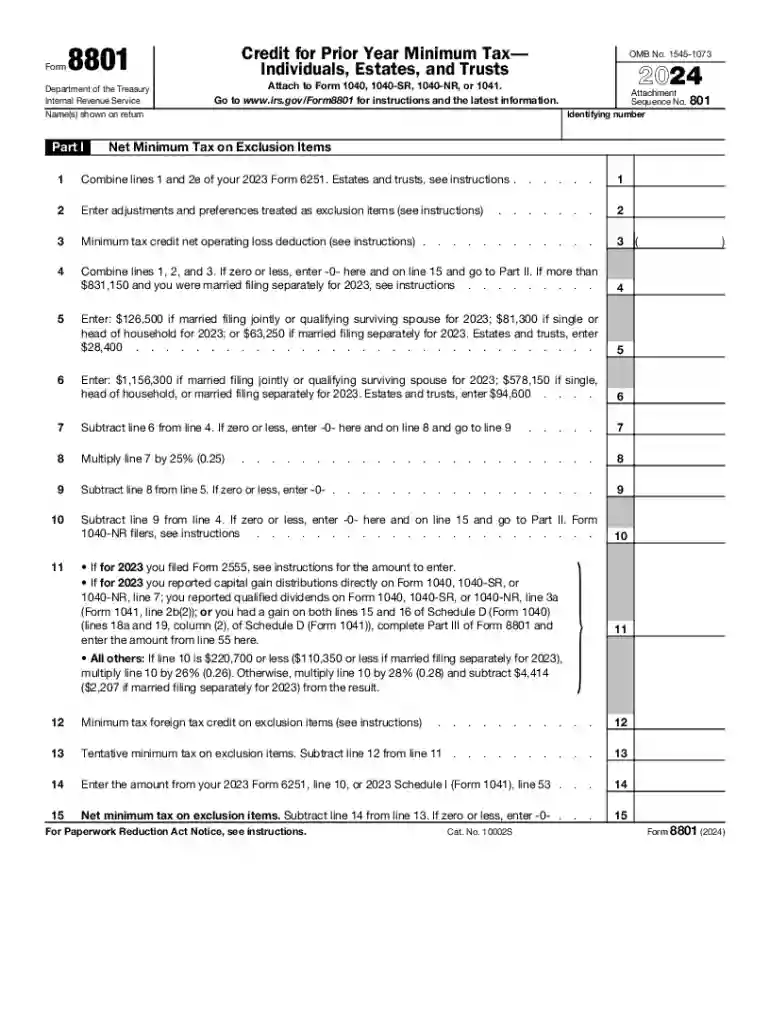
Type text, add images, blackout confidential details, add comments, highlights and more.

Draw your signature, type it, upload its image, or use your mobile device as a signature pad.

Send 8801 pdf via email, link, or fax. You can also download it, export it or print it out.
Form 8801, titled "Credit for Prior Year Minimum Tax—Individuals, Estates, and Trusts," is a tax document used primarily by taxpayers who have been subject to the Alternative Minimum Tax (AMT) in the previous tax year. This form enables these entities to calculate and claim a credit against their regular tax liability in the current year. The credit represents a portion of the AMT paid in prior years that surpasses the AMT liability of the current year. Calculating this credit requires detailed tax information from previous years to determine the net minimum tax on exclusion items and the allowable minimum tax credit.
Form 8801 is readily available for individuals, estates, and trusts through several channels. It can be downloaded directly from the Internal Revenue Service (IRS) website, where the latest versions and instructions are typically posted. Additionally, tax preparation software such as TurboTax and QuickBooks often include integrated versions of the form, allowing users to fill it out digitally. Tax professionals and CPAs can also provide the form for their clients, ensuring correct application based on specific financial records and situations.
Gather Previous Year Tax Information: Collect tax returns and associated documentation from the year in which AMT was paid. These documents include details on income items, deductions, and associated taxes.
Complete Part I – Net Minimum Tax on Exclusion Items: Calculate the net minimum tax using exclusion items from the prior year. This involves adjusting the regular tax liability by adding back specific items that apply only to AMT calculations.
Calculate the Credit in Part II: Use the details from Part I to compute available minimum tax credits for the current year. This step requires understanding previous minimum tax payments and determining the carryover amounts.
Input Values into Part III – Minimum Tax Credit Carryforward: Determine the amount of credit that can be carried forward to future years if the current year credit is not fully utilized.
Review and Submit: Carefully review all computations for accuracy before submitting the form along with your tax return by the appropriate deadline.
Alternative Minimum Tax (AMT): A tax system parallel to the regular income tax that ensures individuals, estates, and trusts pay a minimum amount of tax.
Exclusion Items: These are specific items of income or deductions that can impact AMT calculations but are not considered under regular tax rules.
Credit Carryforward: Unused portions of the credit for prior year minimum tax that can be carried into future tax years to offset regular tax liabilities.
To use Form 8801, individuals, estates, or trusts must have paid AMT in a previous year. Essentially, if a taxpayer was liable for AMT in prior tax periods and their current year tax situation allows for a potential credit, they are eligible to file this form. This eligibility often involves having a significant difference between regular tax calculations and AMT due to specific income or deduction adjustments.


The IRS issues guidelines to ensure that taxpayers correctly apply the credit and adhere to all regulatory requirements. These include instructions for each line item on Form 8801, descriptions of applicable tax items that influence AMT calculations, and explanations of how credit carryforwards work. Regular consultation with IRS updates can prevent errors and misinformation, particularly as tax laws frequently change.
The deadline for filing Form 8801 aligns with the tax return deadline, generally April 15 for the previous calendar year's taxes. The form can be submitted electronically through tax software, which offers convenience and often checks for mathematical errors. Alternatively, paper submissions via traditional mail are available, though these may require more manual checks for accuracy and completeness.
Several scenarios exist where individuals may find Form 8801 relevant. This includes high-income earners with significant deductions or exclusions typically subject to AMT calculations. Trusts or estates with considerable capital gains or distributions may also require this form, especially if AMT was previously applied. Understanding the nuances of these scenarios can help taxpayers effectively utilize any potential credit.

While both digital and paper versions of Form 8801 are available, each has distinct advantages. Digital forms, accessible through tax software, often simplify calculations with built-in checks and balances, reducing errors and verifying compliance with the IRS standards. The paper version requires manual computation, but can be beneficial for those who prefer directly handling their documentation. Taxpayers should choose the format that best suits their workflow preferences and technical comfort level.
We've got more versions of the 8801 tax form form. Select the right 8801 tax form version from the list and start editing it straight away!
At DocHub, your data security is our priority. We follow HIPAA, SOC2, GDPR, and other standards, so you can work on your documents with confidence.




General business credit. Attach Form 3800 (see instructions) ~~~~~~~~~~~~. Credit for prior-year minimum tax (attach Form 8801 or 8827) ~~~~~~~~~~~~. Add
Jun 27, 2026 Product Number Form 8801 Title Credit for Prior Year Minimum Tax - Individuals, Estates, and Trusts, Revision Date 2024 ; Product NumberRead more


