






Definition and Purpose of IRS 1040-NR (SP) 2
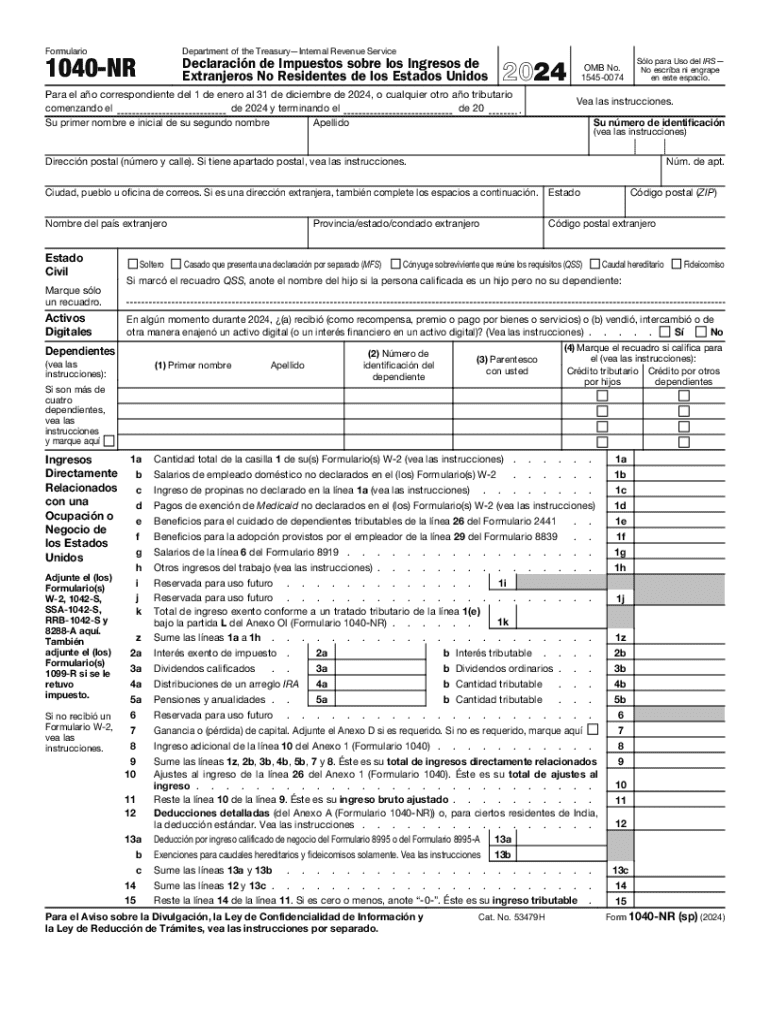
The IRS 1040-NR (SP) form, also known as the "Nonresident Alien Income Tax Return (Spanish version)," is designed specifically for non-resident aliens in the United States to report their income tax obligations. This document caters to individuals whose native language is Spanish, providing them with the necessary instructions and sections to accurately file taxes without language barriers. The form is critical for accountability and tax compliance among nonresident aliens earning income in the U.S., ensuring they can report various income sources, deductions, and credits applicable under U.S. tax law.
How to Use the IRS 1040-NR (SP) 2
Filing the IRS 1040-NR (SP) is a straightforward process designed for Spanish-speaking nonresident aliens. Begin by gathering all necessary financial documents, including income statements, deductions, and proof of any tax credits. Each section requires detailed information about your personal data, income, and any eligible deductions or credits that may minimize your tax liability. A key feature of this form includes the delineation of income by type, such as wages, interest, or dividends, ensuring precise reporting. Review your tax details meticulously to ensure complete accuracy, minimizing any risk of filing errors or subsequent amendments.
Detailed Instructions for Key Sections
- Personal Information: Provide accurate details, such as name, address, and Social Security Number or Individual Taxpayer Identification Number.
- Income Section: Enter all income derived from U.S. sources, segmenting by wages, salaries, and other relevant income streams.
- Deductions and Credits: Record any deductions, such as educational expenses or child tax credits, to lessen taxable income appropriately.
Steps to Complete the IRS 1040-NR (SP) 2
- Collect Documentation: Ensure all necessary documents, such as income statements (Form W-2, 1099s), are gathered in advance.
- Fill Personal Details: Accurately input your personal information at the top of the form.
- Report Income: Carefully document all income from U.S. sources, using the provided categories to maintain accuracy.
- Claim Deductions and Credits: Complete sections related to deductions and credits, ensuring you provide supporting documentation as needed.
- Review for Accuracy: Double-check all entries and calculations before proceeding to submission.
- Submit the Form: File the completed form by mail or electronically through the IRS-approved e-filing system before the deadline.
Who Typically Uses the IRS 1040-NR (SP) 2
This form is primarily aimed at nonresident aliens who receive income from U.S. sources. These individuals could be foreign nationals working temporarily or completing short-term contracts in the United States. Entrepreneurs operating businesses overseas but collecting revenue within the U.S. may also need to utilize this form for their filing requirements. Moreover, those studying in the U.S. or visiting for extended periods and who earn income must also adhere to this tax filing procedure.


Important Terms Related to IRS 1040-NR (SP) 2
Understanding specific terminology is essential for accurately completing the form:
- Nonresident Alien: An individual who is not a U.S. citizen or resident alien, yet earns income within the U.S.
- U.S. Income: Earnings derived from services rendered or investments within the United States.
- Exemption: A deductible amount that reduces the income subject to tax.
- Tax Treaty: Agreements between countries to specify tax rights, potentially reducing taxable income through applicable benefits.
Filing Deadlines and Important Dates
The IRS 1040-NR (SP) 2 must be submitted on or before April 15, 2025, aligning with the standard U.S. tax deadline unless otherwise warranted. Nonresident aliens filing late are subject to penalties and interest on any overdue tax amounts. Timely filing is critical to avoid additional financial burdens and to fulfill tax obligations. Extensions may be requested by submitting the appropriate IRS forms, providing additional time for complex tax scenarios without incurring late penalties.
Form Submission Methods for IRS 1040-NR (SP) 2
The IRS offers multiple avenues for submitting the completed form:
- Online: Use the IRS-authorized e-filing system, which supports Spanish-language submissions for ease and efficiency.
- Mail: If preferred, completed forms can be sent to the IRS via standard mail service, ensuring a postmark before the deadline.
- Professional Service: Employ a certified tax preparer familiar with nonresident alien taxes to manage the submission process.
Software Compatibility with IRS 1040-NR (SP) 2
Numerous tax software solutions, such as TurboTax or QuickBooks, are compatible with this form, offering features that simplify entry, calculation, and electronic submission for tax preparers or self-filers. These programs often include guided assistance in Spanish to help complete forms accurately. Utilizing compatible software can streamline filing, provide automatic calculations, and ensure compliance with current tax regulations, enhancing the filing process for nonresident aliens proficient in Spanish.
By understanding and utilizing the IRS 1040-NR (SP) 2 form accurately, nonresident aliens can ensure compliance with U.S. tax obligations while maximizing their ability to claim applicable deductions and credits, helping to minimize their fiscal responsibility effectively.