Definition & Meaning
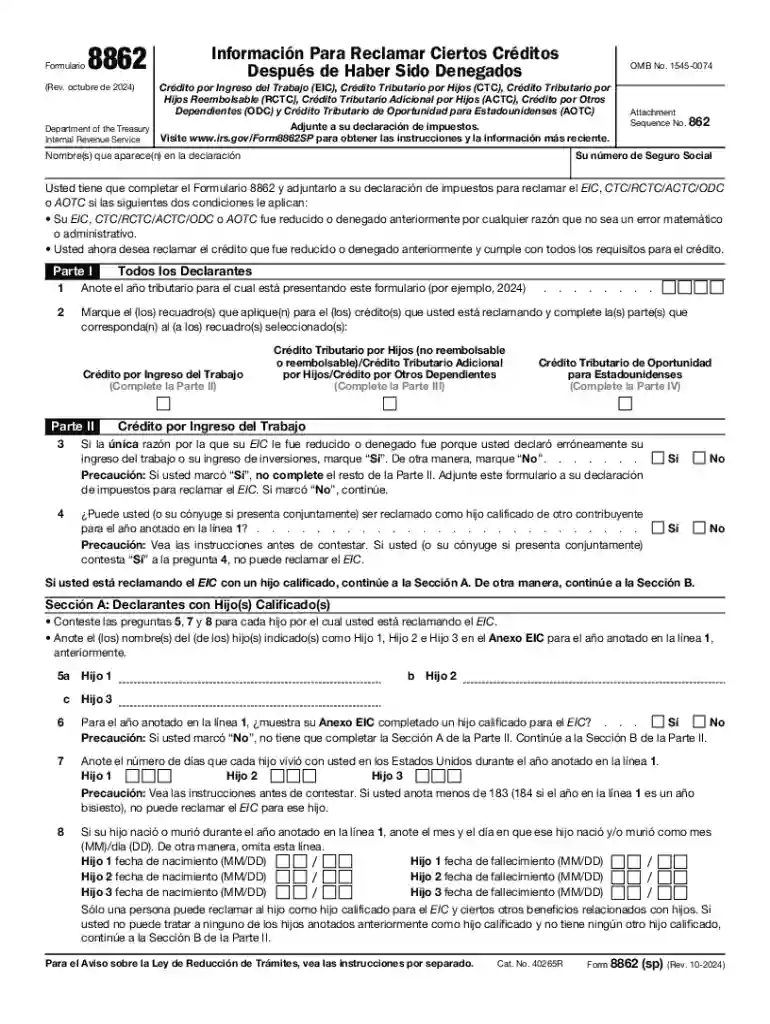
The Form 8862 (sp) (Rev October 2024), officially titled "Information To Claim Earned Income Credit After Disallowance," is a crucial document issued by the Internal Revenue Service (IRS). This form allows taxpayers, who previously had their Earned Income Credit (EIC) disallowed, to reclaim eligibility for the credit. The form is available in Spanish, facilitating access for Spanish-speaking individuals. The Earned Income Credit is aimed at low to moderate-income working individuals and families, offering a tax break based on earnings and family size. The completion of Form 8862 is integral for those looking to reinstate their qualification for the EIC after a disallowance, ensuring they meet all IRS requirements.
How to Obtain the Form
Form 8862 can be acquired in several ways:
- IRS Website: Download directly from the IRS official site, ensuring access to the most current version.
- Tax Professionals: Obtain from an accountant or tax preparer who can provide guidance on completion.
- IRS Offices: Pick up a physical copy from IRS local offices or request it by mail.
- Tax Software: Access through tax preparation software like TurboTax, which integrates with IRS forms. Each method provides a reliable way to acquire the form, supporting various preferences in accessing the necessary documentation.
Steps to Complete the Form
- Gather Information: Assemble all relevant income documents, previous tax filings, and any IRS notices regarding the EIC disallowance.
- Fill Personal Information: Enter your name, Social Security Number, and tax year for which you're claiming the EIC.
- Answer Questions: Respond to specific questions regarding your eligibility and circumstances at the time of the disallowance.
- Provide Additional Details: If required, include details of any changes in your household or financial situation that impact your eligibility.
- Verification: Double-check all entries for accuracy to avoid delays in processing.
- Attach to Tax Return: Submit the completed Form 8862 with your tax return to the IRS.
Eligibility Criteria
To use Form 8862, meet these conditions:

- Previous EIC Disallowance: The credit must have been disallowed in a prior year.
- Rectified Circumstances: Show that conditions leading to disallowance have changed or were in error.
- Eligibility for Current Year: Confirm current eligibility based on IRS rules, including income limits and qualifying child information. These criteria ensure that only those genuinely eligible for reinstatement use the form, maintaining the integrity of the credit system.
IRS Guidelines
The IRS provides several guidelines for Form 8862:
- Documentation: Submit supporting documents to corroborate eligibility claims.
- Accuracy: Ensure all information is precise and corresponds with other IRS records.
- Previous Noncompliance: If based on previous errors or misinformation, demonstrate corrective measures.
- Timeliness: Submit within deadlines to facilitate timely processing and approval.
Required Documents
- Previous Tax Returns: Include copies from the year of disallowance and subsequent years.
- Income Documentation: W-2s, 1099s, or other earnings statements.
- Proof of Residency: Documents proving you and any qualifying children lived together. These documents substantiate your claims and support a smooth review process by the IRS.
Filing Deadlines / Important Dates
- Tax Year Deadline: Submit Form 8862 with the respective year's tax return.
- Amendments: If filing an amended return, ensure this form is included.
- IRS Notice Response: Respond promptly to any IRS correspondence requesting additional information.
Penalties for Non-Compliance
Failure to properly file Form 8862 when required can result in:
- Denial of EIC: Lose eligibility for the credit during the filing year.
- Financial Penalties: Possible fines or repayment of improperly claimed credits.
- Additional Scrutiny: Increased likelihood of IRS audits on future returns. Understanding these penalties underscores the importance of correct and timely filing.
Form Submission Methods (Online / Mail)
- E-Filing: Submit the form electronically via IRS-approved software, ensuring faster processing.
- Paper Filing: Mail a hard copy to the IRS if preferring traditional submission methods.
- Professional Help: Utilize tax preparation services to ensure correct submission regardless of method. Each method has its merits, allowing taxpayers to choose based on preference, access, and confidence in the filing process.