




01. Edit your form online
Type text, add images, blackout confidential details, add comments, highlights and more.

Type text, add images, blackout confidential details, add comments, highlights and more.

Draw your signature, type it, upload its image, or use your mobile device as a signature pad.

Send it via email, link, or fax. You can also download it, export it or print it out.
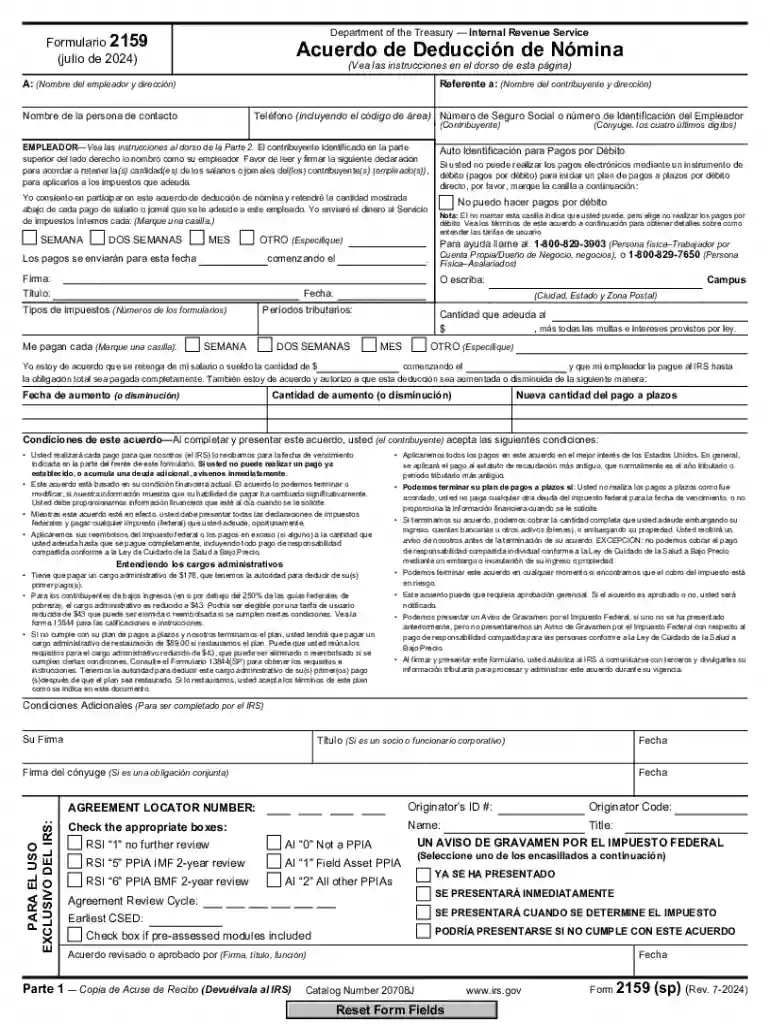
Form 2159 (sp) (Rev 7-2024) is an official document used by the Internal Revenue Service (IRS) to formalize a payroll deduction agreement. This form allows employers to withhold a specific amount from an employee's paycheck to pay off federal taxes owed. It lays out the terms of this agreement, including payment frequency, administrative fees, and responsibilities of both the taxpayer and the employer. The document also highlights potential consequences for non-compliance and outlines how the agreement can be modified based on the taxpayer's financial situation.
Utilizing Form 2159 involves multiple steps:
Initiate the Agreement: The taxpayer contacts the IRS to discuss their tax liability and express their interest in a payroll deduction plan.
Complete the Form: Both the taxpayer and their employer fill out the necessary sections of Form 2159 to establish the payroll deduction arrangement.
Submit the Form: Once completed, the form is submitted to the IRS for review and approval. This can be done through mail or potentially online based on IRS capabilities.
Implement Deductions: After approval, the employer begins withholding the agreed-upon amount from the employee's wages and remits these payments to the IRS.
Completing Form 2159 requires attention to detail:
Personal Information: Fill in the taxpayer's personal details including name, address, and Social Security number.
Employer Information: The employer must provide their business name, address, and federal employer identification number.
Deduction Details: Specify the deduction amount and frequency—weekly, biweekly, or monthly.
Authorization: Both parties must sign and date the form to authorize the deductions.
IRS Review: Send the form to the IRS for final review. They might contact either party for additional information if necessary.
Several critical components define the structure of Form 2159:
Agreement Terms: Defines the monthly deduction amount, duration of the agreement, and the commencement date.
Modification Clause: Allows for amendments to the agreement in the event of significant financial changes, requiring reevaluation of the deduction amount.
Admin Fees: Covers potential administrative fees associated with maintaining the payroll deduction process.
Noncompliance Penalty: Clearly states penalties if either party fails to adhere to the outlined conditions.
The IRS provides specific guidelines to ensure compliance:
Approval Requirement: The IRS must approve the payroll deduction amount before it is implemented.
Annual Review: Taxpayers are advised to conduct an annual review of their financial situation and discuss any necessary changes with the IRS.
Report Changes: Any changes in employment status or significant financial changes must be reported immediately.
Form 2159 does not have a rigid filing deadline but should be submitted promptly once a taxpayer decides on a payroll deduction. Timely submission ensures that the deduction process begins as soon as possible, minimizing potential penalties and interest accrual.
Non-compliance with Form 2159 terms can result in several penalties:
Interest Accrual: Continued accrual of interest on the unpaid tax balance.
Increased Deductions: Failure to adhere can lead to increased future deduction amounts.
Cancellation: The IRS reserves the right to cancel the payroll deduction agreement, potentially pursuing aggressive collection actions if deemed necessary.
There are no direct alternatives to Form 2159, though taxpayers have other options like setting up direct payment agreements with the IRS. Such alternatives are less integrated with employer payroll systems but can be tailored to suit a taxpayer’s individual circumstances.
Tax preparation software like TurboTax and QuickBooks primarily assists with income tax filings but may offer informational guidance on relevant IRS forms. However, they do not typically facilitate the completion or submission of Form 2159 directly. Users should refer to IRS resources or financial advisors for precise guidance on completing payroll deduction agreements.
While Form 2159 is a federal form, some states may impose additional requirements or limitations on wage-garnishment agreements or payroll deductions. Taxpayers should verify whether their state's laws impact form processing or employer participation in payroll deductions.
We've got more versions of the Form 2159 (sp) (Rev 7-2024) form. Select the right Form 2159 (sp) (Rev 7-2024) version from the list and start editing it straight away!
At DocHub, your data security is our priority. We follow HIPAA, SOC2, GDPR, and other standards, so you can work on your documents with confidence.

Form 2159 (sp) (Rev. 7-2024). Formulario 2159. (julio de 2024). Acuerdo de Deduccin de Nmina. (Vea las instrucciones en el dorso de esta pgina). DepartmentRead more
by ZD Zhou 2025 Cited by 26 Growing evidence indicated that GRA can modulate neuroinflammation and protein misfolding and have protective effects on mitochondrial and.Read more


