01. Edit your form online
Type text, add images, blackout confidential details, add comments, highlights and more.

Type text, add images, blackout confidential details, add comments, highlights and more.

Draw your signature, type it, upload its image, or use your mobile device as a signature pad.

Send it via email, link, or fax. You can also download it, export it or print it out.
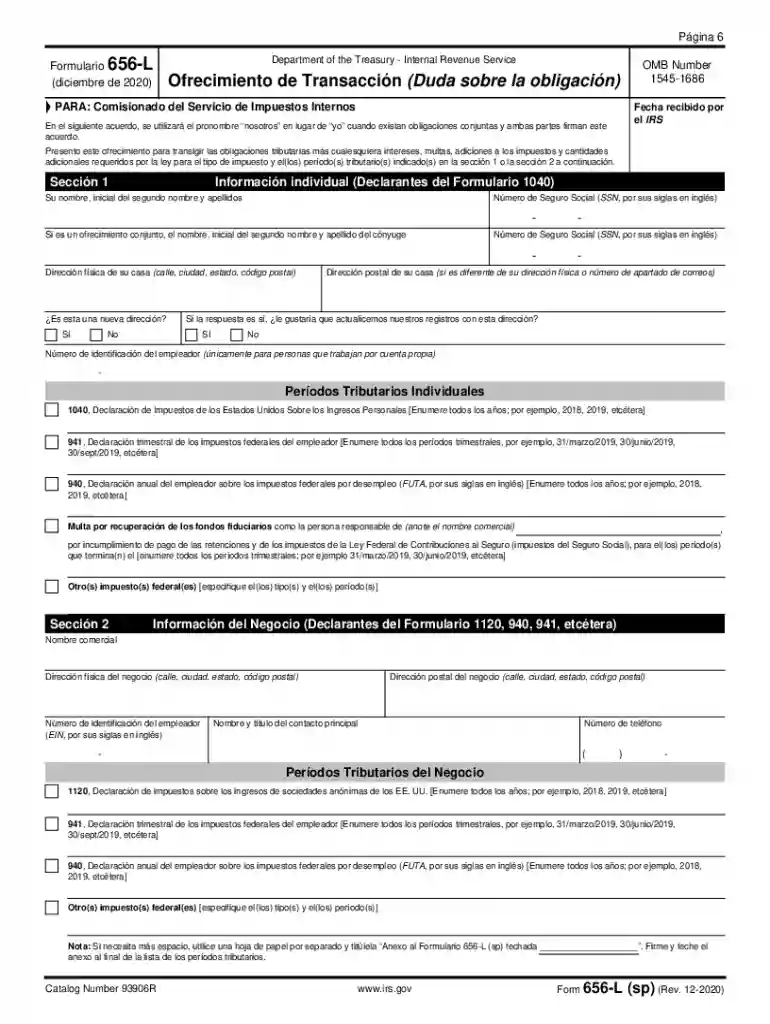
The Form 656-L, known as the Offer in Compromise (Doubt as to Liability) in Spanish, is an IRS document designed for taxpayers who contest the legitimacy or amount of a tax debt. This form provides an avenue for individuals or businesses to negotiate a compromise with the IRS if there is genuine uncertainty regarding the liability. It’s specifically intended for situations where taxpayers believe that they don’t owe a portion or entirety of the tax debt. Understanding its role and potential benefits can assist in determining whether it is the appropriate method to address a tax dispute.
Review Eligibility Criteria: Ensure that the conditions surrounding your tax dispute align with the eligibility for doubting liability. This involves verifying that you do not currently qualify for any other tax relief or have other unresolved compliance issues.
Gather Necessary Documentation: Collect supporting documents that substantiate your claim. This can include past tax returns, statements of corrected income, explanatory letters, and any official correspondence relevant to the disputed amount.
Fill Out Your Personal Information: Accurately enter your personal details, including name, tax identification number, current address, and filing status.
Detail the Nature of the Dispute: Clearly state the reason for believing that your tax liability is incorrect. Provide explanations supported by factual documentation to strengthen your case.
Submit the Form and Documentation: Once the form is completed, assemble it alongside all supporting documentation into a single package for submission.
Genuine Dispute: You must have a valid reason to contest the amount due, proven by credible evidence and a reasonable basis for contesting tax liability.
Current Status: Ensure you are up-to-date with any current tax filings and payments, as unresolved tax matters may aggravate the situation.
Appropriate for Your Situation: This form is not suitable for disputing the ability to pay a tax debt; rather, it should strictly relate to the dispute over liability.


Download from the IRS Website: The form can be accessed and downloaded directly from the IRS official website at no cost.
Request via Mail or Call: You can request a paper copy by contacting the IRS customer service phone lines.
Mail: Traditionally, the completed form, alongside supporting documentation, is submitted through the mail to designated IRS addresses as specified in the form instructions.
Online: While electronic submission capabilities for the 656-L (sp) are limited, the IRS continues to expand its digital services, so it's best to verify the latest options directly from the IRS website.
Previous Correspondence: Include copies of any notifications received from the IRS regarding the disputed debt.
Proof of Income and Statements: Provide recent financial records to elucidate your tax situation.
Explanatory Statements: Detailed letters explaining your argument against the assessed liability with evidence demonstrating the inaccuracies.
Ensuring Compliance: The IRS stipulates that Offer in Compromise submissions must be thoroughly justified to prevent misuse and tax evasion.
Review Process: Once submitted, the form undergoes a review process where the IRS verifies the evidence and rationale provided to ascertain if indeed the claim of doubt as to liability is valid.
Initial Review Period: After submission, the IRS may take several months to process and reach conclusions based on the complexity of the case and the evidence provided.
Approval or Denial: The outcome will either resolve in approval or denial, depending on the satisfaction of the IRS with the proof of disputed liability.
Incorrect Usage: Using the form without an eligible dispute could result in delays or rejections, and potentially incur penalties for filing an incorrect claim.
Maintaining Accuracy: Any misrepresentation of facts or false statements in the documentation or form may lead to significant legal repercussions, including fines or additional liabilities.
Examples include:
Business Discrepancies: A company being audited finds a miscalculation in income reporting, justifying an offer of compromise.
Clerical Errors: An individual who was provided incorrect tax documentation leading to over-assessment can appeal using this form.
Each scenario highlights the importance of thoroughly understanding your tax obligations and having factual evidence to support any claims against the assessed liability.
We've got more versions of the Form 656-L (sp) (Rev 12-2020) Offer in Compromise (Doubt as to Liability) (Spanish Version) form. Select the right Form 656-L (sp) (Rev 12-2020) Offer in Compromise (Doubt as to Liability) (Spanish Version) version from the list and start editing it straight away!
At DocHub, your data security is our priority. We follow HIPAA, SOC2, GDPR, and other standards, so you can work on your documents with confidence.