







Definition and Meaning
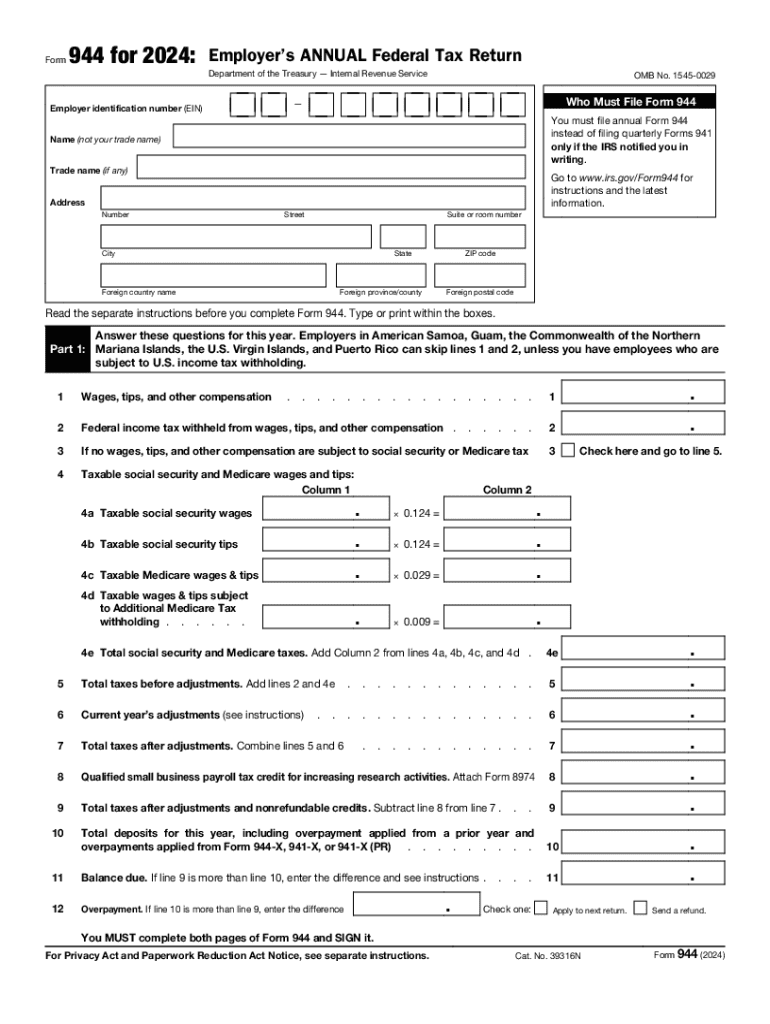
The Employer's Annual Federal Tax Return, commonly known as IRS Form 944, is a tax form required for certain employers to report employee wages, taxes withheld, and tax liabilities to the Internal Revenue Service (IRS) on a yearly basis. This form is designed for businesses that have been notified by the IRS to file annually rather than quarterly, typically when annual employment tax liabilities are $1,000 or less.
Employers use Form 944 to reconcile the taxes they owe with the deposits they have made throughout the year. It includes sections for detailing wages paid, adjustments to tax amounts, and credits that may apply. Understanding its purpose is crucial for employers as it ensures compliance and accurate reporting of payroll taxes.
Key Elements of the Employer's Annual Federal Tax Return: File IRS Form 944
Form 944 contains essential sections that employers must accurately complete. Some of the key components include:
- Wages Paid: Employers must report the total compensation paid to employees throughout the year. This section helps calculate the tax liabilities.
- Withheld Taxes: This includes federal income taxes, Social Security taxes, and Medicare taxes withheld from employee wages.
- Tax Liabilities and Adjustments: Employers must report their tax liabilities, taking into account any adjustments such as sick pay or tips.
- Credits and Payments: Any credits that reduce the tax liability, like overpayments from previous years, must be recorded. Employers also detail total tax deposits made during the year.
- Balance Due or Overpayment: This is the difference between the tax liabilities and the payments/credits. Employers will either have a balance due or an overpayment.
Steps to Complete the Employer's Annual Federal Tax Return: File IRS Form 944
Completing Form 944 requires careful attention to detail. Here are steps that employers typically follow:
- Gather Necessary Documentation: Before starting, gather payroll records, tax deposit records, and any relevant correspondence from the IRS.
- Download and Complete the Form: Access the form from the IRS website. Fill in company information, including the Employer Identification Number (EIN), and complete each section using payroll data.
- Calculate Total Wages and Taxes: Compute the total wages paid and populate the corresponding sections to determine taxes owed.
- Report Tax Deposits: Detail all tax deposits made throughout the year to ensure accuracy in the balance computation.
- Review and File: Verify all entries on the form, sign, and file it with the IRS by the specified deadline.
IRS Guidelines
The IRS provides specific guidelines regarding the completion and submission of Form 944. These instructions cover:
- Eligibility Criteria: Only employers notified by the IRS to use Form 944 may do so; otherwise, Form 941 is standard.
- Filing Deadlines: The deadline for submission is January 31st for the preceding tax year. Extensions may be requested in some circumstances.
- Filing Methods: Employers can file online using the IRS e-file system or mail a paper copy to the designated IRS address.
Penalties for Non-Compliance
Failure to properly file Form 944 can result in penalties. These include:
- Late Filing Penalties: A failure to file timely may lead to a penalty of 5% of the unpaid taxes for each month or part of a month the return is late, up to a maximum of 25%.
- Underpayment Penalties: Employers who do not pay their tax liability in full by the due date may face additional charges.
- Accuracy Penalties: Incorrect information that leads to a miscalculation of taxes may incur a fine.
Who Typically Uses the Employer's Annual Federal Tax Return: File IRS Form 944
Form 944 is typically used by small businesses that have been notified by the IRS to file annually. These businesses often have:
- Lower Payroll Taxes: Liabilities of $1,000 or less per year.
- Simplified Payroll Systems: As single-employee or small-scale operations, detailed quarterly filings may not be necessary.


Filing Deadlines and Important Dates
Understanding the timeline for Form 944 is critical:
- Annual Deadline: January 31st of the following year.
- Payment Dates: Any balance due must be paid by this date to avoid penalties.
- Notice of Filing: Businesses will receive a notice from the IRS if eligible to file Form 944, typically at the start of the tax year.
Business Entity Types and Eligibility Criteria
Form 944 is structured to accommodate various types of business entities, including:
- Sole Proprietorships: Small businesses with minimal staff.
- Partnerships and LLCs: Limited liability companies that have a simple wage structure.
- Nonprofits: Organizations with minimal payroll tax liabilities may also qualify.
Each business must ensure they meet the IRS criteria before opting to use Form 944. Understanding these rules helps maintain compliance and avoid filing errors.




