01. Edit your form online
Type text, add images, blackout confidential details, add comments, highlights and more.

Type text, add images, blackout confidential details, add comments, highlights and more.

Draw your signature, type it, upload its image, or use your mobile device as a signature pad.

Send it via email, link, or fax. You can also download it, export it or print it out.
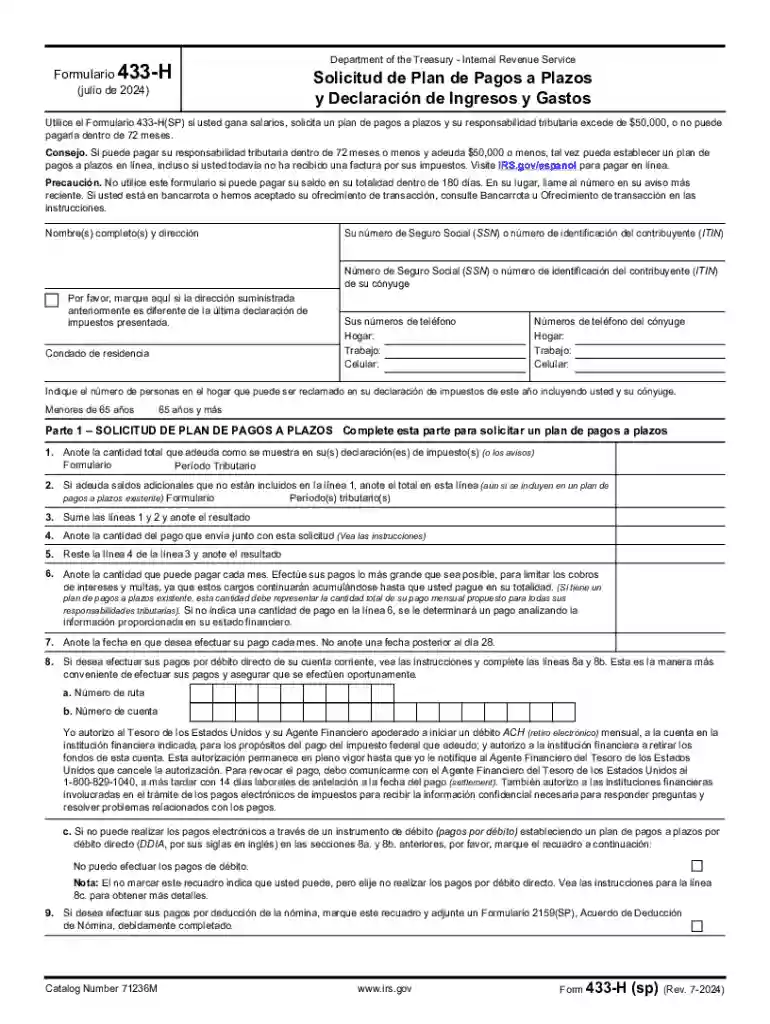
Form 433-H(SP), officially known as the Installment Agreement Request and Collection Information Statement for Wage Earners in Spanish, is a document provided by the IRS designed to assist individuals in establishing a structured payment plan for outstanding taxes. This form is particularly essential for wage earners whose tax liabilities exceed $50,000 or who are unable to satisfy their tax debt within 72 months. It requires the submission of detailed financial disclosures, including assets, monthly income, and expenses, to enable the IRS to assess the taxpayer's capacity to pay. By completing this form, individuals can request a manageable installment agreement, helping them meet their tax obligations without undue financial strain.
To effectively use Form 433-H(SP), taxpayers must first assess their eligibility by determining if their tax liability meets the stipulated threshold and if they cannot settle the amount within the standard period. Following eligibility confirmation, the form needs to be accurately filled, which involves providing personal identification details, financial data, and proposed payment terms. After completing these sections, one must ensure that all required documents are attached and then submit the form to the IRS. This process assists in creating a formal payment agreement that aligns with one’s financial situation, potentially averting more severe enforcement actions.
Gather Financial Information: Compile a comprehensive list of your current income sources, monthly expenses, and assets. This includes pay stubs, bank statements, and lists of other sources of revenue and expenditure.
Fill Personal Information: Start with your basic personal details, such as name, address, and social security number.
Detail Income and Expenses: Break down all monthly income and expenses to provide the IRS with a clear picture of your financial situation. Be meticulous in ensuring all figures are accurate and complete.
Asset Declaration: Record all personal assets, including real estate, vehicles, and financial accounts, as these are crucial for assessing payment capability.
Form Completion and Review: Double-check all entries for accuracy. Any discrepancies could delay the processing by the IRS or result in denial of the request.
Attach Support Documentation: Gather and attach relevant documents that back up your financial claims, such as bank statements and proof of income.
Submit the Form: Once completed, submit the form in accordance with the specified IRS submission methods, ensuring to keep a copy for personal records.
Personal Information Section: Requires the taxpayer's name, address, social security number, and contact information.
Financial Overview Section: Includes a detailed outline of the taxpayer's monthly income, sources, expenses, and overall financial commitments.
Asset and Liability Declaration: Necessitates a declaration of personal assets and liabilities to accurately evaluate the total financial situation.
Installment Agreement Proposal: Suggests the terms under which the taxpayer proposes to pay the outstanding IRS liabilities, including the amount and frequency of installments.
When submitting Form 433-H(SP), accompanying documents are integral to substantiate the financial data provided. Essential documents include:
The IRS prescribes specific guidelines to ensure effective completion and submission of Form 433-H(SP). These guidelines highlight the necessity for accuracy in reporting all financial information, adherence to documented submission procedures, and ensuring all required supporting documentation is included. The IRS emphasizes truthfulness in all disclosures to avoid penalties or rejection of the installment plan request.
Non-compliance with Form 433-H(SP) submission, inaccuracies, or failure to maintain agreed-upon installment payments can result in serious consequences. Penalties may include increased interest on the tax debt, levies on wages or bank accounts, and possible liens on property. The IRS enforces strict adherence to installment agreements to prevent such penalties and to encourage timely tax debt resolution.
While there is no specific filing deadline for Form 433-H(SP), timely submission is crucial to avoid enforcement actions by the IRS. It is recommended to submit the form as soon as a taxpayer identifies difficulty in fulfilling a tax obligation. Additionally, keep an eye out for any deadlines specified in IRS notices when negotiating installment agreements.
The form is tailored for taxpayers who meet certain conditions, such as owing more than $50,000 or being unable to pay their tax liability within the traditional 72-month period. Eligibility is contingent upon accurate financial representation and the willingness to commit to the terms of an installment plan. Those meeting these criteria can apply for structured payment relief through this form.


While traditional paper submission of Form 433-H(SP) remains an option, many taxpayers now opt for the digital version for convenience and speed. The digital format facilitates quicker processing and potentially faster response times from the IRS. Taxpayers can fill out, save, and submit forms through IRS online services, thus streamlining the process and reducing the risk of submission errors.
We've got more versions of the Form 433-H (sp) (Rev 7-2024) Installment Agreement Request and Collection Information Statement (Spa form. Select the right Form 433-H (sp) (Rev 7-2024) Installment Agreement Request and Collection Information Statement (Spa version from the list and start editing it straight away!
At DocHub, your data security is our priority. We follow HIPAA, SOC2, GDPR, and other standards, so you can work on your documents with confidence.