2024 Schedule OI (Form 1040-NR) (sp) Other Information (Spanish Version)-2026

Get Form
2024 Schedule OI (Form 1040-NR) (sp) Other Information (Spanish Version) Preview on Page 1

Here's how it works

01. Edit your form online
Type text, add images, blackout confidential details, add comments, highlights and more.

02. Sign it in a few clicks
Draw your signature, type it, upload its image, or use your mobile device as a signature pad.

03. Share your form with others
Send it via email, link, or fax. You can also download it, export it or print it out.

Definition & Meaning

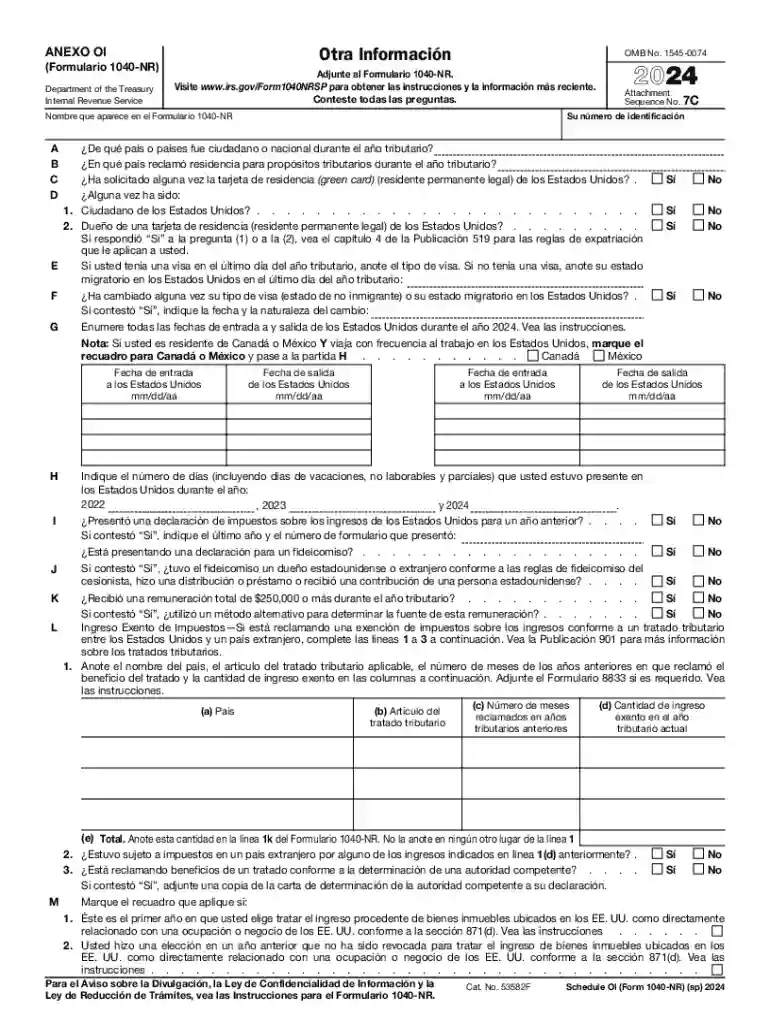
The 2024 Schedule OI (Form 1040-NR) (sp) Other Information is an attachment used by non-resident aliens to report specific details about their income and tax to the IRS. It serves as a comprehensive guide to assess a taxpayer's U.S. tax obligations and potential benefits under international treaties. The Spanish version ("sp") ensures accessibility for Spanish-speaking individuals, allowing them to understand and accurately fill out the form.

  • Purpose: Gathers personal and financial details necessary for determining taxes owed or refunded.
  • Importance: Helps the IRS to verify legal residency, tax treaty benefits, and other critical income factors.
  • Audience: Primarily non-resident aliens who receive income subject to U.S. taxation.

How to Use the 2024 Schedule OI (Form 1040-NR) (sp) Other Information

Using this form entails a detailed understanding of various sections to ensure accurate reporting:

  1. Review U.S. Presence Requirements:

    • Document days present in the U.S. over prior years.
    • Determine residency status using the substantial presence test.
  2. Declare Income Types:

    • List all U.S.-based income, including wages, salaries, and other compensations.
    • Confirm source and nature of income for tax treaty evaluations.
  3. Identify Treaty Benefits:

    • Check eligibility for income tax exclusion or reduction under applicable international treaties.
  • Steps to Ensure Accuracy:
    1. Gather all relevant documents.
    2. Double-check residency requirements.
    3. Clarify income sources and related treaty benefits with a tax professional if needed.

Steps to Complete the 2024 Schedule OI (Form 1040-NR) (sp) Other Information

Completing the form involves several specific actions to ensure all necessary information is provided:

  1. Compile Supporting Documents:

    • Gather recent U.S. visas, I-94s, or travel records showing entry and exit dates.
  2. Fill Out Required Sections:

    • Enter personal identifiers such as full name, Social Security Number (SSN), or Individual Taxpayer Identification Number (ITIN).
  3. Detail Citizenship and Residency Status:

    • Provide country of citizenship and tax home information.
  4. Confirm Prior Tax Filings:

    • Indicate if past 1040-NR forms have been submitted.
  • Recommendations for Accurate Completion:
    1. Use the Spanish instructions provided for clarity.
    2. Verify each section with a checklist before submission.

Important Terms Related to the 2024 Schedule OI (Form 1040-NR) (sp)

Understanding key terms is critical for correctly using the form:

  • Non-resident Alien (NRA): An individual who isn't a U.S. citizen or resident.

  • Substantial Presence Test: A calculation used to determine residency status based on days spent in the U.S.

  • Tax Treaty: An agreement between countries to avoid double taxation and allocate taxing rights.

  • Commonly Misunderstood Terms:

    • Dependent: Often confused with exemptions, this needs precise documentation.
    • Exclusion: Not all exclusions apply universally; familiarity with venue-specific treaties is needed.

Key Elements of the 2024 Schedule OI (Form 1040-NR) (sp)

When using Schedule OI, users need to address integral parts of the form:

  • Residency Details: Accurate recording of U.S. presence is essential.

  • Income Disclosures: Detailed categorization of income types and sources.

  • Treaty Benefits: Precise identification under IRS guidelines.

  • Elements Impacting Accuracy:

    • Misstatement or omission in residency days can impact tax determination.
    • Incomplete income declarations may result in compliance issues.

IRS Guidelines

The IRS provides specific instructions to ensure compliance:

  • Filing Instructions: Follow IRS protocols to avoid penalties.

  • Documentation Requirements: Adhere to guidelines for legal documentation and proof.

  • Deadline Compliance: Ensure timely completion to avoid late fees or scrutineering.

  • Guideline Summary:

    • Regularly check the IRS website for updates.
    • Consult tax advisors for clarification on complex guidelines.

Filing Deadlines / Important Dates

Aligning filing schedules with IRS deadlines prevents penalties:

  • Typically Due: April 15 of each year.

  • Extension Requests: Possible upon filing for automatic extensions using Form 4868.

  • Critical Timelines:

    • January 31: Finalize prior year's records.
    • February: Prepare documents, verify information accuracy.

Penalties for Non-Compliance

Failure to comply with filing requirements can result in penalties:

  • Common Penalties:

    • Fines for late filing.
    • Interest on overdue taxes.
    • Increased scrutiny or audit by the IRS.
  • Mitigation Strategies:

    • Submit a formal request for exceptions where applicable.
    • Keep meticulous records and consult with professionals.

Readers of this guide should carefully follow each section to ensure comprehensive and accurate completion of 2024 Schedule OI (Form 1040-NR) (sp). Consulting with a tax professional is advisable for complex situations or uncertainties.

be ready to get more

Complete this form in 5 minutes or less

Get form

Got questions?

We have answers to the most popular questions from our customers. If you can't find an answer to your question, please contact us.
Contact us
The official name of Form 1040-NR (Schedule A) is Itemized Deductions. It serves the purpose of allowing nonresident aliens of the United States to calculate and claim allowable deductions against their income, thus potentially reducing their overall tax liability.
The choice between Form 1040 and Form 1040NR largely depends on your residency status, which influences both income reporting and deductions. For nonresident aliens, Form 1040NR should be used to report U.S.-sourced income only, while Form 1040 requires U.S. residents and citizens to report their worldwide income.
Form 1040-NR Helpful Hints You may also need the three Form 1040 numbered schedules: Schedule 1 (Form 1040), Additional Income and Adjustments to Income; Schedule 2 (Form 1040), Additional Taxes; and Schedule 3 (Form 1040), Additional Credits and Payments.
For individual taxpayers, Schedule A is used in conjunction with Form 1040 to report itemized deductions. If you choose to claim itemized deductions instead of the standard deduction, you would use Schedule A to list your deductions. Your itemized total is then subtracted from your taxable income.
Schedule A is the tax form used by taxpayers to itemize their deductible expenses. A taxpayer with expenses that exceed the standard deduction will file a Schedule A rather than take the standard deduction.

Security and compliance

At DocHub, your data security is our priority. We follow HIPAA, SOC2, GDPR, and other standards, so you can work on your documents with confidence.

Learn more
ccpa2
pci-dss
gdpr-compliance
hipaa
soc-compliance
be ready to get more

Complete this form in 5 minutes or less

Get form

People also ask

Since 2016, the IRS has allowed Form 1040-NR U.S. Nonresident Alien Income Tax Return to be e-filed.
General Instructions If you itemize, you can deduct a part of your medical and dental expenses, and amounts you paid for certain taxes, interest, contributions, and other expenses. You can also deduct certain casualty and theft losses.
Schedule OI (Form 1040 OI), Other Information If you file Form 1040-NR, use Schedule OI (Form 1040-NR) to provide additional information not directly entered on Form 1040-NR including whether you are claiming a benefit under a tax treaty.

Related links